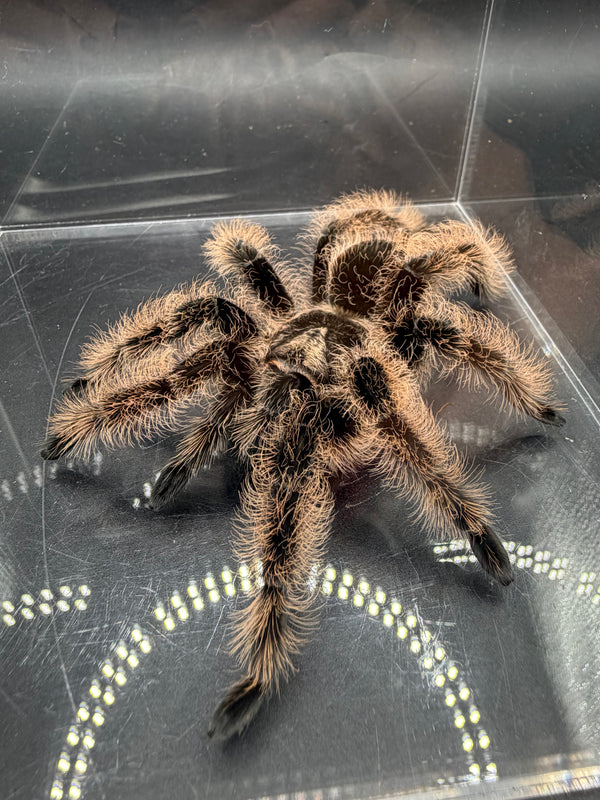
Curly Hair Tarantula (Tliltocatl albopilosus)
Tarantula

Florida Tailless Whipspider for sale from Big Z's (Phrynus marginemaculatus). Spice-rated keeper notes, care guidance, and live-arrival packing where eligible.
Looks like a movie monster. Is completely harmless.
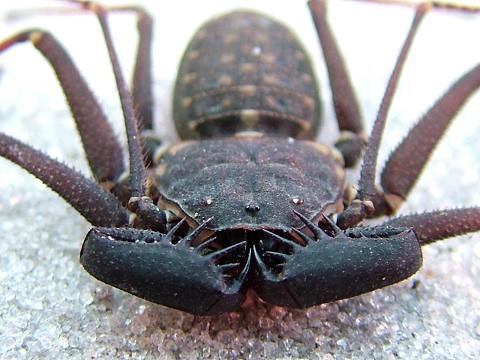
Phrynus marginemaculatus, the Florida Tailless Whip Spider, is not a spider. Or a scorpion. It is an amblypygid: a flat, sideways-scuttling arachnid with two raptorial pedipalps that snap shut on prey, and a pair of impossibly long, antenna-like “whip” legs that feel the world ahead of it. It looks like something that crawled out of a sci-fi set.
And the headline: amblypygids have no venom and no silk. They are one hundred percent theatrics and zero danger, calm enough that a patient keeper can let one walk onto a hand. Native to Florida and the Caribbean, communal if you give them vertical cork and enough food, and hands-down one of the best “wow, what IS that” animals you can put in front of someone. A tall enclosure with a couple of cork slabs and a few of these is one of the coolest displays you will ever build.
The numbers live in the care guide. Enclosure size, temps, humidity, feeding schedule, premolt signs, handling boundaries: it's all in the care guide for this exact fella. Start with the full Advanced guide, or click for the quick Open the Simple version →
Arachnid
Florida Tailless Whipspider (Phrynus marginemaculatus) care guide Read shipping & LAG
Florida Tailless Whipspider for sale from Big Z's (Phrynus marginemaculatus). Spice-rated keeper notes, care guidance, and live-arrival packing where eligible.
Looks like a movie monster. Is completely harmless.
Phrynus marginemaculatus, the Florida Tailless Whip Spider, is not a spider. Or a scorpion. It is an amblypygid: a flat, sideways-scuttling arachnid with two raptorial pedipalps that snap shut on prey, and a pair of impossibly long, antenna-like “whip” legs that feel the world ahead of it. It looks like something that crawled out of a sci-fi set.
And the headline: amblypygids have no venom and no silk. They are one hundred percent theatrics and zero danger, calm enough that a patient keeper can let one walk onto a hand. Native to Florida and the Caribbean, communal if you give them vertical cork and enough food, and hands-down one of the best “wow, what IS that” animals you can put in front of someone. A tall enclosure with a couple of cork slabs and a few of these is one of the coolest displays you will ever build.
The numbers live in the care guide. Enclosure size, temps, humidity, feeding schedule, premolt signs, handling boundaries: it's all in the care guide for this exact fella. Start with the full Advanced guide, or click for the quick Open the Simple version →
Phrynus marginemaculatus - Spice 3: Intermediate. Baby Buddy for small juveniles; Bark Buddy for juveniles/adults
Phrynus marginemaculatus
Big Z's Quick Verdict: An amblypygid. Looks harmless, moves sideways fast. Needs vertical bark and humidity. Groups can work if the animals are the same size and there is enough cork.
| Temp | 75-82°F |
|---|---|
| Humidity | Moderate-High ambient (70-80%) with cross ventilation; damp substrate, dry cork faces |
| Setup | Vertical cork amblypygid setup |
| Substrate | Moist substrate + tall cork |
| Feeding | Small roaches/crickets weekly |
| Handling | Not recommended |
Humidity zones: Very Low under 30% - Low 30-60% - Low-Moderate 40-70% - Moderate 60-80% - Moderate-High 70-85% - High 80%+ - Very High 90%+
Current Big Z's catalog: Yes
Phrynus marginemaculatus
Keeper Snapshot: An amblypygid. Looks harmless, moves sideways fast. Needs vertical bark and humidity. Groups can work if the animals are the same size and there is enough cork.
| Temperature | 75-82°F |
|---|---|
| Humidity | Moderate-High ambient (70-80%) with cross ventilation; damp substrate, dry cork faces |
| Setup Type | Vertical cork amblypygid setup |
| Substrate | Moist substrate + tall cork |
| Feeding | Small roaches/crickets weekly |
| Care Difficulty | Spice 3: Intermediate |
| Handling | Not recommended |
Humidity zones: Very Low under 30% - Low 30-60% - Low-Moderate 40-70% - Moderate 60-80% - Moderate-High 70-85% - High 80%+ - Very High 90%+

Tarantula

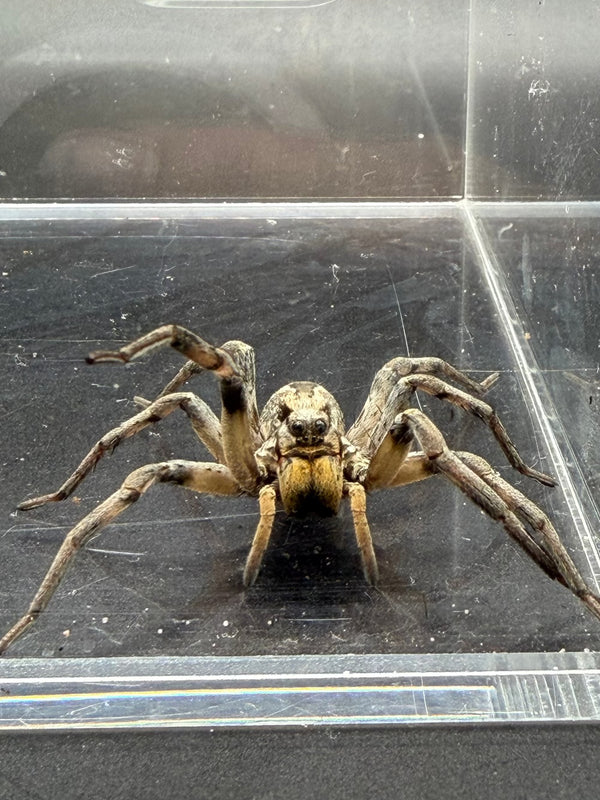
Spider

Tarantula

Invertebrate

Tarantula

Tarantula

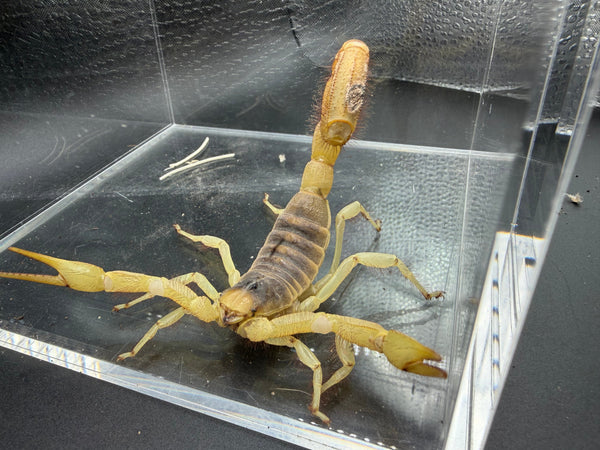
Scorpion

Tarantula