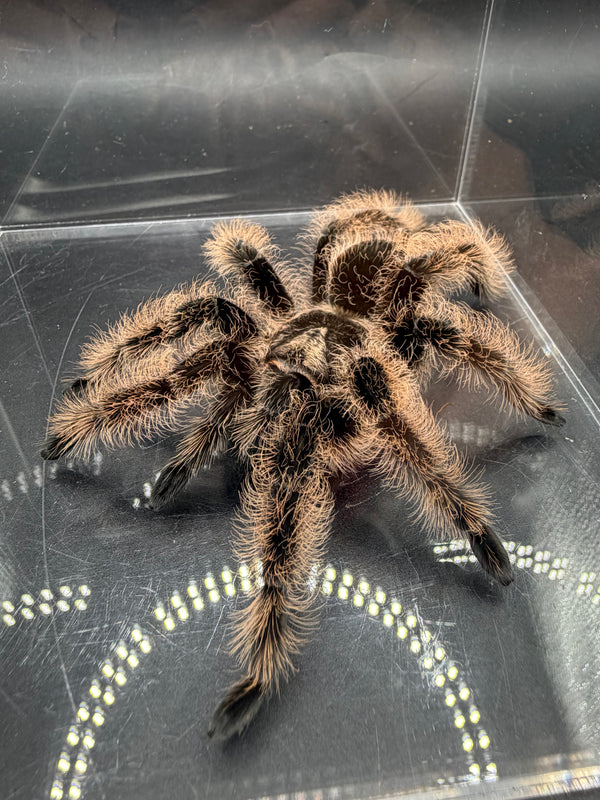
Curly Hair Tarantula (Tliltocatl albopilosus)
Tarantula

Mexican Red Rump Tarantula for sale from Big Z's (Tliltocatl vagans). Spice-rated keeper notes, care guidance, and live-arrival packing where eligible.
Deep black-brown body, a burning red rump, and the best feeding response in the beginner cabinet
Tliltocatl vagans, the Mexican Red Rump, is a sturdy terrestrial burrower out of Mexico and Central America, dressed in deep black-brown with a crown of reddish hairs on its rump that earns the name. A New World classic built like a tank: dark, substantial, and never shy about dinner. It is one of the most reliable feeders in the entire hobby, the spider that hits food like it means it every single time.
Rated Spice 2 and genuinely beginner friendly, it is calm, hardy, and forgiving of a new keeper's learning curve. Set it up dry: 3 to 5 inches of mostly dry substrate with one lightly damp corner, a hide, and a water dish, and skip feeding during molt windows. This is not a handling spider, since urticating hairs and fall risk both apply, but it asks very little for how rewarding it is to watch. The matched care guide has the full dry-terrestrial build. Taxonomy note: older hobby labels often use Brachypelma vagans, while current usage commonly places this animal as Tliltocatl vagans.
The numbers live in the care guide. Enclosure size, temps, humidity, feeding schedule, premolt signs, handling boundaries: it's all in the care guide for this exact fella. Start with the full Advanced guide, or click for the quick Open the Simple version →
Tarantula
Mexican Red Rump Tarantula (Tliltocatl vagans) care guide Read shipping & LAG
Mexican Red Rump Tarantula for sale from Big Z's (Tliltocatl vagans). Spice-rated keeper notes, care guidance, and live-arrival packing where eligible.
Deep black-brown body, a burning red rump, and the best feeding response in the beginner cabinet
Tliltocatl vagans, the Mexican Red Rump, is a sturdy terrestrial burrower out of Mexico and Central America, dressed in deep black-brown with a crown of reddish hairs on its rump that earns the name. A New World classic built like a tank: dark, substantial, and never shy about dinner. It is one of the most reliable feeders in the entire hobby, the spider that hits food like it means it every single time.
Rated Spice 2 and genuinely beginner friendly, it is calm, hardy, and forgiving of a new keeper's learning curve. Set it up dry: 3 to 5 inches of mostly dry substrate with one lightly damp corner, a hide, and a water dish, and skip feeding during molt windows. This is not a handling spider, since urticating hairs and fall risk both apply, but it asks very little for how rewarding it is to watch. The matched care guide has the full dry-terrestrial build. Taxonomy note: older hobby labels often use Brachypelma vagans, while current usage commonly places this animal as Tliltocatl vagans.
The numbers live in the care guide. Enclosure size, temps, humidity, feeding schedule, premolt signs, handling boundaries: it's all in the care guide for this exact fella. Start with the full Advanced guide, or click for the quick Open the Simple version →
Tliltocatl vagans - Spice 2: Beginner. Baby Buddy: spiderlings only, with ventilation openings too narrow for the spider to pass and packed substrate for a starter burrow; Burrow Buddy: juvenile grow-out and adult home, filled deeply enough to support a burrow while limiting fall distance
Tliltocatl vagans
Big Z's Quick Verdict: A sturdy New World terrestrial that needs more digging room than a shallow display setup provides. Give this fella deep, firmly packed substrate, a started burrow under cork, a dry surface over moist lower layers, low cross-ventilation, and a full pebble-filled dish. Adults may sit in the open, but individuals can bolt or kick urticating hairs when disturbed, so use tools and a catch cup. Keep it spicy. - Big Z
| Temp | 70-76F. Keeper-selected working range from the overlap of multiple species-specific keeper sources. Avoid direct or unregulated supplemental heat and judge the animal and enclosure, not a single hot spot. |
|---|---|
| Humidity | No numeric % target. Manage moisture by substrate condition: keep lower substrate layers lightly moist while the surface dries between waterings, cross-ventilate at substrate level, and keep a pebble-filled water dish full. |
| Setup | Terrestrial burrower with deep, packable substrate |
| Substrate | Fill 1/2 to 2/3 of the enclosure with deep, packable soil-based substrate. Firm it enough to support a starter burrow under anchored cork; keep the surface dry over lightly moist lower layers. |
| Feeding | Spiderlings twice weekly; juveniles every 7-10 days; adults every 2-3 weeks. Use appropriately sized invertebrate prey, remove uneaten prey after 24 hours, and adjust by abdomen condition. |
| Handling | Handling discouraged. Kicks urticating hairs when disturbed. |
Humidity zones: Very Low under 30% - Low 30-60% - Low-Moderate 40-70% - Moderate 60-80% - Moderate-High 70-85% - High 80%+ - Very High 90%+
Current Big Z's catalog: Yes
Tliltocatl vagans
Keeper Snapshot: A sturdy New World terrestrial that needs more digging room than a shallow display setup provides. Give this fella deep, firmly packed substrate, a started burrow under cork, a dry surface over moist lower layers, low cross-ventilation, and a full pebble-filled dish. Adults may sit in the open, but individuals can bolt or kick urticating hairs when disturbed, so use tools and a catch cup. Keep it spicy. - Big Z
| Temperature | 70-76F. Keeper-selected working range from the overlap of multiple species-specific keeper sources. Avoid direct or unregulated supplemental heat and judge the animal and enclosure, not a single hot spot. |
|---|---|
| Humidity | No numeric % target. Manage moisture by substrate condition: keep lower substrate layers lightly moist while the surface dries between waterings, cross-ventilate at substrate level, and keep a pebble-filled water dish full. |
| Setup Type | Terrestrial burrower with deep, packable substrate |
| Substrate | Fill 1/2 to 2/3 of the enclosure with deep, packable soil-based substrate. Firm it enough to support a starter burrow under anchored cork; keep the surface dry over lightly moist lower layers. |
| Feeding | Spiderlings twice weekly; juveniles every 7-10 days; adults every 2-3 weeks. Use appropriately sized invertebrate prey, remove uneaten prey after 24 hours, and adjust by abdomen condition. |
| Care Difficulty | Spice 2: Beginner |
| Handling | Handling discouraged. Kicks urticating hairs when disturbed. |
Humidity zones: Very Low under 30% - Low 30-60% - Low-Moderate 40-70% - Moderate 60-80% - Moderate-High 70-85% - High 80%+ - Very High 90%+

Tarantula

Spider

Tarantula

Invertebrate

Tarantula

Scorpion

Tarantula

Spider