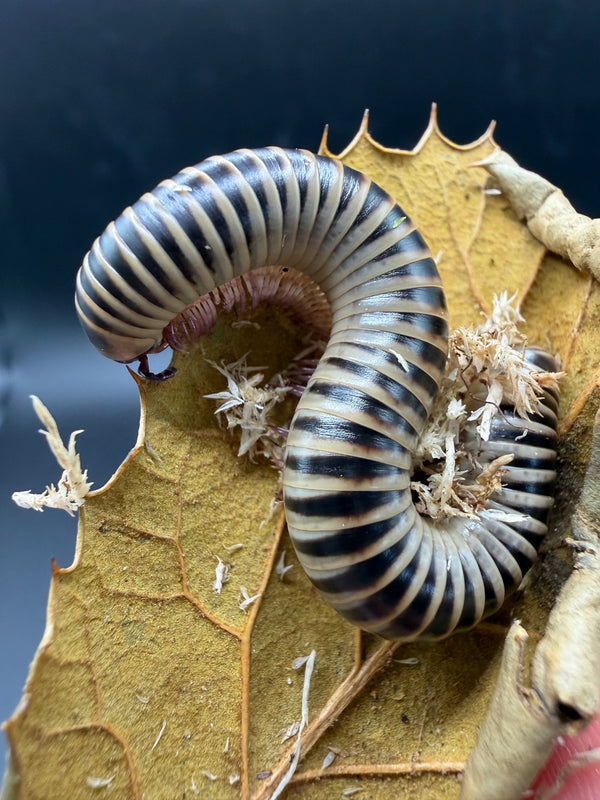
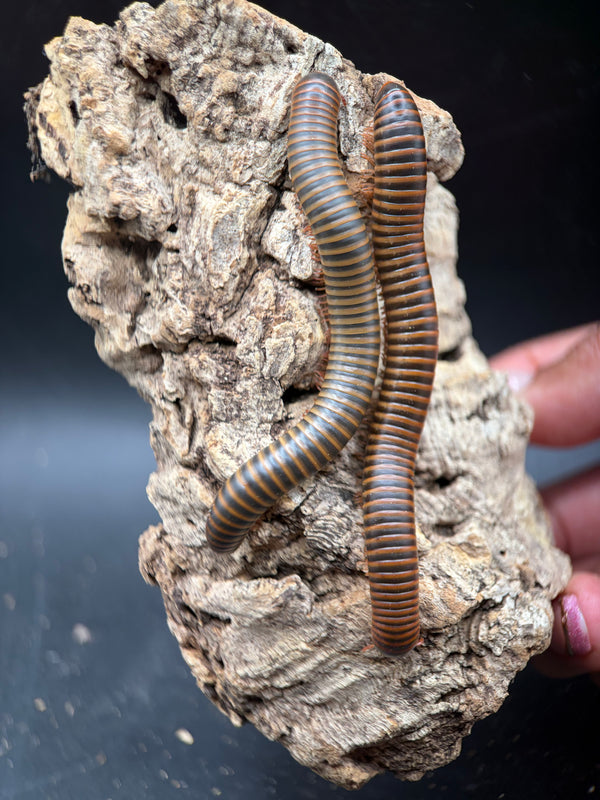
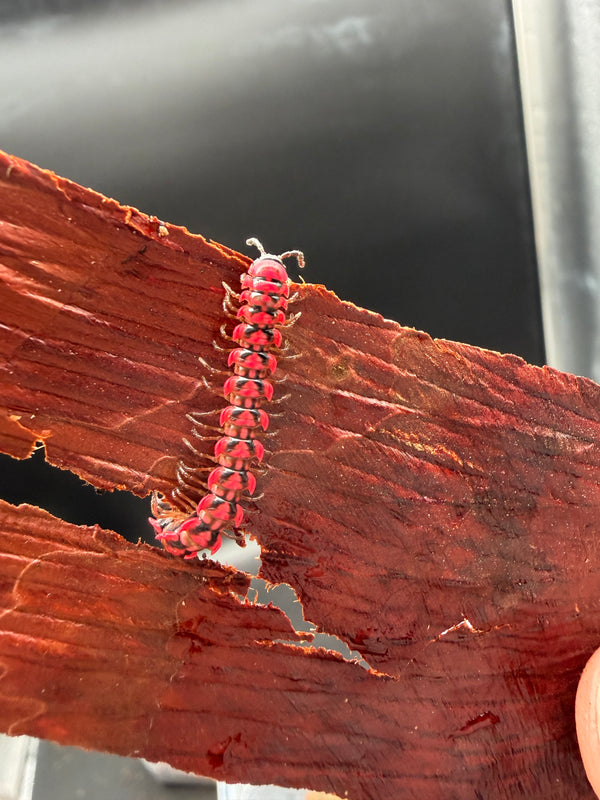
Purple Rainbow Ivory Millipede (Chicobolus spinigerus)
Millipede

African Giant Millipede for sale from Big Z's (Archispirostreptus gigas). Spice-rated keeper notes, care guidance, and live-arrival packing where eligible.
A foot of gentle, ancient, armored calm
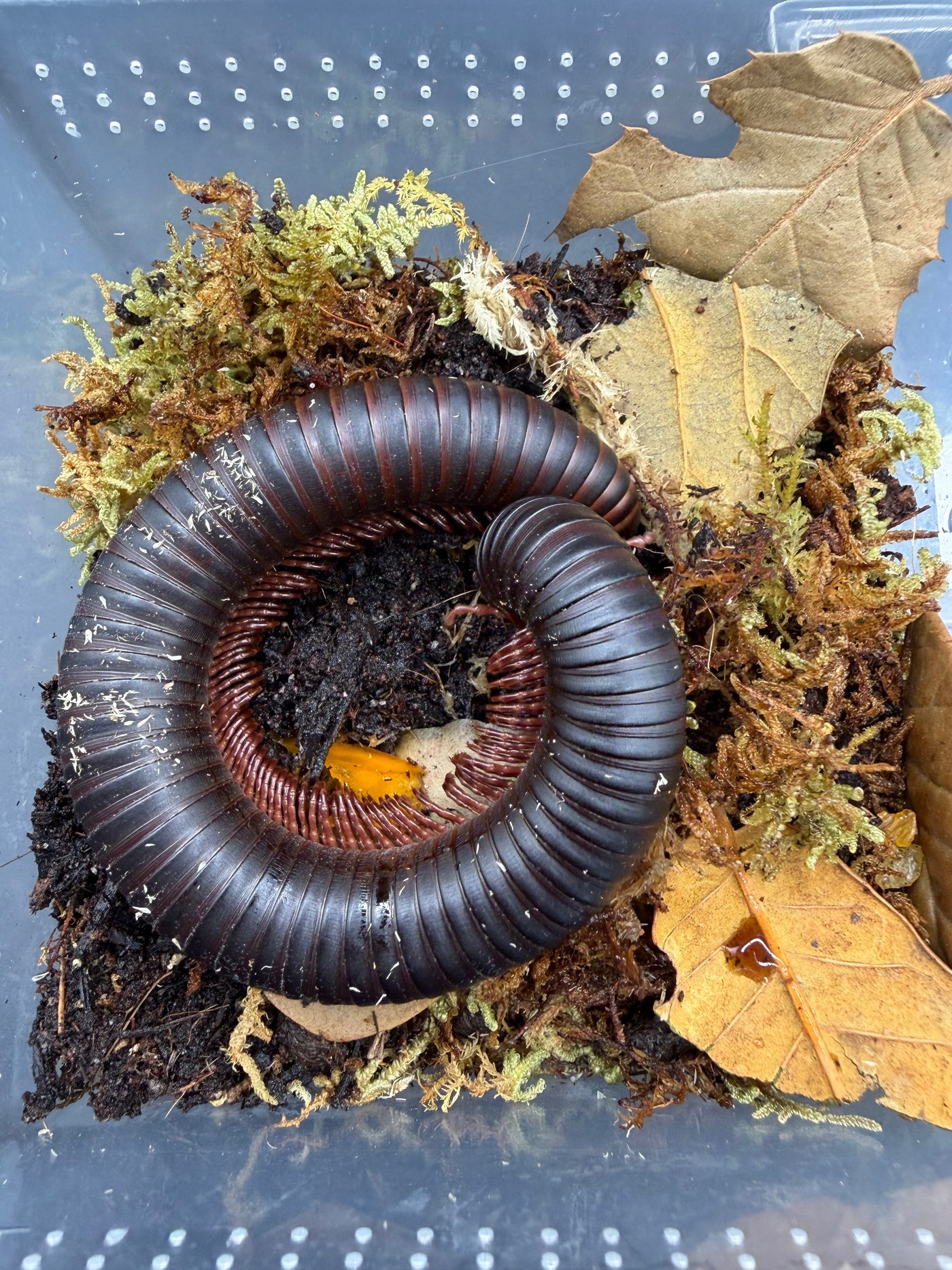
The African Giant Black Millipede, Archispirostreptus gigas, is the largest millipede on Earth: a smooth, glossy-black cylinder up to a foot long, rippling along on hundreds of tiny legs in slow hypnotic waves. It comes from the coastal forests of East Africa, where it spends its life quietly recycling fallen leaves and rotting wood.
It is completely harmless and famously docile; its only defense is to curl into a tight coil and seep a mild, almond-scented irritant (just wash your hands). It lives 7-10+ years, can be kept in groups, and basically eats its own substrate: a deep bed of hardwood leaf litter is the whole feeding plan. The most low-stress big invert in the hobby, and a longtime Kidz Zone favorite. The care guide has the bioactive setup.
The numbers live in the care guide. Enclosure size, temps, humidity, feeding schedule, premolt signs, handling boundaries: it's all in the care guide for this exact fella. Start with the full Advanced guide, or click for the quick Open the Simple version →
Millipede
Burrow Buddy fits the listed juvenile size, but the animal may outgrow it at around 6" length. Plan for long horizontal enclosure; adults hit 11–12", they need floor run, not depth. Ask Big Z if you need help choosing the next enclosure.
African Giant Millipede (Archispirostreptus gigas) care guide Read shipping & LAG
African Giant Millipede for sale from Big Z's (Archispirostreptus gigas). Spice-rated keeper notes, care guidance, and live-arrival packing where eligible.
A foot of gentle, ancient, armored calm
The African Giant Black Millipede, Archispirostreptus gigas, is the largest millipede on Earth: a smooth, glossy-black cylinder up to a foot long, rippling along on hundreds of tiny legs in slow hypnotic waves. It comes from the coastal forests of East Africa, where it spends its life quietly recycling fallen leaves and rotting wood.
It is completely harmless and famously docile; its only defense is to curl into a tight coil and seep a mild, almond-scented irritant (just wash your hands). It lives 7-10+ years, can be kept in groups, and basically eats its own substrate: a deep bed of hardwood leaf litter is the whole feeding plan. The most low-stress big invert in the hobby, and a longtime Kidz Zone favorite. The care guide has the bioactive setup.
The numbers live in the care guide. Enclosure size, temps, humidity, feeding schedule, premolt signs, handling boundaries: it's all in the care guide for this exact fella. Start with the full Advanced guide, or click for the quick Open the Simple version →
Archispirostreptus gigas - Spice 1: Kid Friendly. Baby Buddy or Burrow Buddy: conditional fit for small animals/groups, not a fixed stocking recommendation.; Deep custom enclosure: use when animal size, group size or food-substrate needs exceed a Buddy's usable dimensions.
Archispirostreptus gigas
Big Z's Quick Verdict: For an African Giant Millipede, the substrate is a meal as well as a home. Build a deep bed of decomposed leaves and soft rotten hardwood, keep it damp without soaking it, and replenish the edible material as it is eaten. Give the animal room to burrow and leave buried millipedes alone.
| Temp | 75-78°F (about 24-26°C), following Cincinnati Zoo's keeper protocol. This is an institutional care range, not a tested tolerance limit. |
|---|---|
| Humidity | No fixed humidity % target. Keep sheltered litter and the lower substrate damp, not dripping or waterlogged. Check below the surface before adding water, moisten a section at a time, and leave ventilation open. Avoid both a completely dried-out bed and standing water. |
| Setup | Deep, food-rich burrowing enclosure with a damp lower layer |
| Substrate | Use pesticide-free soil or humus containing plenty of decomposed hardwood leaves and very soft rotten hardwood. As a general millipede planning rule, provide substrate at least as deep as the longest animal is long, with extra depth where needed to retain a damp burrowing area. Coir alone is not a food supply. |
| Feeding | Keep decomposed leaves and soft rotten hardwood available continuously; replace them as they are eaten. Small portions of vegetables can supplement this base, not replace it. Remove spoiled or uneaten supplements before they foul the substrate. |
| Handling | Brief, gentle contact is optional; keep the animal low over a soft surface and supervise children. Never pull it from a surface or force it to uncoil. Wash hands after contact or enclosure work. |
Humidity zones: Very Low under 30% - Low 30-60% - Low-Moderate 40-70% - Moderate 60-80% - Moderate-High 70-85% - High 80%+ - Very High 90%+
Current Big Z's catalog: Yes
Archispirostreptus gigas
Keeper Snapshot: For an African Giant Millipede, the substrate is a meal as well as a home. Build a deep bed of decomposed leaves and soft rotten hardwood, keep it damp without soaking it, and replenish the edible material as it is eaten. Give the animal room to burrow and leave buried millipedes alone.
| Temperature | 75-78°F (about 24-26°C), following Cincinnati Zoo's keeper protocol. This is an institutional care range, not a tested tolerance limit. |
|---|---|
| Humidity | No fixed humidity % target. Keep sheltered litter and the lower substrate damp, not dripping or waterlogged. Check below the surface before adding water, moisten a section at a time, and leave ventilation open. Avoid both a completely dried-out bed and standing water. |
| Setup Type | Deep, food-rich burrowing enclosure with a damp lower layer |
| Substrate | Use pesticide-free soil or humus containing plenty of decomposed hardwood leaves and very soft rotten hardwood. As a general millipede planning rule, provide substrate at least as deep as the longest animal is long, with extra depth where needed to retain a damp burrowing area. Coir alone is not a food supply. |
| Feeding | Keep decomposed leaves and soft rotten hardwood available continuously; replace them as they are eaten. Small portions of vegetables can supplement this base, not replace it. Remove spoiled or uneaten supplements before they foul the substrate. |
| Care Difficulty | Spice 1: Kid Friendly |
| Handling | Brief, gentle contact is optional; keep the animal low over a soft surface and supervise children. Never pull it from a surface or force it to uncoil. Wash hands after contact or enclosure work. |
Humidity zones: Very Low under 30% - Low 30-60% - Low-Moderate 40-70% - Moderate 60-80% - Moderate-High 70-85% - High 80%+ - Very High 90%+

Millipede

Millipede

Clean-up Crew

Invertebrate

Millipede

Millipede

Millipede