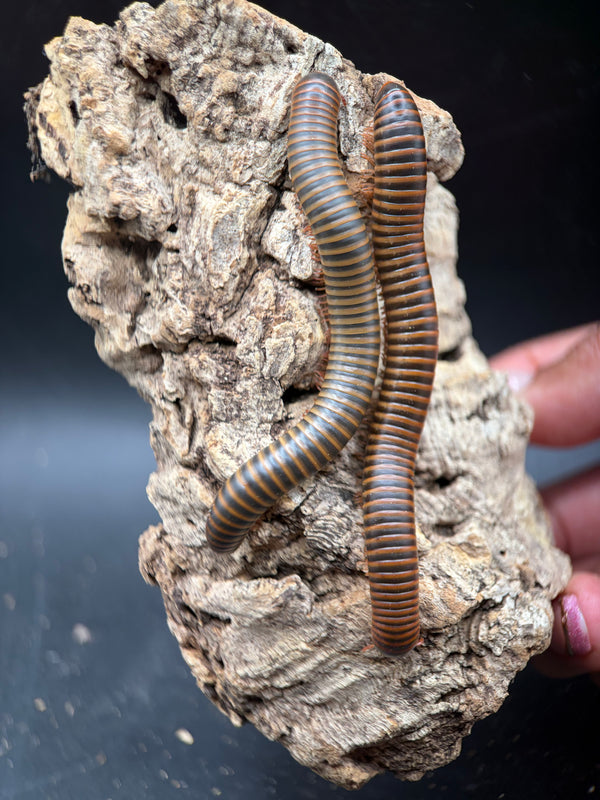
African Giant Millipede (Archispirostreptus gigas)
Millipede

Candy Corn Pill Millipede for sale from Big Z's (Rhopalomeris carnifex). Spice-rated keeper notes, care guidance, and live-arrival packing where eligible.
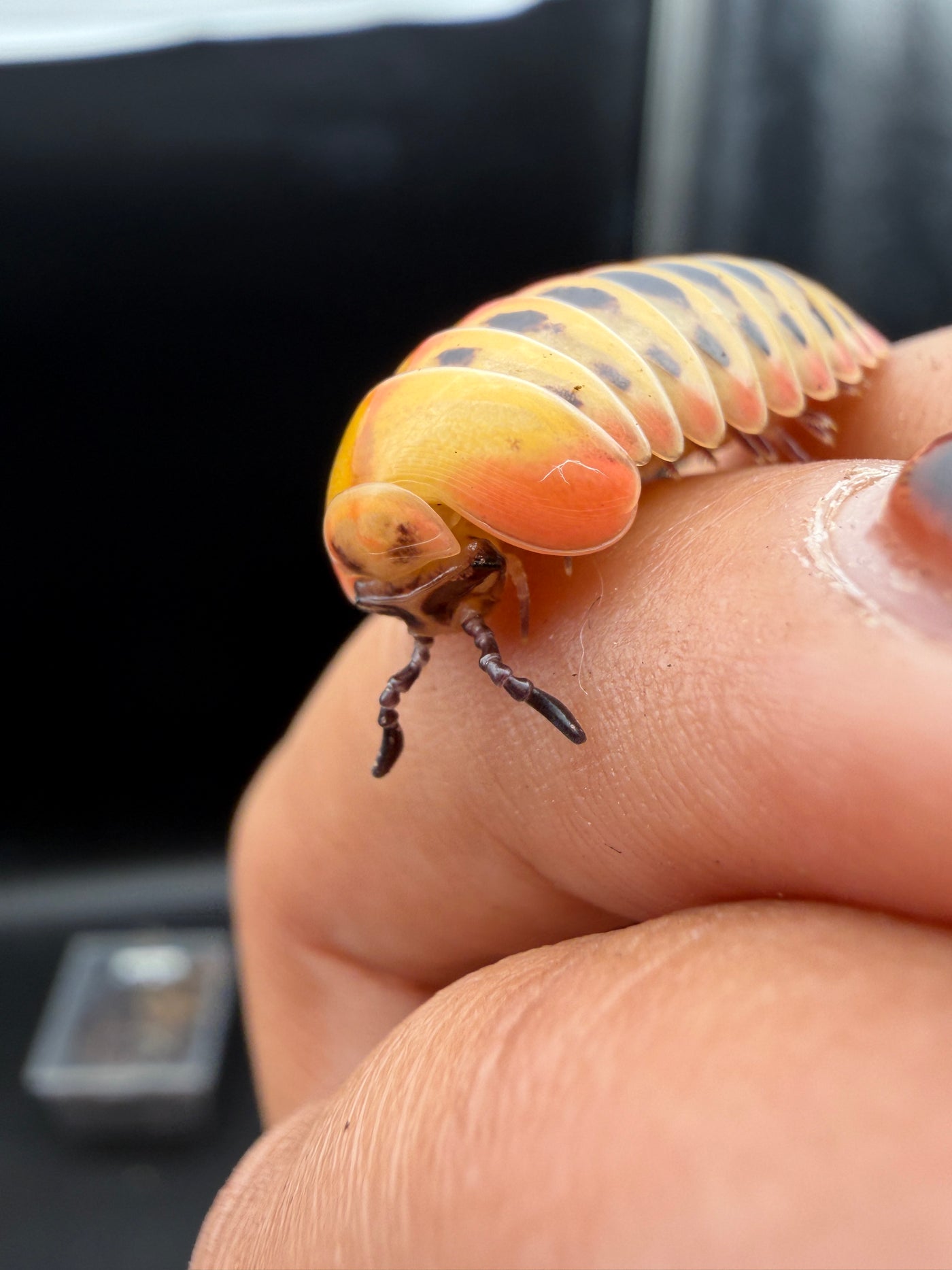
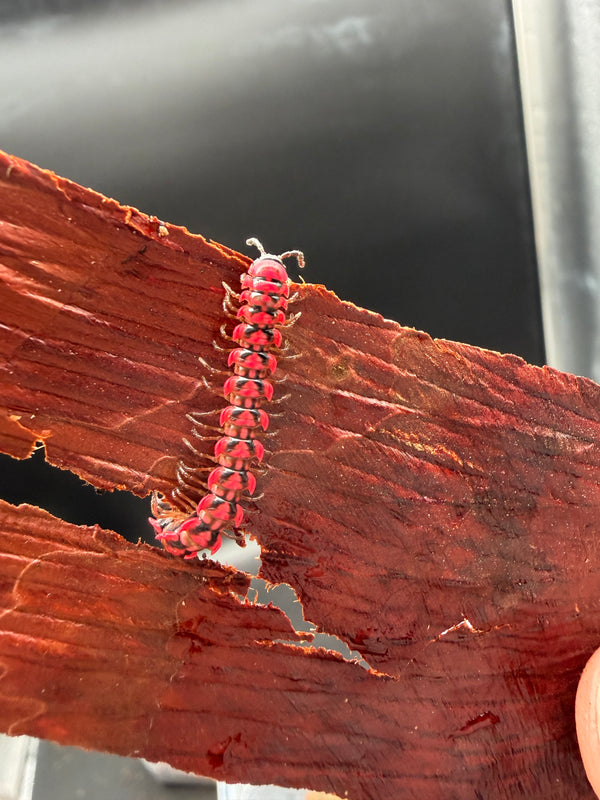
Candy-corn colors wrapped around a compact little dome.
The Candy Corn Pill Millipede has cream bands, dark spots, and orange-red trim across a rounded set of body plates. The pale areas give this form a different look from the darker Candy and Rainbow Candy offerings. It is sold under Rhopalomeris carnifex and offered in mixed sizes, with the Candy Corn color form kept as its own selection.
Spice Level 1: Kid Safe. Our care approach follows related Rhopalomeris: a settled bed of decomposed hardwood leaves and very soft, decayed hardwood, with damp shelter and open ventilation. That material is also food, so its quality matters more than adding decorative extras. Replenish what is being eaten and refresh small sections without digging through occupied areas. Keep handling minimal and never force a curled animal open. The Big Z's care guide explains the food-rich setup and routine maintenance.
The numbers live in the care guide. Enclosure size, temps, humidity, feeding schedule, premolt signs, handling boundaries: it's all in the care guide for this exact fella. Start with the full Advanced guide, or click for the quick Open the Simple version →
Millipede
Candy Corn Pill Millipede (Rhopalomeris carnifex) care guide Read shipping & LAG
Candy Corn Pill Millipede for sale from Big Z's (Rhopalomeris carnifex). Spice-rated keeper notes, care guidance, and live-arrival packing where eligible.
Candy-corn colors wrapped around a compact little dome.
The Candy Corn Pill Millipede has cream bands, dark spots, and orange-red trim across a rounded set of body plates. The pale areas give this form a different look from the darker Candy and Rainbow Candy offerings. It is sold under Rhopalomeris carnifex and offered in mixed sizes, with the Candy Corn color form kept as its own selection.
Spice Level 1: Kid Safe. Our care approach follows related Rhopalomeris: a settled bed of decomposed hardwood leaves and very soft, decayed hardwood, with damp shelter and open ventilation. That material is also food, so its quality matters more than adding decorative extras. Replenish what is being eaten and refresh small sections without digging through occupied areas. Keep handling minimal and never force a curled animal open. The Big Z's care guide explains the food-rich setup and routine maintenance.
The numbers live in the care guide. Enclosure size, temps, humidity, feeding schedule, premolt signs, handling boundaries: it's all in the care guide for this exact fella. Start with the full Advanced guide, or click for the quick Open the Simple version →
Rhopalomeris carnifex - Spice 1: Kid Friendly. Baby Buddy or Burrow Buddy: conditional fit for small animals/groups, not a fixed stocking recommendation.; Deep custom enclosure: use when animal size, group size or food-substrate needs exceed a Buddy's usable dimensions.
Rhopalomeris carnifex
Identity confidence: provisional. This is a genus, group, or trade name rather than a confirmed species. Treat it as the closest match we can stand behind, and use the more conservative end of any range.
Big Z's Quick Verdict: Keep candy-pill millipedes in a settled, food-rich leaf-litter enclosure with soft decayed hardwood and steady moisture. The colour forms are not securely identified; this care combines observations of related Rhopalomeris with broader millipede practice, not a proven recipe for every form.
| Temp | Keep conditions steady at normal indoor room temperature and measure beside the occupied substrate. A reliable temperature range for these candy-pill forms has not been established; do not add heat simply to match a tropical label. |
|---|---|
| Humidity | No fixed humidity % target. Keep sheltered litter and the lower substrate damp, not dripping or waterlogged. Check below the surface before adding water, moisten a section at a time, and leave ventilation open. Avoid both a completely dried-out bed and standing water. |
| Setup | Moist, food-rich leaf-litter enclosure with sheltered feeding areas |
| Substrate | Build a substantial food bed of well-decayed hardwood leaves and suitable crumbly white-rotted wood over a moisture-holding base. Related Rhopalomeris keeper trials show that leaf type and decay stage matter: generic humus or arbitrary rotted wood is not enough. Check for actual feeding and frass, and replenish accepted material. No fixed depth or ingredient ratio is established for these forms. |
| Feeding | Keep decomposed leaves and soft, decayed hardwood available continuously. Watch which materials are actually being eaten and replenish them before they run out. Fresh produce is not a substitute for the edible substrate; remove spoiled supplemental food promptly. |
| Handling | Brief, gentle contact is optional; keep the animal low over a soft surface and supervise children. Never pull it from a surface or force it to uncoil. Wash hands after contact or enclosure work. |
Humidity zones: Very Low under 30% - Low 30-60% - Low-Moderate 40-70% - Moderate 60-80% - Moderate-High 70-85% - High 80%+ - Very High 90%+
Current Big Z's catalog: Yes
Rhopalomeris carnifex
Identity confidence: provisional. This is a genus, group, or trade name rather than a confirmed species. Treat it as the closest match we can stand behind, and use the more conservative end of any range.
Keeper Snapshot: Keep candy-pill millipedes in a settled, food-rich leaf-litter enclosure with soft decayed hardwood and steady moisture. The colour forms are not securely identified; this care combines observations of related Rhopalomeris with broader millipede practice, not a proven recipe for every form.
| Temperature | Keep conditions steady at normal indoor room temperature and measure beside the occupied substrate. A reliable temperature range for these candy-pill forms has not been established; do not add heat simply to match a tropical label. |
|---|---|
| Humidity | No fixed humidity % target. Keep sheltered litter and the lower substrate damp, not dripping or waterlogged. Check below the surface before adding water, moisten a section at a time, and leave ventilation open. Avoid both a completely dried-out bed and standing water. |
| Setup Type | Moist, food-rich leaf-litter enclosure with sheltered feeding areas |
| Substrate | Build a substantial food bed of well-decayed hardwood leaves and suitable crumbly white-rotted wood over a moisture-holding base. Related Rhopalomeris keeper trials show that leaf type and decay stage matter: generic humus or arbitrary rotted wood is not enough. Check for actual feeding and frass, and replenish accepted material. No fixed depth or ingredient ratio is established for these forms. |
| Feeding | Keep decomposed leaves and soft, decayed hardwood available continuously. Watch which materials are actually being eaten and replenish them before they run out. Fresh produce is not a substitute for the edible substrate; remove spoiled supplemental food promptly. |
| Care Difficulty | Spice 1: Kid Friendly |
| Handling | Brief, gentle contact is optional; keep the animal low over a soft surface and supervise children. Never pull it from a surface or force it to uncoil. Wash hands after contact or enclosure work. |
Humidity zones: Very Low under 30% - Low 30-60% - Low-Moderate 40-70% - Moderate 60-80% - Moderate-High 70-85% - High 80%+ - Very High 90%+

Millipede

Millipede

Millipede

Clean-up Crew

Invertebrate

Millipede

Millipede