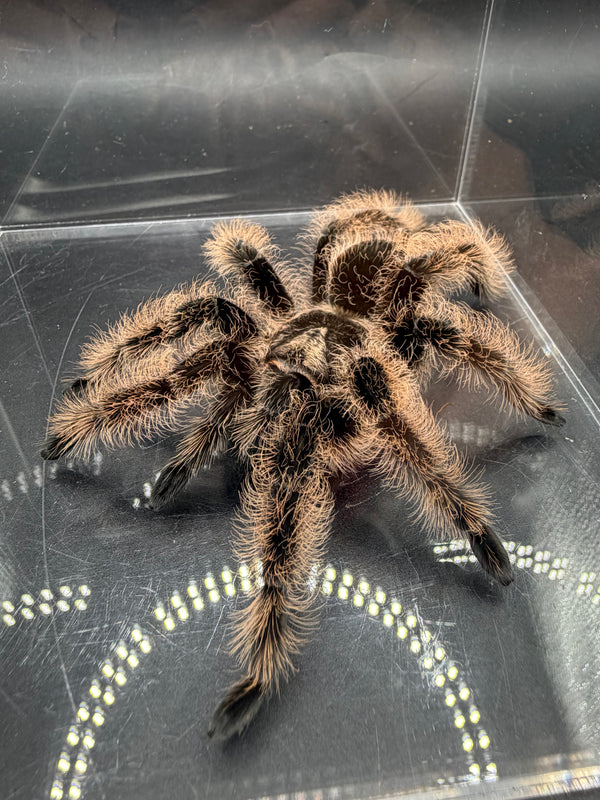
Curly Hair Tarantula (Tliltocatl albopilosus)
Tarantula

Florida Giant Vinegaroon for sale from Big Z's (Mastigoproctus floridanus). Spice-rated keeper notes, care guidance, and live-arrival packing where eligible.
A living fossil that sprays vinegar instead of stinging you
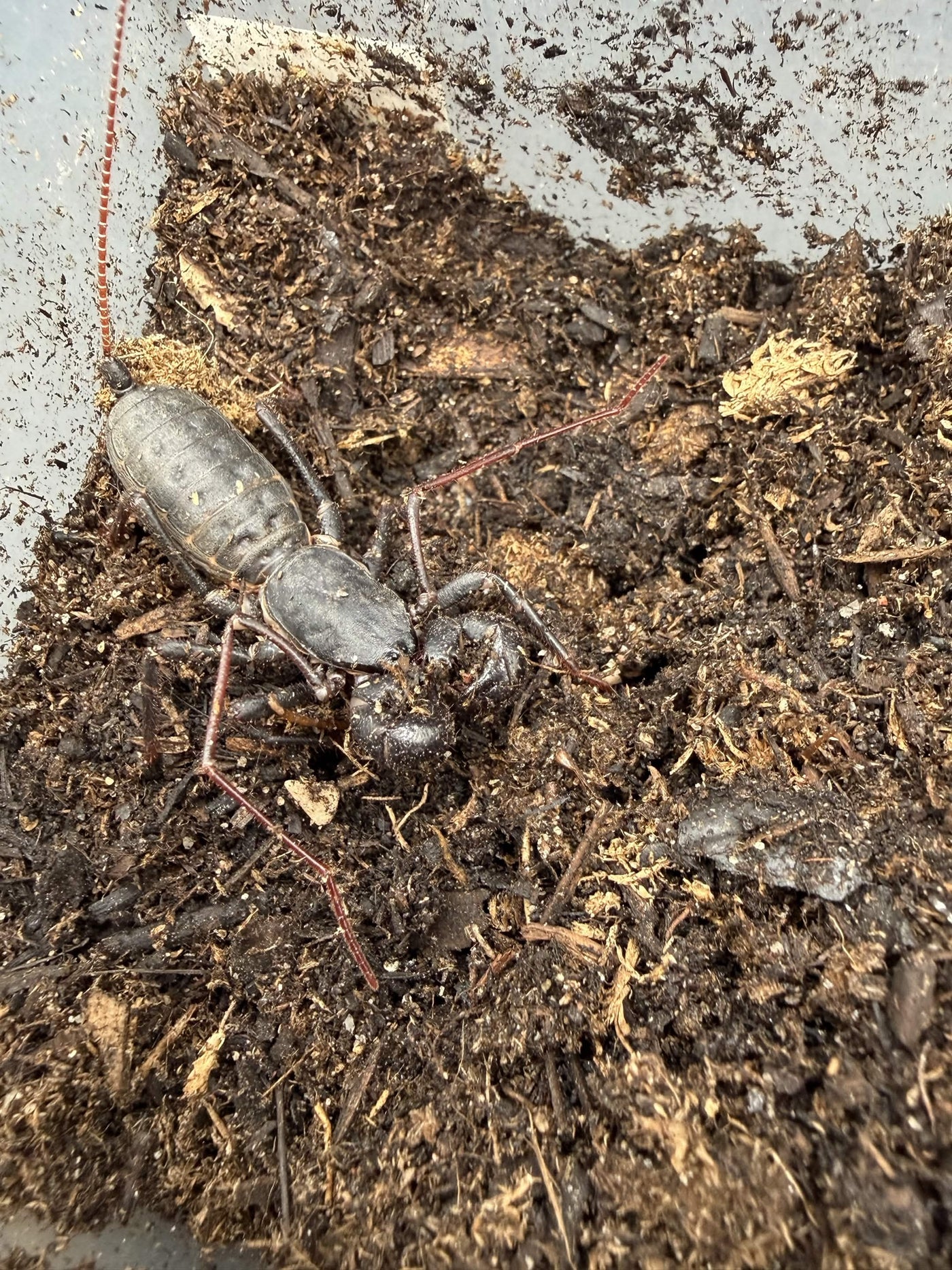
Mastigoproctus floridanus, the Florida Giant Vinegaroon, is a big, dark whip scorpion built like something out of the fossil record: a heavy body, thick grabbing pedipalps, and a long tail-like flagellum trailing behind it. It is Florida's own species, split off from the wider M. giganteus complex in 2018, and it comes with a genuine party trick. Corner one and it aims that tail and sprays concentrated acetic acid, real vinegar, straight at the threat. At 2 to 2.5 inches it is a slow, deliberate, oddly graceful predator that looks far scarier than it is.
Here is the honest part: no sting, no hard bite, no medically significant venom. The vinegar spray is the entire defense: no venom and no sting, but it is an acetic-acid mist that stings the eyes, so keep contact brief, protect your face, and wash your hands after. This is a genuine beginner animal, long-lived and low-drama, that just wants an arid, burrowing setup with real digging depth and a hide. Read the care guide for the exact build and the few boundaries worth respecting.
The numbers live in the care guide. Enclosure size, temps, humidity, feeding schedule, premolt signs, handling boundaries: it's all in the care guide for this exact fella. Start with the full Advanced guide, or click for the quick Open the Simple version →
Invertebrate
Florida Giant Vinegaroon (Mastigoproctus floridanus) care guide Read shipping & LAG
Florida Giant Vinegaroon for sale from Big Z's (Mastigoproctus floridanus). Spice-rated keeper notes, care guidance, and live-arrival packing where eligible.
A living fossil that sprays vinegar instead of stinging you
Mastigoproctus floridanus, the Florida Giant Vinegaroon, is a big, dark whip scorpion built like something out of the fossil record: a heavy body, thick grabbing pedipalps, and a long tail-like flagellum trailing behind it. It is Florida's own species, split off from the wider M. giganteus complex in 2018, and it comes with a genuine party trick. Corner one and it aims that tail and sprays concentrated acetic acid, real vinegar, straight at the threat. At 2 to 2.5 inches it is a slow, deliberate, oddly graceful predator that looks far scarier than it is.
Here is the honest part: no sting, no hard bite, no medically significant venom. The vinegar spray is the entire defense: no venom and no sting, but it is an acetic-acid mist that stings the eyes, so keep contact brief, protect your face, and wash your hands after. This is a genuine beginner animal, long-lived and low-drama, that just wants an arid, burrowing setup with real digging depth and a hide. Read the care guide for the exact build and the few boundaries worth respecting.
The numbers live in the care guide. Enclosure size, temps, humidity, feeding schedule, premolt signs, handling boundaries: it's all in the care guide for this exact fella. Start with the full Advanced guide, or click for the quick Open the Simple version →
Mastigoproctus floridanus - Spice 2: Beginner. Burrow Buddy: the correct format for this species at every stage, filled deep and packed firm with a flat cork or bark piece laid on the surface; Baby Buddy: nymphs only, filled to the same depth fraction; Adult custom terrestrial build sized from the measured animal - depth and floor area over height
Mastigoproctus floridanus
Identity confidence: provisional. This is a genus, group, or trade name rather than a confirmed species. Treat it as the closest match we can stand behind, and use the more conservative end of any range.
Big Z's Quick Verdict: Florida's own vinegaroon, and genuinely its own species since 2018 - not the desert giant most care sheets are written about. That matters twice over: Florida animals are SMALLER (measured Florida adults average about 45 mm, roughly 1.8 in, where hobby 'giant vinegaroon' figures come from Texas and Arizona animals), and they come from humid subtropical sand-scrub rather than desert, so the famous desert water-relations numbers do not transfer. Give it deep, well-drained sandy substrate it can actually dig, a flat piece of cork or bark on top because Florida records find these animals under surface debris as often as in burrows, a full water dish, and moisture low in the column with a dry surface. No venom, no bite worth the name - but it sprays concentrated acetic acid accurately for about a foot, and that is an eyes-and-nose problem, not a skin one. Watch it, do not carry it. Keep it spicy. - Big Z
| Temp | Ordinary room warmth, roughly 72-82F, with a normal indoor night drop. No heat mat, no hot spot. LABELLED SCOPE - HOUSE STANDARD, NOT SPECIES EVIDENCE: no temperature study exists for this species and every hobby figure in circulation was refuted or narrowed during verification. The nearest measured work is on Chihuahuan Desert congeners from Big Bend, Texas, which settled at 23-28.9C on a gradient, and the 2018 revision explicitly warns that this desert research does not describe the more mesic Florida animal. Depth is your real temperature control: in a measured congeneric population the soil surface swung between 59.5C and -15C while the 15-30 cm layer stayed within 3.2-38.1C. |
|---|---|
| Humidity | No numeric % ambient target - manage by substrate, not by air. Keep the bottom third of the column lightly damp, let the top inch dry, and keep a shallow pebble-packed water dish full at all times. LABELLED SCOPE: no humidity figure has ever been published for this species; congeneric embryo work failed entirely at 12% RH and succeeded at 40% and 75%, and dry air measurably lowers heat tolerance in the genus, which is why the damp lower layer and the dish matter more than any wall gauge. |
| Setup | Subtropical sand-scrub burrower with surface refugia |
| Substrate | 6 in or more of packable sandy soil - sand cut with topsoil, coco fiber or clay loam. Coco fiber alone collapses and will not hold a burrow or a molt chamber. LABELLED SCOPE: the depth figure is Big Z's house standard, not a published requirement. The only peer-reviewed substrate figure for the genus is a laboratory colony jar filled to 16 cm with moistened sandy loam, for the Arizona species. |
| Feeding | Soft-bodied insects - roaches, crickets, termites - fed to body condition rather than to a schedule |
| Handling | Handling discouraged. No venom and no real bite, but the acetic acid spray is genuinely dangerous to eyes, and the whip-like flagellum breaks easily. Catch cup for transfers. |
Humidity zones: Very Low under 30% - Low 30-60% - Low-Moderate 40-70% - Moderate 60-80% - Moderate-High 70-85% - High 80%+ - Very High 90%+
Current Big Z's catalog: Yes
Mastigoproctus floridanus
Identity confidence: provisional. This is a genus, group, or trade name rather than a confirmed species. Treat it as the closest match we can stand behind, and use the more conservative end of any range.
Keeper Snapshot: Florida's own vinegaroon, and genuinely its own species since 2018 - not the desert giant most care sheets are written about. That matters twice over: Florida animals are SMALLER (measured Florida adults average about 45 mm, roughly 1.8 in, where hobby 'giant vinegaroon' figures come from Texas and Arizona animals), and they come from humid subtropical sand-scrub rather than desert, so the famous desert water-relations numbers do not transfer. Give it deep, well-drained sandy substrate it can actually dig, a flat piece of cork or bark on top because Florida records find these animals under surface debris as often as in burrows, a full water dish, and moisture low in the column with a dry surface. No venom, no bite worth the name - but it sprays concentrated acetic acid accurately for about a foot, and that is an eyes-and-nose problem, not a skin one. Watch it, do not carry it. Keep it spicy. - Big Z
| Temperature | Ordinary room warmth, roughly 72-82F, with a normal indoor night drop. No heat mat, no hot spot. LABELLED SCOPE - HOUSE STANDARD, NOT SPECIES EVIDENCE: no temperature study exists for this species and every hobby figure in circulation was refuted or narrowed during verification. The nearest measured work is on Chihuahuan Desert congeners from Big Bend, Texas, which settled at 23-28.9C on a gradient, and the 2018 revision explicitly warns that this desert research does not describe the more mesic Florida animal. Depth is your real temperature control: in a measured congeneric population the soil surface swung between 59.5C and -15C while the 15-30 cm layer stayed within 3.2-38.1C. |
|---|---|
| Humidity | No numeric % ambient target - manage by substrate, not by air. Keep the bottom third of the column lightly damp, let the top inch dry, and keep a shallow pebble-packed water dish full at all times. LABELLED SCOPE: no humidity figure has ever been published for this species; congeneric embryo work failed entirely at 12% RH and succeeded at 40% and 75%, and dry air measurably lowers heat tolerance in the genus, which is why the damp lower layer and the dish matter more than any wall gauge. |
| Setup Type | Subtropical sand-scrub burrower with surface refugia |
| Substrate | 6 in or more of packable sandy soil - sand cut with topsoil, coco fiber or clay loam. Coco fiber alone collapses and will not hold a burrow or a molt chamber. LABELLED SCOPE: the depth figure is Big Z's house standard, not a published requirement. The only peer-reviewed substrate figure for the genus is a laboratory colony jar filled to 16 cm with moistened sandy loam, for the Arizona species. |
| Feeding | Soft-bodied insects - roaches, crickets, termites - fed to body condition rather than to a schedule |
| Care Difficulty | Spice 2: Beginner |
| Handling | Handling discouraged. No venom and no real bite, but the acetic acid spray is genuinely dangerous to eyes, and the whip-like flagellum breaks easily. Catch cup for transfers. |
Humidity zones: Very Low under 30% - Low 30-60% - Low-Moderate 40-70% - Moderate 60-80% - Moderate-High 70-85% - High 80%+ - Very High 90%+

Tarantula

Spider

Tarantula

Invertebrate

Tarantula

Tarantula

Scorpion

Tarantula