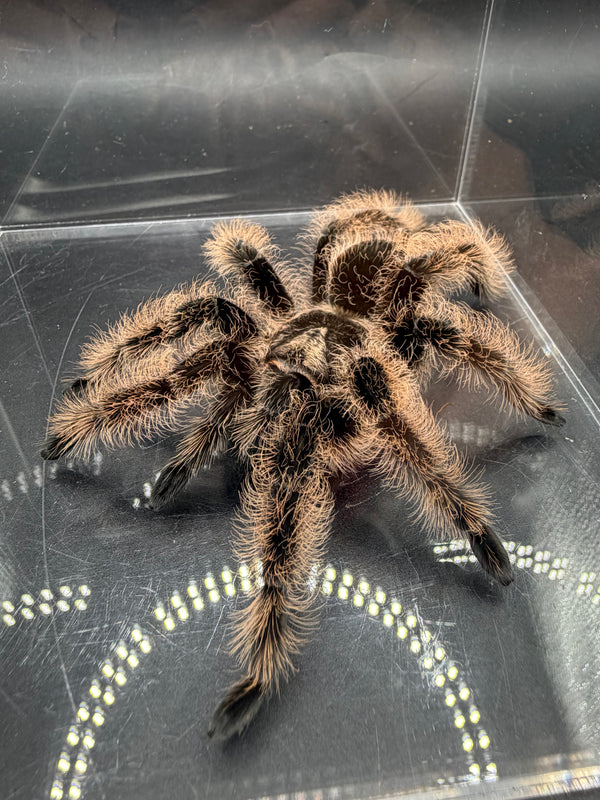
Curly Hair Tarantula (Tliltocatl albopilosus)
Tarantula

Mexican Bloodleg Tarantula for sale from Big Z's (Aphonopelma bicoloratum). Spice-rated keeper notes, care guidance, and live-arrival packing where eligible.
Jet black body, blood-orange legs, and one of Mexico's most wanted
Aphonopelma bicoloratum, the Mexican Bloodleg, is the showpiece of a genus otherwise known for plain desert browns: a deep black carapace and abdomen carrying legs washed in blood-orange to salmon-red. It is endemic to a small slice of Michoacán with a genuinely restricted range, which is a large part of why well-started captive-bred stock like this commands what it does. At 1.5 to 2 inches this one has its colour and its confidence already.
Temperament is classic Aphonopelma: slow, calm, and thoroughly unwilling to make a scene. Care is just as undramatic, needing dry terrestrial substrate, a hide, a shallow water dish, and patience. That last one is not a figure of speech. This is among the slowest-growing tarantulas in the hobby, and you should expect years rather than months between size classes. The slow climb is the trade for an animal that stays this beautiful for decades. Spice 2, beginner lane, and the care guide has the full build.
The numbers live in the care guide. Enclosure size, temps, humidity, feeding schedule, premolt signs, handling boundaries: it's all in the care guide for this exact fella. Start with the full Advanced guide, or click for the quick Open the Simple version →
Tarantula
Mexican Bloodleg Tarantula (Aphonopelma bicoloratum) care guide Read shipping & LAG
Mexican Bloodleg Tarantula for sale from Big Z's (Aphonopelma bicoloratum). Spice-rated keeper notes, care guidance, and live-arrival packing where eligible.
Jet black body, blood-orange legs, and one of Mexico's most wanted
Aphonopelma bicoloratum, the Mexican Bloodleg, is the showpiece of a genus otherwise known for plain desert browns: a deep black carapace and abdomen carrying legs washed in blood-orange to salmon-red. It is endemic to a small slice of Michoacán with a genuinely restricted range, which is a large part of why well-started captive-bred stock like this commands what it does. At 1.5 to 2 inches this one has its colour and its confidence already.
Temperament is classic Aphonopelma: slow, calm, and thoroughly unwilling to make a scene. Care is just as undramatic, needing dry terrestrial substrate, a hide, a shallow water dish, and patience. That last one is not a figure of speech. This is among the slowest-growing tarantulas in the hobby, and you should expect years rather than months between size classes. The slow climb is the trade for an animal that stays this beautiful for decades. Spice 2, beginner lane, and the care guide has the full build.
The numbers live in the care guide. Enclosure size, temps, humidity, feeding schedule, premolt signs, handling boundaries: it's all in the care guide for this exact fella. Start with the full Advanced guide, or click for the quick Open the Simple version →
Aphonopelma bicoloratum - Spice 2: Beginner. Baby Buddy: spiderlings only, with ventilation openings too narrow for the animal to pass; Burrow Buddy: correct home for the supplied 1.5-2 in juveniles and for several years afterward, given this species' growth rate; Adult custom terrestrial build sized from the measured animal, low profile, wide floor, strong cross ventilation
Aphonopelma bicoloratum
Big Z's Quick Verdict: A restricted-range Mexican terrestrial and one of the calmest tarantulas Big Z's stocks, but also one of the slowest growers in the hobby. Keep it at 72-80F in a low horizontal enclosure on 3-4 in of dry, firmly packed substrate with an anchored hide and a full pebble-filled dish. Do not chase humidity and do not push feeding to speed it up; this animal moves at its own pace and stays beautiful for decades. Spice 2 for temperament, not for patience. Keep it spicy. - Big Z
| Temp | 72-80F working room range. Ordinary indoor night drop to the upper 60s is fine and needs no correction. Aphonopelma are montane and semi-arid Mexican animals that tolerate a normal household range; a concentrated hot spot is a bigger risk than a cool night. |
|---|---|
| Humidity | No numeric % target. Manage by method: keep the substrate surface dry, keep a pebble-filled water dish full at all times, and ventilate at substrate level. If the enclosure needs moisture, add it to one lower corner under the hide rather than spraying the animal. A permanently damp enclosure is the main husbandry killer for this species. |
| Setup | Dry terrestrial with a shallow scrape retreat and low fall zone |
| Substrate | 3-4 in of dry, firmly packed coco fiber and topsoil or another additive-free soil mix that holds a shallow scrape. Fill enough that the animal cannot fall more than roughly its own diagonal leg span from the highest point it can reach. Anchor a cork hide over a started depression. |
| Feeding | Spiderlings: one small prey item weekly. Supplied 1.5-2 in juveniles: one appropriately sized cricket or small roach every 7-10 days. Adults: one suitable meal every 2-4 weeks, adjusted by abdomen condition. Prey no longer than the spider's body. Remove uneaten prey within 24 hours, and withhold entirely through premolt until fangs are dark and the exoskeleton is firm. |
| Handling | Not recommended. Catch cup transfers only. |
Humidity zones: Very Low under 30% - Low 30-60% - Low-Moderate 40-70% - Moderate 60-80% - Moderate-High 70-85% - High 80%+ - Very High 90%+
Current Big Z's catalog: Yes
Aphonopelma bicoloratum
Keeper Snapshot: A restricted-range Mexican terrestrial and one of the calmest tarantulas Big Z's stocks, but also one of the slowest growers in the hobby. Keep it at 72-80F in a low horizontal enclosure on 3-4 in of dry, firmly packed substrate with an anchored hide and a full pebble-filled dish. Do not chase humidity and do not push feeding to speed it up; this animal moves at its own pace and stays beautiful for decades. Spice 2 for temperament, not for patience. Keep it spicy. - Big Z
| Temperature | 72-80F working room range. Ordinary indoor night drop to the upper 60s is fine and needs no correction. Aphonopelma are montane and semi-arid Mexican animals that tolerate a normal household range; a concentrated hot spot is a bigger risk than a cool night. |
|---|---|
| Humidity | No numeric % target. Manage by method: keep the substrate surface dry, keep a pebble-filled water dish full at all times, and ventilate at substrate level. If the enclosure needs moisture, add it to one lower corner under the hide rather than spraying the animal. A permanently damp enclosure is the main husbandry killer for this species. |
| Setup Type | Dry terrestrial with a shallow scrape retreat and low fall zone |
| Substrate | 3-4 in of dry, firmly packed coco fiber and topsoil or another additive-free soil mix that holds a shallow scrape. Fill enough that the animal cannot fall more than roughly its own diagonal leg span from the highest point it can reach. Anchor a cork hide over a started depression. |
| Feeding | Spiderlings: one small prey item weekly. Supplied 1.5-2 in juveniles: one appropriately sized cricket or small roach every 7-10 days. Adults: one suitable meal every 2-4 weeks, adjusted by abdomen condition. Prey no longer than the spider's body. Remove uneaten prey within 24 hours, and withhold entirely through premolt until fangs are dark and the exoskeleton is firm. |
| Care Difficulty | Spice 2: Beginner |
| Handling | Not recommended. Catch cup transfers only. |
Humidity zones: Very Low under 30% - Low 30-60% - Low-Moderate 40-70% - Moderate 60-80% - Moderate-High 70-85% - High 80%+ - Very High 90%+

Tarantula

Spider

Tarantula

Invertebrate

Tarantula

Tarantula

Scorpion

Tarantula