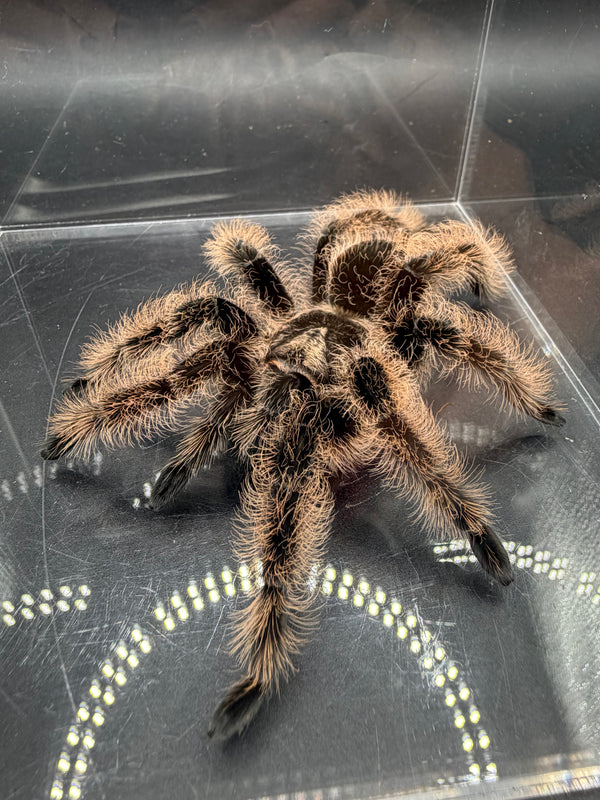
Curly Hair Tarantula (Tliltocatl albopilosus)
Tarantula

Yucatan Rustrump Tarantula for sale from Big Z's (Tliltocatl epicureanus). Spice-rated keeper notes, care guidance, and live-arrival packing where eligible.
Matte black with a rust-red rump, and the easy temperament the genus is famous for
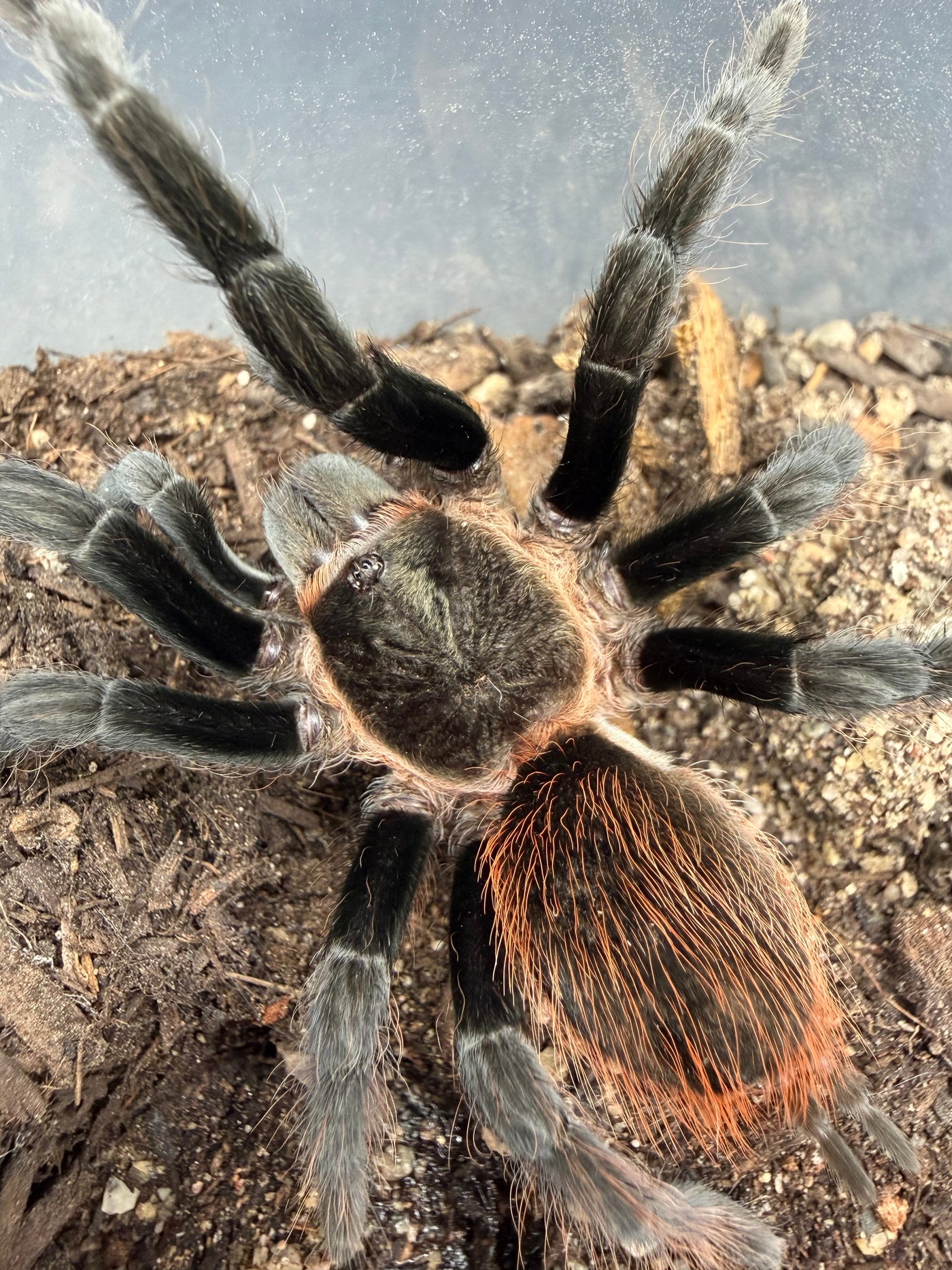
Tliltocatl epicureanus, the Yucatan Rustrump, is a Central American terrestrial out of the Yucatán Peninsula: deep matte black legs and carapace set against a warm rust-red flush across the abdomen. At 2.75 inches it is already carrying adult colour and is well on its way to a five or six inch adult.
Tliltocatl are the workhorse beginner genus for good reason. They are slow, heavy-footed, and reluctant to do anything dramatic, and this one holds to type. It wants a dry terrestrial setup with a hide, a water dish, and enough substrate to scrape out a shallow burrow. The one honest note is that when it does get irritated it kicks urticating hair rather than running, so give it room during maintenance. Spice 2, beginner lane, and a genuinely long-lived animal. The care guide covers the rest.
The numbers live in the care guide. Enclosure size, temps, humidity, feeding schedule, premolt signs, handling boundaries: it's all in the care guide for this exact fella. Start with the full Advanced guide, or click for the quick Open the Simple version →
Tarantula
Yucatan Rustrump Tarantula (Tliltocatl epicureanus) care guide Read shipping & LAG
Yucatan Rustrump Tarantula for sale from Big Z's (Tliltocatl epicureanus). Spice-rated keeper notes, care guidance, and live-arrival packing where eligible.
Matte black with a rust-red rump, and the easy temperament the genus is famous for
Tliltocatl epicureanus, the Yucatan Rustrump, is a Central American terrestrial out of the Yucatán Peninsula: deep matte black legs and carapace set against a warm rust-red flush across the abdomen. At 2.75 inches it is already carrying adult colour and is well on its way to a five or six inch adult.
Tliltocatl are the workhorse beginner genus for good reason. They are slow, heavy-footed, and reluctant to do anything dramatic, and this one holds to type. It wants a dry terrestrial setup with a hide, a water dish, and enough substrate to scrape out a shallow burrow. The one honest note is that when it does get irritated it kicks urticating hair rather than running, so give it room during maintenance. Spice 2, beginner lane, and a genuinely long-lived animal. The care guide covers the rest.
The numbers live in the care guide. Enclosure size, temps, humidity, feeding schedule, premolt signs, handling boundaries: it's all in the care guide for this exact fella. Start with the full Advanced guide, or click for the quick Open the Simple version →
Tliltocatl epicureanus - Spice 2: Beginner. Baby Buddy may suit a measured sling if every opening is checked against the individual; Burrow Buddy may suit a measured juvenile while preserving deep substrate and short fall distance; For an adult, select a low horizontal enclosure from the measured leg span, with at least 3 times that span in floor length, deep fill, cross-ventilation, and tool access
Tliltocatl epicureanus
Big Z's Quick Verdict: A Mexican terrestrial tarantula formerly placed in Brachypelma. Species-specific husbandry literature is sparse, so this guide uses a keeper-selected congeneric protocol: a low enclosure, firm diggable substrate, anchored cork, a localized moisture gradient, strong cross-ventilation, and feeding adjusted to body condition. The Spice 2 lane is a provisional house classification, not a promise about an individual animal.
| Temp | 70-76F. Keeper-selected working range from the overlap of Tliltocatl vagans and T. schroederi guidance. Avoid direct or unregulated supplemental heat. |
|---|---|
| Humidity | No numeric % target. Use substrate condition instead: keep the open surface mostly dry, maintain light moisture lower in one corner, cross-ventilate at substrate level, and keep a pebble-filled water dish full on the drier side. |
| Setup | Terrestrial setup with deep substrate and an optional started retreat. This conservative enclosure design does not assume every individual will burrow. |
| Substrate | Fill about 1/2 to 2/3 of a low enclosure with a firmly packed, diggable coco, peat, or topsoil-based blend without added fertilizer or pesticides. Anchor cork over a started retreat. This is keeper-selected congeneric and fall-prevention guidance. |
| Feeding | Keeper-selected congeneric schedule: offer slings small prey twice weekly and pre-kill prey over about 2/3 of the sling's body length; offer juveniles 2-3 small to medium crickets or 1 medium Dubia roach every 7-10 days; offer adults 4-5 large crickets or 1 large Dubia roach every 2-3 weeks. Adjust to abdomen condition and remove refused prey within 24 hours. |
| Handling | Not recommended. Catch-cup transfers only. |
Humidity zones: Very Low under 30% - Low 30-60% - Low-Moderate 40-70% - Moderate 60-80% - Moderate-High 70-85% - High 80%+ - Very High 90%+
Current Big Z's catalog: No
Tliltocatl epicureanus
Keeper Snapshot: A Mexican terrestrial tarantula formerly placed in Brachypelma. Species-specific husbandry literature is sparse, so this guide uses a keeper-selected congeneric protocol: a low enclosure, firm diggable substrate, anchored cork, a localized moisture gradient, strong cross-ventilation, and feeding adjusted to body condition. The Spice 2 lane is a provisional house classification, not a promise about an individual animal.
| Temperature | 70-76F. Keeper-selected working range from the overlap of Tliltocatl vagans and T. schroederi guidance. Avoid direct or unregulated supplemental heat. |
|---|---|
| Humidity | No numeric % target. Use substrate condition instead: keep the open surface mostly dry, maintain light moisture lower in one corner, cross-ventilate at substrate level, and keep a pebble-filled water dish full on the drier side. |
| Setup Type | Terrestrial setup with deep substrate and an optional started retreat. This conservative enclosure design does not assume every individual will burrow. |
| Substrate | Fill about 1/2 to 2/3 of a low enclosure with a firmly packed, diggable coco, peat, or topsoil-based blend without added fertilizer or pesticides. Anchor cork over a started retreat. This is keeper-selected congeneric and fall-prevention guidance. |
| Feeding | Keeper-selected congeneric schedule: offer slings small prey twice weekly and pre-kill prey over about 2/3 of the sling's body length; offer juveniles 2-3 small to medium crickets or 1 medium Dubia roach every 7-10 days; offer adults 4-5 large crickets or 1 large Dubia roach every 2-3 weeks. Adjust to abdomen condition and remove refused prey within 24 hours. |
| Care Difficulty | Spice 2: Beginner |
| Handling | Not recommended. Catch-cup transfers only. |
Humidity zones: Very Low under 30% - Low 30-60% - Low-Moderate 40-70% - Moderate 60-80% - Moderate-High 70-85% - High 80%+ - Very High 90%+

Tarantula

Spider

Tarantula

Invertebrate

Tarantula

Tarantula

Scorpion

Tarantula