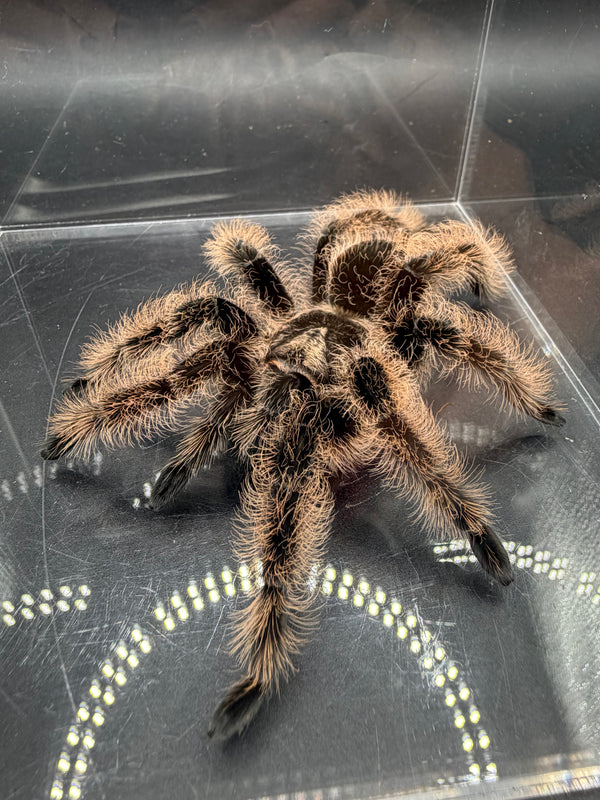
Curly Hair Tarantula (Tliltocatl albopilosus)
Tarantula

Ruby Rock Scorpion for sale from Big Z's (Diplocentrus spitzeri). Spice-rated keeper notes, care guidance, and live-arrival packing where eligible.
A jewel-toned little tank from the desert Southwest
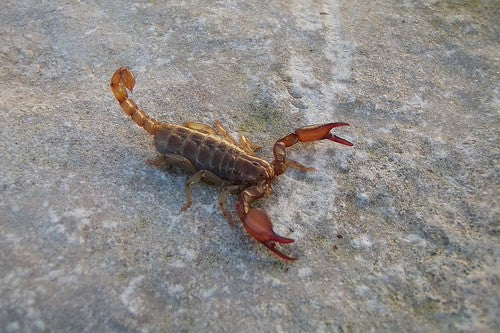
Diplocentrus spitzeri, the Ruby Rock Scorpion, is a stocky, heavy-bodied scorpion in a gorgeous deep ruby-to-red-brown, native to the rocky desert canyons of the southwestern US and northern Mexico. Compact, broad-clawed, and built low to the ground: a desert species with real presence at a manageable size.
It is a Diplocentrus, which means reduced venom and a calm streak: a great display scorpion for someone who wants something distinctive without buthid danger. Stings are localized and mild, but it is still not a handling animal; it would much rather be wedged under a flat rock with a slightly humid corner nearby. Easygoing, beautiful, and not what everyone else has.
The numbers live in the care guide. Enclosure size, temps, humidity, feeding schedule, premolt signs, handling boundaries: it's all in the care guide for this exact fella. Start with the full Advanced guide, or click for the quick Open the Simple version →
Scorpion
Ruby Rock Scorpion (Diplocentrus spitzeri) care guide Read shipping & LAG
Ruby Rock Scorpion for sale from Big Z's (Diplocentrus spitzeri). Spice-rated keeper notes, care guidance, and live-arrival packing where eligible.
A jewel-toned little tank from the desert Southwest
Diplocentrus spitzeri, the Ruby Rock Scorpion, is a stocky, heavy-bodied scorpion in a gorgeous deep ruby-to-red-brown, native to the rocky desert canyons of the southwestern US and northern Mexico. Compact, broad-clawed, and built low to the ground: a desert species with real presence at a manageable size.
It is a Diplocentrus, which means reduced venom and a calm streak: a great display scorpion for someone who wants something distinctive without buthid danger. Stings are localized and mild, but it is still not a handling animal; it would much rather be wedged under a flat rock with a slightly humid corner nearby. Easygoing, beautiful, and not what everyone else has.
The numbers live in the care guide. Enclosure size, temps, humidity, feeding schedule, premolt signs, handling boundaries: it's all in the care guide for this exact fella. Start with the full Advanced guide, or click for the quick Open the Simple version →
Diplocentrus spitzeri - Spice 2: Beginner. Baby Buddy: for 2i-3i instars (escape-proof ventilation only); Burrow Buddy: for larger juveniles and adults; a full-grown adult appreciates a roomier floor and a bit more depth than the bare minimum
Diplocentrus spitzeri
Big Z's Quick Verdict: A stocky semi-arid scorpion that loves to dig deep, then hide under bark: hardy and room-temperature friendly, adults about 3-4 inches with mild venom.
| Temp | 70-90°F |
|---|---|
| Humidity | Low ambient (35-50%) with good airflow; dry surface, faintly damp burrow depth |
| Setup | Semi-arid burrowing terrestrial (deep substrate + bark hides) |
| Substrate | Deep (3-4 in+) packable coco/sand/peat or topsoil mix to burrow in: dry on top, faintly moist down low; plus bark slabs to hide under |
| Feeding | Small prey weekly |
| Handling | Not recommended |
Humidity zones: Very Low under 30% - Low 30-60% - Low-Moderate 40-70% - Moderate 60-80% - Moderate-High 70-85% - High 80%+ - Very High 90%+
Current Big Z's catalog: Yes
Diplocentrus spitzeri
Keeper Snapshot: A stocky semi-arid scorpion that loves to dig deep, then hide under bark: hardy and room-temperature friendly, adults about 3-4 inches with mild venom.
| Temperature | 70-90°F |
|---|---|
| Humidity | Low ambient (35-50%) with good airflow; dry surface, faintly damp burrow depth |
| Setup Type | Semi-arid burrowing terrestrial (deep substrate + bark hides) |
| Substrate | Deep (3-4 in+) packable coco/sand/peat or topsoil mix to burrow in: dry on top, faintly moist down low; plus bark slabs to hide under |
| Feeding | Small prey weekly |
| Care Difficulty | Spice 2: Beginner |
| Handling | Not recommended |
Humidity zones: Very Low under 30% - Low 30-60% - Low-Moderate 40-70% - Moderate 60-80% - Moderate-High 70-85% - High 80%+ - Very High 90%+

Tarantula

Spider

Tarantula

Invertebrate

Tarantula

Tarantula

Scorpion

Tarantula