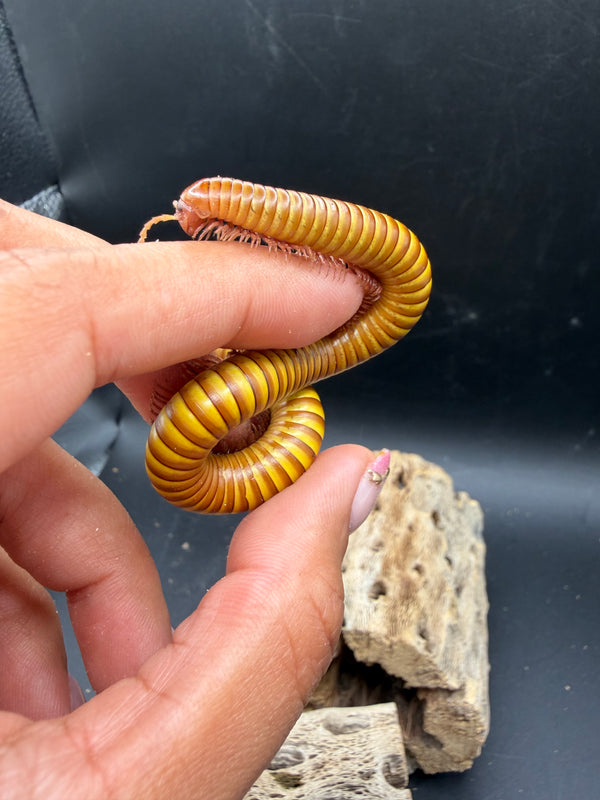
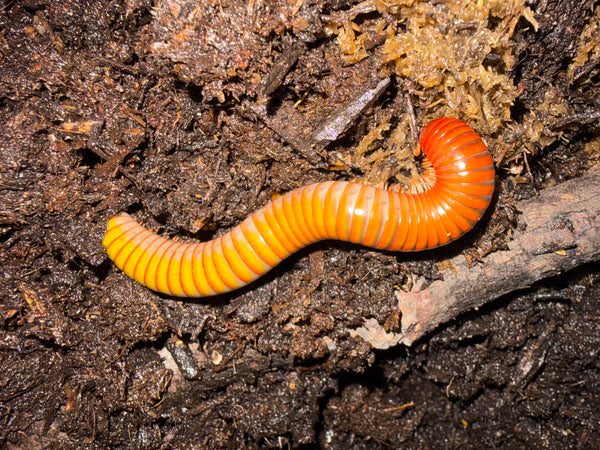
Texas Gold Millipede (Orthoporus ornatus)
Millipede

Blue Scorpion for sale from Big Z's (Heteroctenus junceus). Spice-rated keeper notes, care guidance, and live-arrival packing where eligible.
A Cuban scorpion that climbs, and a lid that has to assume it.
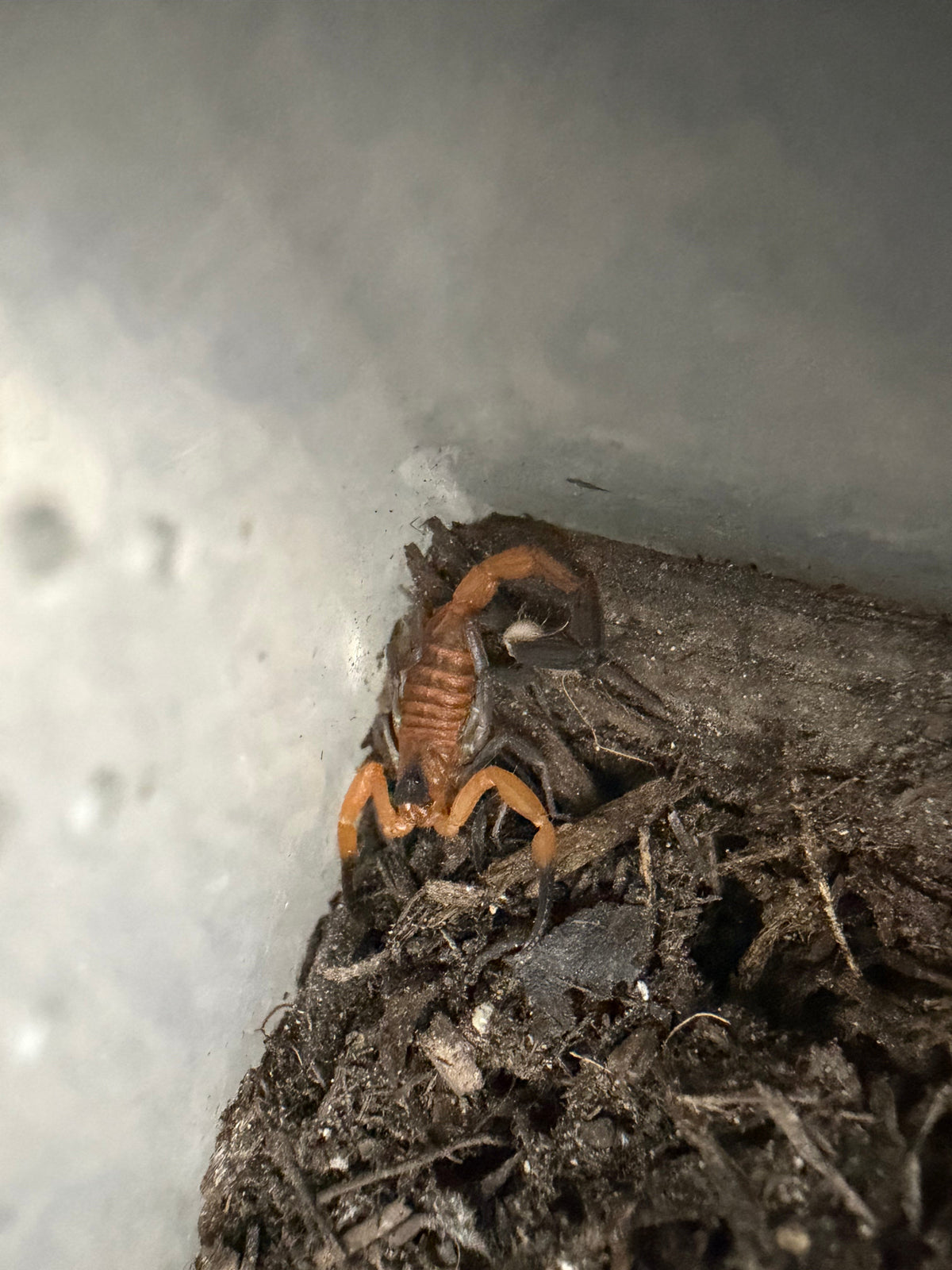
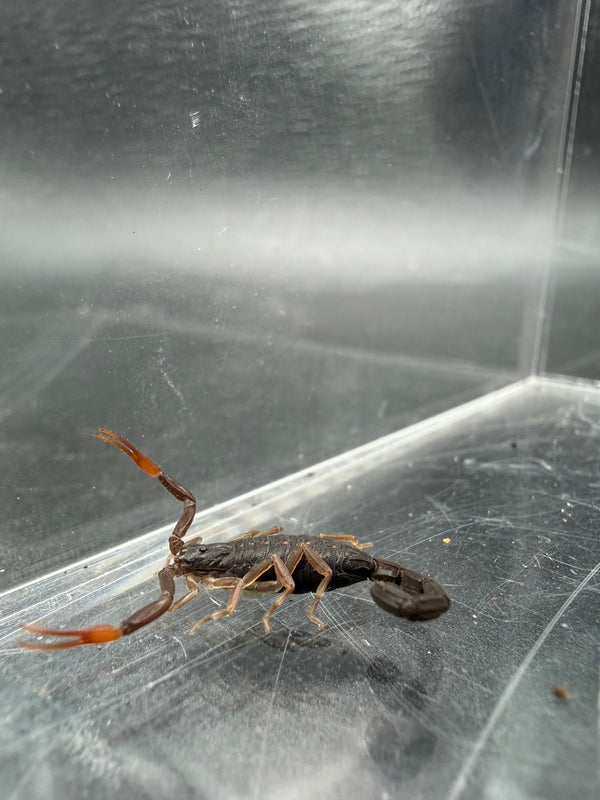
Heteroctenus junceus, the Cuban Blue Scorpion, is an island endemic that lives under stones and logs and behind loose bark, and it is one of the animals Cuba is genuinely known for. It climbs readily and it stridulates when disturbed. This batch arrived at 0.25 to 0.5 inches, small juveniles and scorplings; the exact instar is not known.
At that size containment is most of the job. House them one to an enclosure, with a secure lid and every vent opening smaller than the tail, and build on the assumption that it will use the walls rather than stay on the floor. Give it flat cover to slide under, a vertical piece of cork, lightly damp substrate that never sits wet, and cross ventilation. Skip a standing water dish until the animal is big enough for one to be safe. Spice Level 3: Intermediate, and it is a display animal with no hand contact. The matched Big Z's care guide covers the climb-proof build.
The numbers live in the care guide. Enclosure size, temps, humidity, feeding schedule, premolt signs, handling boundaries: it's all in the care guide for this exact fella. Start with the full Advanced guide, or click for the quick Open the Simple version →
Scorpion
Blue Scorpion (Heteroctenus junceus) care guide Read shipping & LAG
Blue Scorpion for sale from Big Z's (Heteroctenus junceus). Spice-rated keeper notes, care guidance, and live-arrival packing where eligible.
A Cuban scorpion that climbs, and a lid that has to assume it.
Heteroctenus junceus, the Cuban Blue Scorpion, is an island endemic that lives under stones and logs and behind loose bark, and it is one of the animals Cuba is genuinely known for. It climbs readily and it stridulates when disturbed. This batch arrived at 0.25 to 0.5 inches, small juveniles and scorplings; the exact instar is not known.
At that size containment is most of the job. House them one to an enclosure, with a secure lid and every vent opening smaller than the tail, and build on the assumption that it will use the walls rather than stay on the floor. Give it flat cover to slide under, a vertical piece of cork, lightly damp substrate that never sits wet, and cross ventilation. Skip a standing water dish until the animal is big enough for one to be safe. Spice Level 3: Intermediate, and it is a display animal with no hand contact. The matched Big Z's care guide covers the climb-proof build.
The numbers live in the care guide. Enclosure size, temps, humidity, feeding schedule, premolt signs, handling boundaries: it's all in the care guide for this exact fella. Start with the full Advanced guide, or click for the quick Open the Simple version →
Heteroctenus junceus - Spice 3: Intermediate. Baby Buddy: suitable for this 0.25-0.5 in batch of small juveniles/scorplings; exact instar unknown; one animal per enclosure and every opening smaller than the metasoma; Bark Buddy: useful as the animal grows because vertical cork and tight crevices match the documented rock-and-bark ecology; Burrow Buddy: usable for larger animals when fitted with flat cover and vertical cork; substrate depth here buffers moisture rather than asserting deep-burrowing behavior
Heteroctenus junceus
Big Z's Quick Verdict: A Cuban rock-and-bark scorpion that climbs readily and can stridulate when disturbed. Published secondary accounts describe comparatively low venom severity, frequent Cuban stings, and no toxin-attributed fatalities while noting suspected allergic fatalities; the underlying LD50 experiment and surveillance records were not retrieved. Big Z's keeps a no-contact boundary anyway. Give it flat cover, vertical cork, lightly damp moisture-retentive substrate, cross-ventilation, and a secure lid. This batch is 0.25-0.5 in: small juveniles/scorplings, exact instar unknown, housed one per enclosure. - Big Z
| Temp | No captive optimum is established. One adult LABIOFAM colony was maintained at 22.8 C (73 F), while a Cuban dry-forest source gives a regional annual mean near 25 C (77 F). A 73-80/82 F working band is a Big Z house synthesis, not a source intersection or proven optimum. Maintain a gradient and avoid uncontrolled heat. |
|---|---|
| Humidity | The LABIOFAM adult colony reported 76% RH. No validated lower threshold was found. Keep the substrate lightly damp through its depth without free water, allow exposed surfaces to become less wet, and cross-ventilate. Add water to one end of the substrate rather than spraying the animal; this physical method is Big Z house practice. |
| Setup | Lapidicolous Caribbean buthid setup: flat cover objects and vertical cork over lightly damp substrate |
| Substrate | Use packed, moisture-retentive coco, peat, topsoil, or a stable blend. Exact mix and depth are Big Z house choices for moisture buffering, not species measurements. Primary records place this species in rock crevices, under stones and logs, and behind bark, so provide flat cover objects and a vertical cork slab rather than treating it as a deep burrower. Centruroides gracilis is used only as a same-family Caribbean keeper analogue, not a congener. |
| Feeding | Adults in the species-level LABIOFAM colony were fed weekly. For small juveniles, very small or pre-killed prey once weekly is a same-family keeper analogue and Big Z starting practice, not H. junceus rearing evidence. Adjust from intake and condition; remove leftovers promptly and remove live prey during molt. |
| Handling | No contact. Catch cup and long tongs only. |
Humidity zones: Very Low under 30% - Low 30-60% - Low-Moderate 40-70% - Moderate 60-80% - Moderate-High 70-85% - High 80%+ - Very High 90%+
Current Big Z's catalog: Yes
Heteroctenus junceus
Keeper Snapshot: A Cuban rock-and-bark scorpion that climbs readily and can stridulate when disturbed. Published secondary accounts describe comparatively low venom severity, frequent Cuban stings, and no toxin-attributed fatalities while noting suspected allergic fatalities; the underlying LD50 experiment and surveillance records were not retrieved. Big Z's keeps a no-contact boundary anyway. Give it flat cover, vertical cork, lightly damp moisture-retentive substrate, cross-ventilation, and a secure lid. This batch is 0.25-0.5 in: small juveniles/scorplings, exact instar unknown, housed one per enclosure. - Big Z
| Temperature | No captive optimum is established. One adult LABIOFAM colony was maintained at 22.8 C (73 F), while a Cuban dry-forest source gives a regional annual mean near 25 C (77 F). A 73-80/82 F working band is a Big Z house synthesis, not a source intersection or proven optimum. Maintain a gradient and avoid uncontrolled heat. |
|---|---|
| Humidity | The LABIOFAM adult colony reported 76% RH. No validated lower threshold was found. Keep the substrate lightly damp through its depth without free water, allow exposed surfaces to become less wet, and cross-ventilate. Add water to one end of the substrate rather than spraying the animal; this physical method is Big Z house practice. |
| Setup Type | Lapidicolous Caribbean buthid setup: flat cover objects and vertical cork over lightly damp substrate |
| Substrate | Use packed, moisture-retentive coco, peat, topsoil, or a stable blend. Exact mix and depth are Big Z house choices for moisture buffering, not species measurements. Primary records place this species in rock crevices, under stones and logs, and behind bark, so provide flat cover objects and a vertical cork slab rather than treating it as a deep burrower. Centruroides gracilis is used only as a same-family Caribbean keeper analogue, not a congener. |
| Feeding | Adults in the species-level LABIOFAM colony were fed weekly. For small juveniles, very small or pre-killed prey once weekly is a same-family keeper analogue and Big Z starting practice, not H. junceus rearing evidence. Adjust from intake and condition; remove leftovers promptly and remove live prey during molt. |
| Care Difficulty | Spice 3: Intermediate |
| Handling | No contact. Catch cup and long tongs only. |
Humidity zones: Very Low under 30% - Low 30-60% - Low-Moderate 40-70% - Moderate 60-80% - Moderate-High 70-85% - High 80%+ - Very High 90%+

Millipede

Scorpion

Tarantula

Spider

Millipede

Tarantula

Arachnid

Millipede