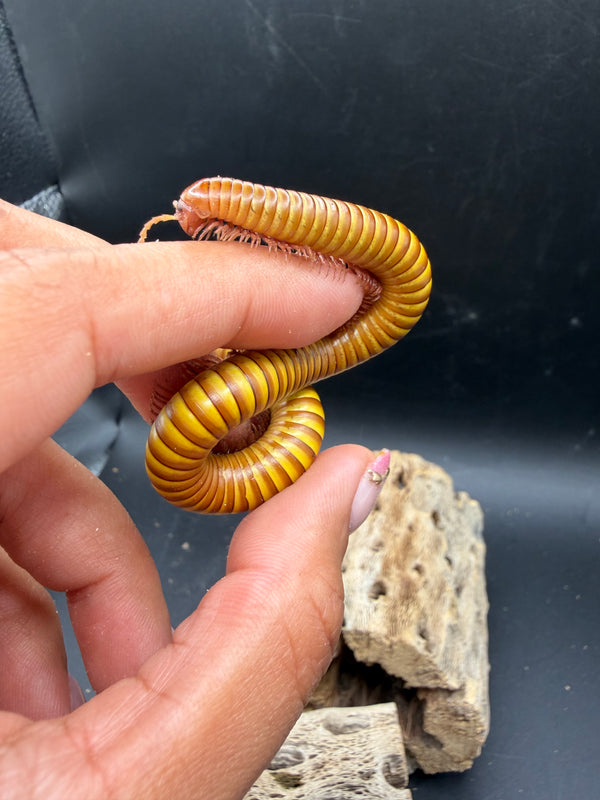
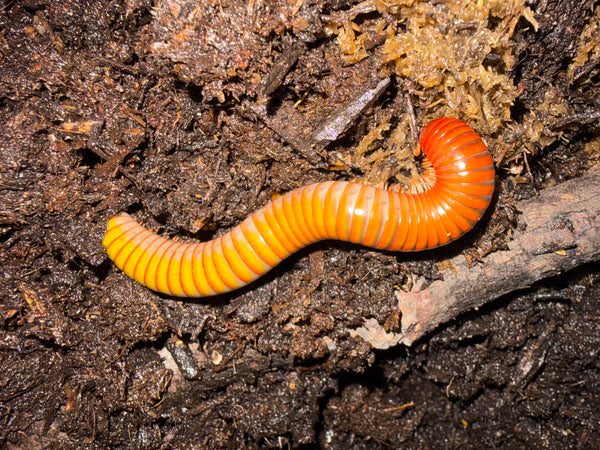
Texas Gold Millipede (Orthoporus ornatus)
Millipede

Central American Whipspider for sale from Big Z's (Phrynus maesi). Spice-rated keeper notes, care guidance, and live-arrival packing where eligible.
Six legs walking, two legs feeling, and no venom at all
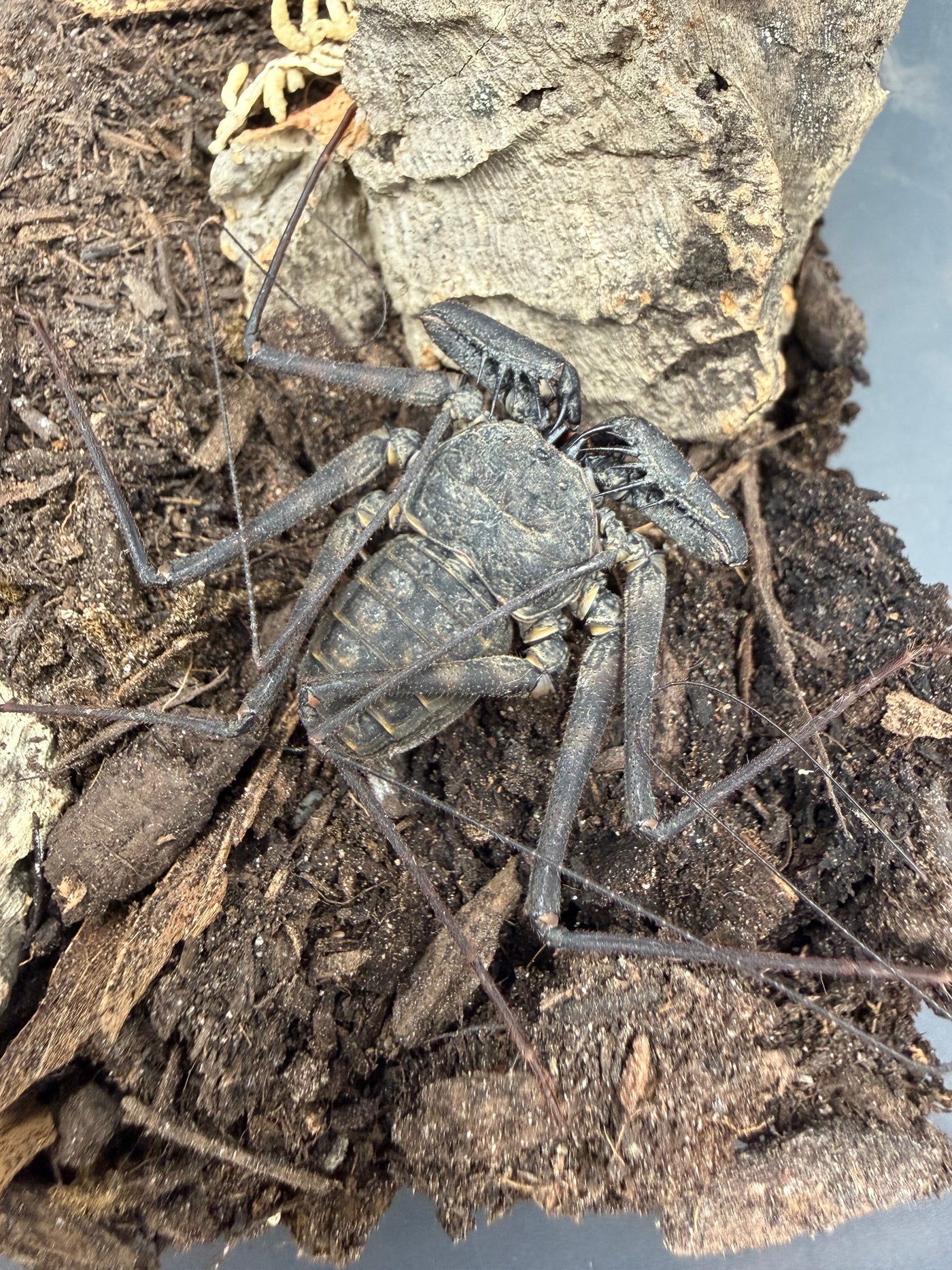
Phrynus maesi is a Central American amblypygid, a tailless whip spider that walks sideways on six legs while sweeping a pair of whip-thin antenniform front legs through the dark ahead of it. The spined raptorial pedipalps stay folded under the head until something brushes those feelers, then close on it in a fraction of a second. Flattened almost paper thin, it spends its life pressed into bark and rock crevices.
It looks like the most dangerous animal in the room and it is very nearly the safest. Amblypygids have no venom glands, spin no silk, and cannot deliver a bite of any consequence. What they are is fast and delicate, with legs that detach easily under stress, so this is an animal to watch rather than hold. Give it a tall enclosure with vertical cork to cling to, steady humidity, and small live prey. The Spice 3 reflects the setup and the fragility, not any danger to you. The care guide covers the vertical build.
The numbers live in the care guide. Enclosure size, temps, humidity, feeding schedule, premolt signs, handling boundaries: it's all in the care guide for this exact fella. Start with the full Advanced guide, or click for the quick Open the Simple version →
Arachnid
Central American Whipspider (Phrynus maesi) care guide Read shipping & LAG
Central American Whipspider for sale from Big Z's (Phrynus maesi). Spice-rated keeper notes, care guidance, and live-arrival packing where eligible.
Six legs walking, two legs feeling, and no venom at all
Phrynus maesi is a Central American amblypygid, a tailless whip spider that walks sideways on six legs while sweeping a pair of whip-thin antenniform front legs through the dark ahead of it. The spined raptorial pedipalps stay folded under the head until something brushes those feelers, then close on it in a fraction of a second. Flattened almost paper thin, it spends its life pressed into bark and rock crevices.
It looks like the most dangerous animal in the room and it is very nearly the safest. Amblypygids have no venom glands, spin no silk, and cannot deliver a bite of any consequence. What they are is fast and delicate, with legs that detach easily under stress, so this is an animal to watch rather than hold. Give it a tall enclosure with vertical cork to cling to, steady humidity, and small live prey. The Spice 3 reflects the setup and the fragility, not any danger to you. The care guide covers the vertical build.
The numbers live in the care guide. Enclosure size, temps, humidity, feeding schedule, premolt signs, handling boundaries: it's all in the care guide for this exact fella. Start with the full Advanced guide, or click for the quick Open the Simple version →
Phrynus maesi - Spice 3: Intermediate. Bark Buddy only if it provides secure climbing anchors and adequate unobstructed molt space; use a larger custom vertical enclosure when needed.
Phrynus maesi
Big Z's Quick Verdict: Prioritize secure climbing surfaces and open space beneath them for molting. Keep a lightly damp base with ventilation, offer small manageable prey, and use container transfers. Big Z's recommends separate housing.
| Temp | Keep the enclosure in steady indoor conditions and measure near the occupied cork. No reliable species-specific care range has been established for P. maesi; avoid direct sun and unregulated heat rather than borrowing a precise range from another whip spider. |
|---|---|
| Humidity | No fixed humidity % target. Maintain lightly damp substrate and ventilation. Lightly wet an accessible wall or cork surface to provide drinking droplets, then let exposed surfaces dry between applications; do not soak the animal or seal the enclosure. |
| Setup | Vertical and overhead cork with clear hanging-molt space, damp substrate and ventilation |
| Substrate | Use moisture-holding soil or coir as a damp base beneath securely anchored cork. The priority is usable vertical and overhead grip with unobstructed hanging room; a substrate-depth number alone cannot provide a complete setup. |
| Feeding | Offer small crickets or roaches that the animal can grasp and eat comfortably. Scale portions to its body and feeding response. Remove refused prey promptly and pause feeding during a molt and while the new body is still soft. |
| Handling | Catch-cup transfers only. Coax the animal into a container without grabbing its legs or pedipalps; support the cork securely if moving it with the animal. |
Humidity zones: Very Low under 30% - Low 30-60% - Low-Moderate 40-70% - Moderate 60-80% - Moderate-High 70-85% - High 80%+ - Very High 90%+
Current Big Z's catalog: Yes
Phrynus maesi
Keeper Snapshot: Prioritize secure climbing surfaces and open space beneath them for molting. Keep a lightly damp base with ventilation, offer small manageable prey, and use container transfers. Big Z's recommends separate housing.
| Temperature | Keep the enclosure in steady indoor conditions and measure near the occupied cork. No reliable species-specific care range has been established for P. maesi; avoid direct sun and unregulated heat rather than borrowing a precise range from another whip spider. |
|---|---|
| Humidity | No fixed humidity % target. Maintain lightly damp substrate and ventilation. Lightly wet an accessible wall or cork surface to provide drinking droplets, then let exposed surfaces dry between applications; do not soak the animal or seal the enclosure. |
| Setup Type | Vertical and overhead cork with clear hanging-molt space, damp substrate and ventilation |
| Substrate | Use moisture-holding soil or coir as a damp base beneath securely anchored cork. The priority is usable vertical and overhead grip with unobstructed hanging room; a substrate-depth number alone cannot provide a complete setup. |
| Feeding | Offer small crickets or roaches that the animal can grasp and eat comfortably. Scale portions to its body and feeding response. Remove refused prey promptly and pause feeding during a molt and while the new body is still soft. |
| Care Difficulty | Spice 3: Intermediate |
| Handling | Catch-cup transfers only. Coax the animal into a container without grabbing its legs or pedipalps; support the cork securely if moving it with the animal. |
Humidity zones: Very Low under 30% - Low 30-60% - Low-Moderate 40-70% - Moderate 60-80% - Moderate-High 70-85% - High 80%+ - Very High 90%+

Millipede

Scorpion

Tarantula

Spider

Millipede

Tarantula

Millipede

Scorpion