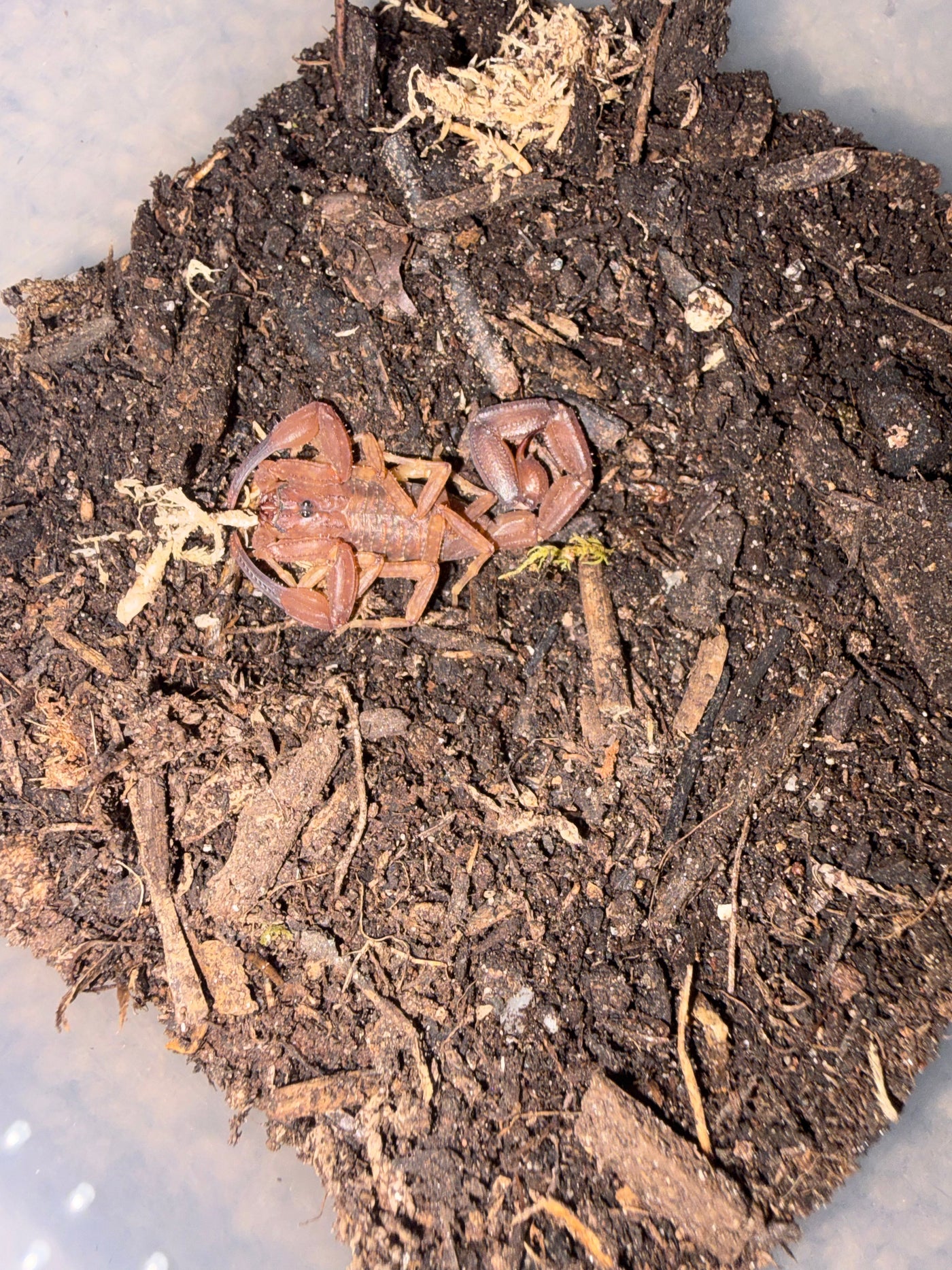
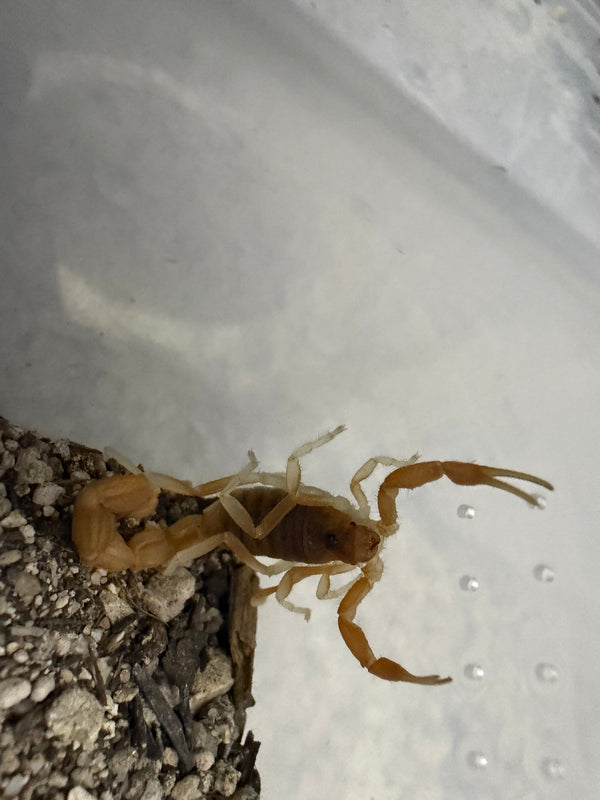
Arizona Bark Scorpion (Centruroides sculpturatus)
Scorpion

Magnificent Thick-tailed Scorpion for sale from Big Z's (Androcottus magnimanus). Spice-rated keeper notes, care guidance, and live-arrival packing where eligible.
It is under an inch long and the rule is still no hand contact.
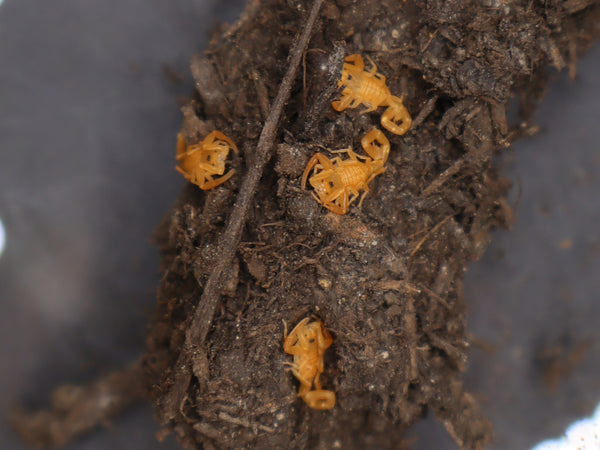
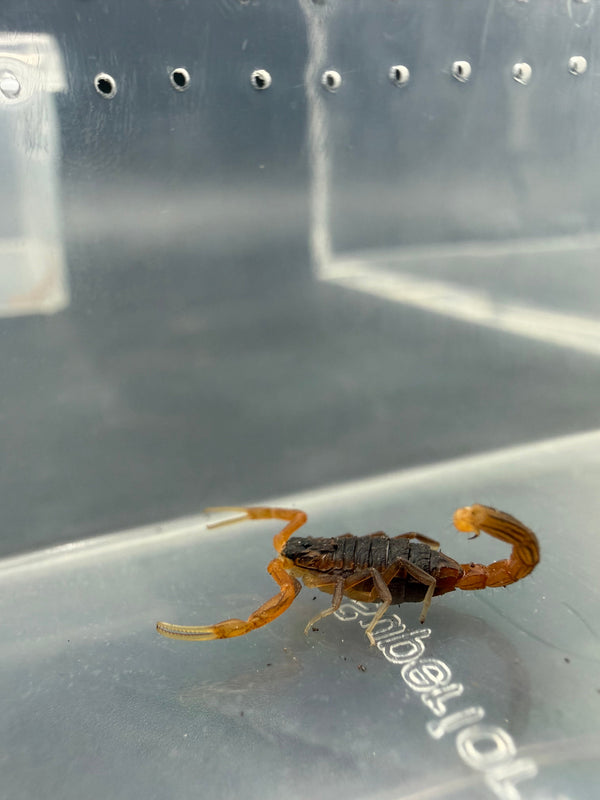
Androcottus magnimanus is a captive-bred Venezuelan buthid, and it still circulates in the hobby under the legacy name Tityus magnimanus, so if that is the name you searched, this is the same scorpion. These arrived at 0.5 to 0.75 inches, scorplings and small juveniles, and the exact instar is unknown.
Keep it on moisture-retentive substrate, moist but never saturated, with cork for cover and ventilation that actually moves air. Individual housing, always. The Baby Buddy habitat is the right fit at this size.
Spice Level 5: Extreme. No hand contact, at any size. Big Z's works every buthid the same conservative way, long tools, a staged catch cup, and secondary containment. Read the Big Z's care guide before it arrives.
The numbers live in the care guide. Enclosure size, temps, humidity, feeding schedule, premolt signs, handling boundaries: it's all in the care guide for this exact fella. Start with the full Advanced guide, or click for the quick Open the Simple version →
Scorpion
Magnificent Thick-tailed Scorpion (Androcottus magnimanus) care guide Read shipping & LAG
Magnificent Thick-tailed Scorpion for sale from Big Z's (Androcottus magnimanus). Spice-rated keeper notes, care guidance, and live-arrival packing where eligible.
It is under an inch long and the rule is still no hand contact.
Androcottus magnimanus is a captive-bred Venezuelan buthid, and it still circulates in the hobby under the legacy name Tityus magnimanus, so if that is the name you searched, this is the same scorpion. These arrived at 0.5 to 0.75 inches, scorplings and small juveniles, and the exact instar is unknown.
Keep it on moisture-retentive substrate, moist but never saturated, with cork for cover and ventilation that actually moves air. Individual housing, always. The Baby Buddy habitat is the right fit at this size.
Spice Level 5: Extreme. No hand contact, at any size. Big Z's works every buthid the same conservative way, long tools, a staged catch cup, and secondary containment. Read the Big Z's care guide before it arrives.
The numbers live in the care guide. Enclosure size, temps, humidity, feeding schedule, premolt signs, handling boundaries: it's all in the care guide for this exact fella. Start with the full Advanced guide, or click for the quick Open the Simple version →
Androcottus magnimanus - Spice 5: Extreme. Baby Buddy: suitable for the current 0.25-0.5 in and 0.5-0.75 in lots when vents are escape-proof and the build retains a moist lower zone, less-wet surface, cork cover, and safe water delivery; Bark Buddy: use as the animal grows, retaining moisture-retentive substrate, cork cover, functional cross-ventilation, and a staged catch-cup service plan; Adult secure terrestrial build: scale from the measured animal, provide moist substrate and cover, open water, effective ventilation, and secondary containment; no published universal minimum was found
Androcottus magnimanus
Identity confidence: provisional. This is a genus, group, or trade name rather than a confirmed species. Treat it as the closest match we can stand behind, and use the more conservative end of any range.
Big Z's Quick Verdict: Current taxonomy places the Venezuelan trade scorpion long sold as Tityus magnimanus in Androcottus: Androcottus magnimanus (Pocock, 1897), comb. nov. The store has two separate size lots, 0.25-0.5 in and 0.5-0.75 in as supplied, represented in the shared upstream vendor channel as captive bred; neither size establishes an instar. Published successful captive conditions used 22-30 C with moistened lignocel and bark cover, or approximately 70-80% RH with moist soil and cork. Treat those as documented conditions, not an optimum: keep a moisture gradient, functional ventilation and no standing wet substrate. House individually and never handle. Species-specific clinical severity is not established, so Spice 5 is a conservative buthid containment lane. - Big Z
| Temp | Published captive reports maintained this taxon within 22-30 C (72-86 F); a separate adult study used about 26.6-29 C by day and 23.8-25 C by night. These are successful study conditions, not a tested optimum. Big Z uses stable ordinary warm-room conditions within that envelope, with a gradient and no direct unregulated heat. |
|---|---|
| Humidity | Published captive reports used moistened lignocel, or approximately 70-80% RH with moist soil. Treat these as documented methods, not a proven threshold. Maintain a damp lower layer or reliably moist retreat with a less-wet surface, functional cross-ventilation, and no saturation or standing water. |
| Setup | Secure Venezuelan terrestrial buthid setup: moist but not saturated moisture-retentive substrate, cork or bark cover, functional cross-ventilation, open water when safely sized, and individual housing. |
| Substrate | Use moisture-retentive soil/coir or a stable equivalent, kept moist but not saturated, with cork or bark cover. One published adult study used about 50 mm of moist soil; another used moistened lignocel. Exact mix and depth are Big Z construction choices scaled to the animal. |
| Feeding | Published animals accepted suitably sized crickets, but no validated scorpling cadence was found. For the current small lots, offer very small soft-bodied or pre-killed prey at a cautious recorded house cadence, remove leftovers promptly, and stop live prey around molt. Adjust from intake and body condition. |
| Handling | Never. No hand contact. Use long tools, a staged catch cup, and secondary containment for every opening or transfer. |
Humidity zones: Very Low under 30% - Low 30-60% - Low-Moderate 40-70% - Moderate 60-80% - Moderate-High 70-85% - High 80%+ - Very High 90%+
Current Big Z's catalog: Yes
Androcottus magnimanus
Identity confidence: provisional. This is a genus, group, or trade name rather than a confirmed species. Treat it as the closest match we can stand behind, and use the more conservative end of any range.
Keeper Snapshot: Current taxonomy places the Venezuelan trade scorpion long sold as Tityus magnimanus in Androcottus: Androcottus magnimanus (Pocock, 1897), comb. nov. The store has two separate size lots, 0.25-0.5 in and 0.5-0.75 in as supplied, represented in the shared upstream vendor channel as captive bred; neither size establishes an instar. Published successful captive conditions used 22-30 C with moistened lignocel and bark cover, or approximately 70-80% RH with moist soil and cork. Treat those as documented conditions, not an optimum: keep a moisture gradient, functional ventilation and no standing wet substrate. House individually and never handle. Species-specific clinical severity is not established, so Spice 5 is a conservative buthid containment lane. - Big Z
| Temperature | Published captive reports maintained this taxon within 22-30 C (72-86 F); a separate adult study used about 26.6-29 C by day and 23.8-25 C by night. These are successful study conditions, not a tested optimum. Big Z uses stable ordinary warm-room conditions within that envelope, with a gradient and no direct unregulated heat. |
|---|---|
| Humidity | Published captive reports used moistened lignocel, or approximately 70-80% RH with moist soil. Treat these as documented methods, not a proven threshold. Maintain a damp lower layer or reliably moist retreat with a less-wet surface, functional cross-ventilation, and no saturation or standing water. |
| Setup Type | Secure Venezuelan terrestrial buthid setup: moist but not saturated moisture-retentive substrate, cork or bark cover, functional cross-ventilation, open water when safely sized, and individual housing. |
| Substrate | Use moisture-retentive soil/coir or a stable equivalent, kept moist but not saturated, with cork or bark cover. One published adult study used about 50 mm of moist soil; another used moistened lignocel. Exact mix and depth are Big Z construction choices scaled to the animal. |
| Feeding | Published animals accepted suitably sized crickets, but no validated scorpling cadence was found. For the current small lots, offer very small soft-bodied or pre-killed prey at a cautious recorded house cadence, remove leftovers promptly, and stop live prey around molt. Adjust from intake and body condition. |
| Care Difficulty | Spice 5: Extreme |
| Handling | Never. No hand contact. Use long tools, a staged catch cup, and secondary containment for every opening or transfer. |
Humidity zones: Very Low under 30% - Low 30-60% - Low-Moderate 40-70% - Moderate 60-80% - Moderate-High 70-85% - High 80%+ - Very High 90%+

Scorpion

Tarantula

Tarantula

Tarantula

Tarantula

Tarantula

Scorpion

Scorpion