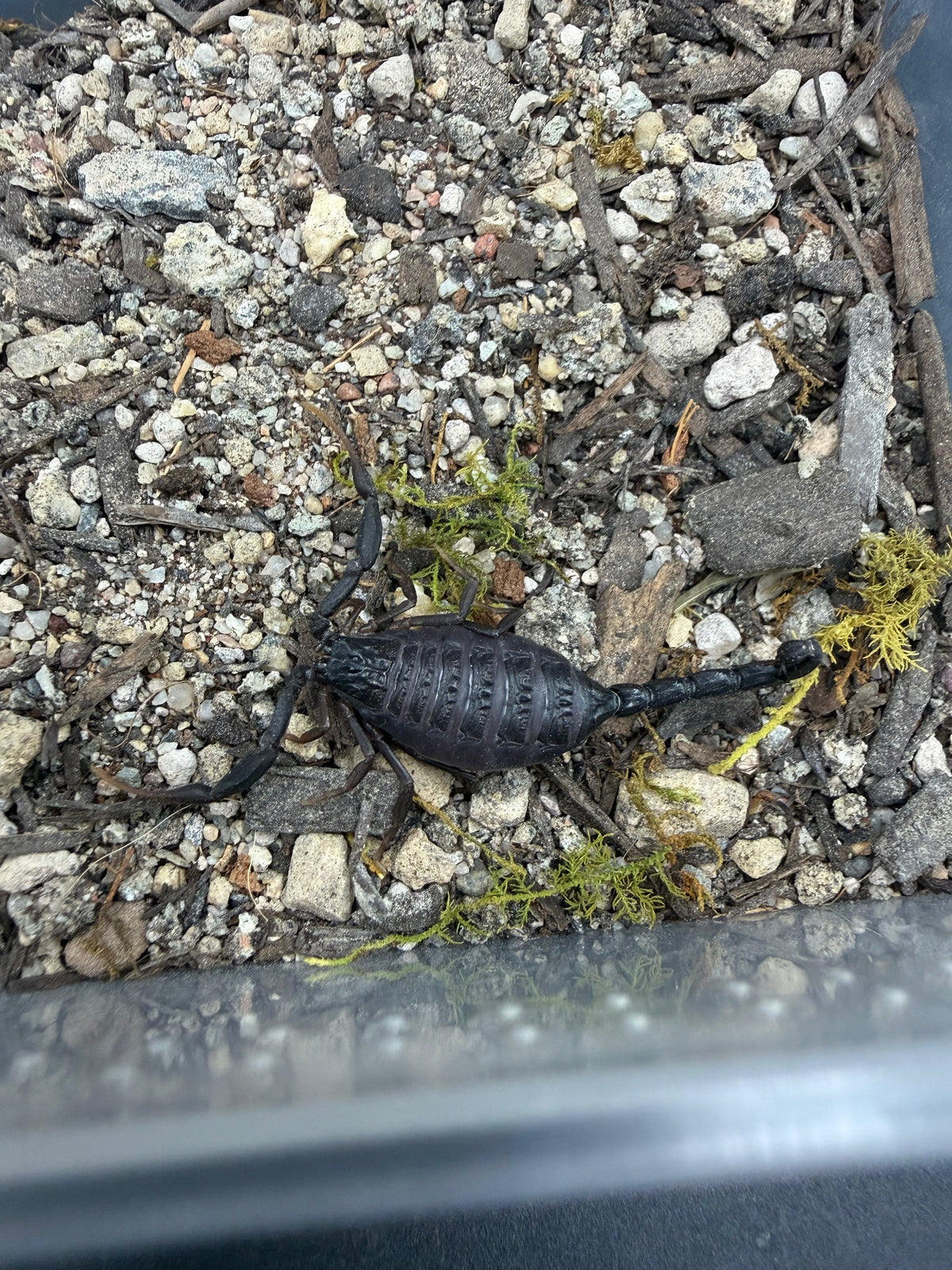
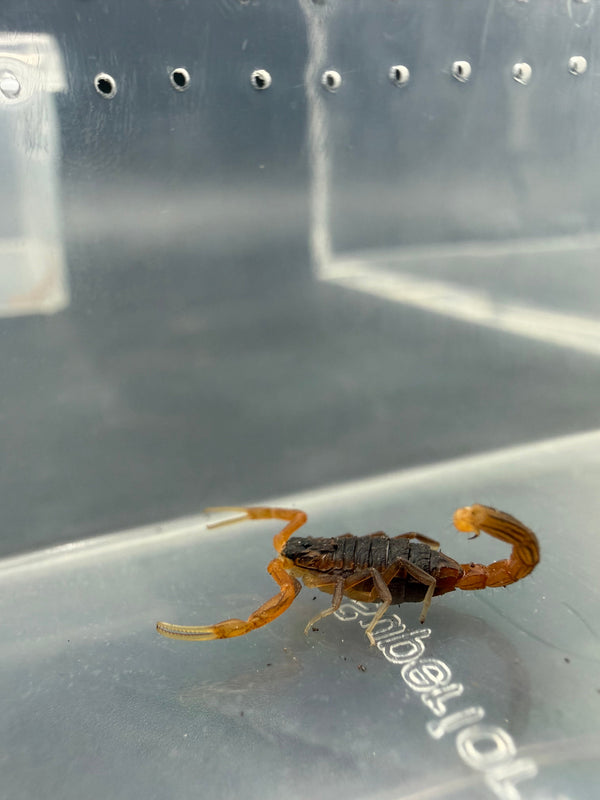
Arizona Bark Scorpion (Centruroides sculpturatus)
Scorpion

Central Morocco Scorpion for sale from Big Z's (Hottentotta gentili). Spice-rated keeper notes, care guidance, and live-arrival packing where eligible.
North African, well started, and the reason the tools stay long.
Hottentotta gentili is a large Moroccan buthid recorded from rocky country across the Anti-Atlas, the High Atlas and the Souss-Draa, where it uses cracks and cover rather than digging much of its own. It sells under the Central Morocco label, which is a trade name rather than a collection locality. Big Z's has no verified collection point for these animals and will not invent one. These arrived at 0.75 to 1 inch, small juveniles, exact instar unknown.
This is a medically significant scorpion and Big Z's is not going to soften that. The published review places it in the serious sting class and attributes fatalities to it. There is no hand contact with this animal at any size: long tools, a staged catch cup, a latched enclosure, and a suspected sting means professional care immediately, not wait and see. The setup itself is deliberately plain, which is the point when you are working at arm's length. Flat rock or cork crevices to sit in, a dry exposed surface, one sheltered damp refuge, real ventilation, and a warm gradient. Spice Level 5: Extreme. Read the matched Big Z's care guide before it ships.
The numbers live in the care guide. Enclosure size, temps, humidity, feeding schedule, premolt signs, handling boundaries: it's all in the care guide for this exact fella. Start with the full Advanced guide, or click for the quick Open the Simple version →
Scorpion
Central Morocco Scorpion (Hottentotta gentili) care guide Read shipping & LAG
Central Morocco Scorpion for sale from Big Z's (Hottentotta gentili). Spice-rated keeper notes, care guidance, and live-arrival packing where eligible.
North African, well started, and the reason the tools stay long.
Hottentotta gentili is a large Moroccan buthid recorded from rocky country across the Anti-Atlas, the High Atlas and the Souss-Draa, where it uses cracks and cover rather than digging much of its own. It sells under the Central Morocco label, which is a trade name rather than a collection locality. Big Z's has no verified collection point for these animals and will not invent one. These arrived at 0.75 to 1 inch, small juveniles, exact instar unknown.
This is a medically significant scorpion and Big Z's is not going to soften that. The published review places it in the serious sting class and attributes fatalities to it. There is no hand contact with this animal at any size: long tools, a staged catch cup, a latched enclosure, and a suspected sting means professional care immediately, not wait and see. The setup itself is deliberately plain, which is the point when you are working at arm's length. Flat rock or cork crevices to sit in, a dry exposed surface, one sheltered damp refuge, real ventilation, and a warm gradient. Spice Level 5: Extreme. Read the matched Big Z's care guide before it ships.
The numbers live in the care guide. Enclosure size, temps, humidity, feeding schedule, premolt signs, handling boundaries: it's all in the care guide for this exact fella. Start with the full Advanced guide, or click for the quick Open the Simple version →
Hottentotta gentili - Spice 5: Extreme. Baby Buddy: suitable for the 0.75-1 in small juveniles in this batch; exact instar unknown; house one per enclosure and keep every vent opening smaller than the metasoma.; Burrow Buddy: for larger juveniles and adults, but fit it with flat rock and cork crevices rather than treating it as a burrowing setup - this animal does not dig; Whatever the size, keep the layout deliberately bare. On a medically significant buthid you never want to open a lid without knowing exactly where the animal is
Hottentotta gentili
Big Z's Quick Verdict: A large North African buthid with a proportionately serious exposure boundary. El Hidan et al. measured 0.46 mg/kg by subcutaneous injection in mice; Ward et al. (2018) assigned sting class III and cited at least ten fatalities, while a 1994-98 regional paper attributed a disproportionate share of deaths to the then-named taxon without individual molecular confirmation. No hand contact: stage a catch cup, use long tools, and treat any suspected sting as an emergency requiring professional care. Husbandry numbers come chiefly from one keeper, so build around dry exposed substrate, a sheltered damp refuge, secure rocky cover, water access, ventilation, and a warm gradient rather than treating exact figures as species optima. - Big Z
| Temp | No species captive optimum is established. One experienced keeper reported about 95 F (34 C) by day and 68 F (20 C) at night. A warm daytime gradient and ordinary night cooling are keeper-plus-regional context, not a proven 86-95/68-72 F species range. Avoid uncontrolled or under-floor heating. |
|---|---|
| Humidity | No numeric RH % target is established. Keep most substrate and the exposed surface dry while maintaining a reliable sheltered damp zone and water access appropriate to size; preserve ventilation and never saturate the enclosure. The exact weekly-quarter mist routine and one wet-molt loss are one keeper's observations. Primary regional work also records dry-area Maghreb Hottentotta in more humid microhabitats. |
| Setup | Warm dry Moroccan lithophilic setup: sand-heavy substrate, flat rock and cork crevices, no burrowing depth |
| Substrate | Use a stable, dry-biased, form-holding sand/soil blend with flat rock or cork crevices. One keeper used about three parts sand to one part coco; that ratio is a keeper recipe, not a species requirement. Rocky shelter and limited self-burrowing have species field support. Keep a sheltered portion able to hold a small moisture reserve without making the enclosure wet. |
| Feeding | One keeper reported twice-weekly feeding at second instar and weekly from third instar onward. Use that only as a keeper starting observation: offer appropriately sized prey, record individual intake and body condition, remove leftovers promptly, and remove live prey during molt. The 19-25 mm supplier size does not establish this batch's instar. |
| Handling | Never. Not once, not briefly, not for a photo. Catch cup, long tongs, secondary containment. |
Humidity zones: Very Low under 30% - Low 30-60% - Low-Moderate 40-70% - Moderate 60-80% - Moderate-High 70-85% - High 80%+ - Very High 90%+
Current Big Z's catalog: Yes
Hottentotta gentili
Keeper Snapshot: A large North African buthid with a proportionately serious exposure boundary. El Hidan et al. measured 0.46 mg/kg by subcutaneous injection in mice; Ward et al. (2018) assigned sting class III and cited at least ten fatalities, while a 1994-98 regional paper attributed a disproportionate share of deaths to the then-named taxon without individual molecular confirmation. No hand contact: stage a catch cup, use long tools, and treat any suspected sting as an emergency requiring professional care. Husbandry numbers come chiefly from one keeper, so build around dry exposed substrate, a sheltered damp refuge, secure rocky cover, water access, ventilation, and a warm gradient rather than treating exact figures as species optima. - Big Z
| Temperature | No species captive optimum is established. One experienced keeper reported about 95 F (34 C) by day and 68 F (20 C) at night. A warm daytime gradient and ordinary night cooling are keeper-plus-regional context, not a proven 86-95/68-72 F species range. Avoid uncontrolled or under-floor heating. |
|---|---|
| Humidity | No numeric RH % target is established. Keep most substrate and the exposed surface dry while maintaining a reliable sheltered damp zone and water access appropriate to size; preserve ventilation and never saturate the enclosure. The exact weekly-quarter mist routine and one wet-molt loss are one keeper's observations. Primary regional work also records dry-area Maghreb Hottentotta in more humid microhabitats. |
| Setup Type | Warm dry Moroccan lithophilic setup: sand-heavy substrate, flat rock and cork crevices, no burrowing depth |
| Substrate | Use a stable, dry-biased, form-holding sand/soil blend with flat rock or cork crevices. One keeper used about three parts sand to one part coco; that ratio is a keeper recipe, not a species requirement. Rocky shelter and limited self-burrowing have species field support. Keep a sheltered portion able to hold a small moisture reserve without making the enclosure wet. |
| Feeding | One keeper reported twice-weekly feeding at second instar and weekly from third instar onward. Use that only as a keeper starting observation: offer appropriately sized prey, record individual intake and body condition, remove leftovers promptly, and remove live prey during molt. The 19-25 mm supplier size does not establish this batch's instar. |
| Care Difficulty | Spice 5: Extreme |
| Handling | Never. Not once, not briefly, not for a photo. Catch cup, long tongs, secondary containment. |
Humidity zones: Very Low under 30% - Low 30-60% - Low-Moderate 40-70% - Moderate 60-80% - Moderate-High 70-85% - High 80%+ - Very High 90%+

Scorpion

Scorpion

Tarantula

Tarantula

Tarantula

Tarantula

Tarantula

Scorpion