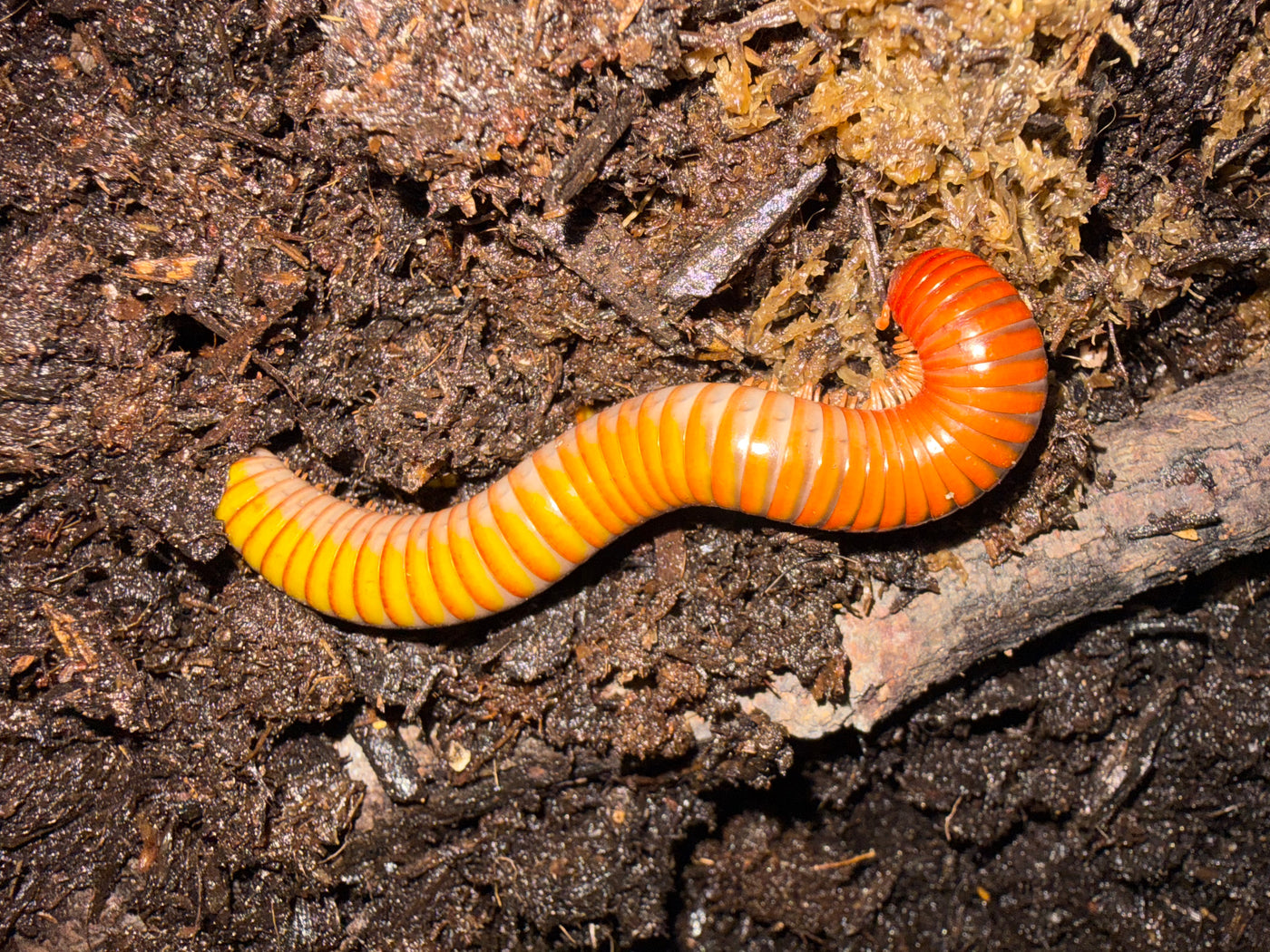
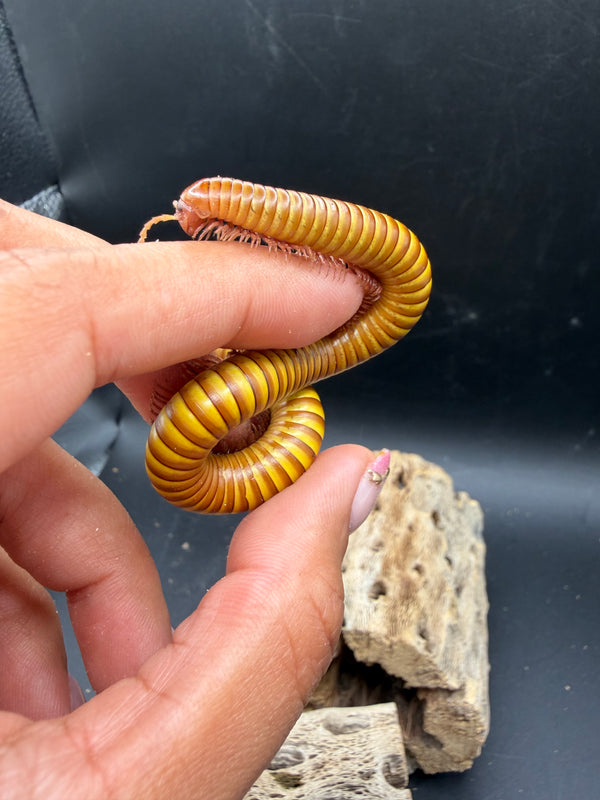
Texas Gold Millipede (Orthoporus ornatus)
Millipede

Ember Millipede for sale from Big Z's (Thyropygus sp.). Spice-rated keeper notes, care guidance, and live-arrival packing where eligible.
Half a foot of glowing ember-brown muscle that eats wood and never bites
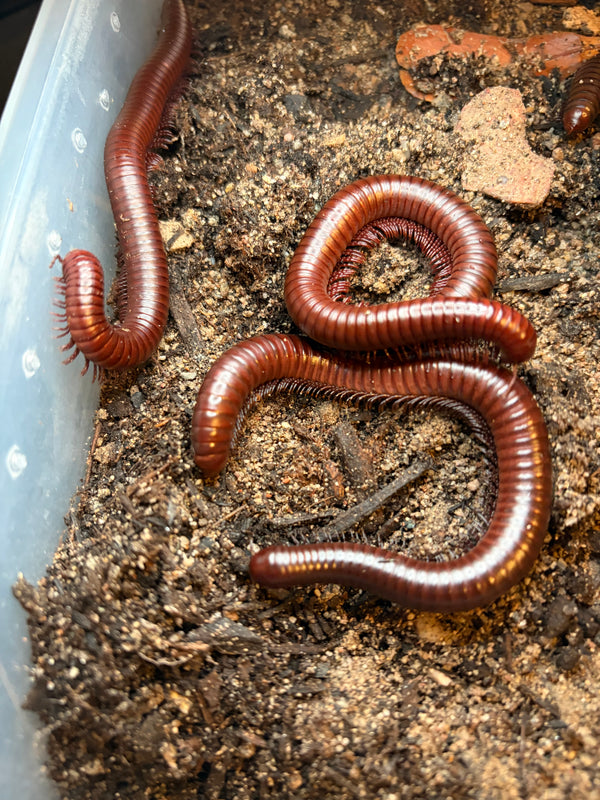
Thyropygus sp. "Ember", the Ember Millipede, is one of Southeast Asia's long cylindrical giants, wearing a warm reddish ember-brown that catches the light as it rolls. This is a field-collected Asian species, and we label it honestly: species-level ID in this genus is genuinely unsettled in the hobby, so we call it Thyropygus sp. rather than dress it up with an invented name. Adults stretch a solid 4 to 6 inches of segmented, slow-rolling armor.
Gentle, with no venom, no bite, and no sting, the Ember is a classic detritivore that doubles as living cleanup crew in a bioactive setup. Keep any handling gentle and brief. It's an intermediate keeper's animal (Spice 3): give it deep, moist leaf-litter substrate, plenty of decaying hardwood to burrow through and eat, and a calcium source like cuttlebone. It ships wild-caught, so quarantine on arrival and check for mites. Easygoing, handsome, and communal in a tropical setup: the care guide has your full build.
The numbers live in the care guide. Enclosure size, temps, humidity, feeding schedule, premolt signs, handling boundaries: it's all in the care guide for this exact fella. Start with the full Advanced guide, or click for the quick Open the Simple version →
Millipede
Ember Millipede (Thyropygus sp.) care guide Read shipping & LAG
Ember Millipede for sale from Big Z's (Thyropygus sp.). Spice-rated keeper notes, care guidance, and live-arrival packing where eligible.
Half a foot of glowing ember-brown muscle that eats wood and never bites
Thyropygus sp. "Ember", the Ember Millipede, is one of Southeast Asia's long cylindrical giants, wearing a warm reddish ember-brown that catches the light as it rolls. This is a field-collected Asian species, and we label it honestly: species-level ID in this genus is genuinely unsettled in the hobby, so we call it Thyropygus sp. rather than dress it up with an invented name. Adults stretch a solid 4 to 6 inches of segmented, slow-rolling armor.
Gentle, with no venom, no bite, and no sting, the Ember is a classic detritivore that doubles as living cleanup crew in a bioactive setup. Keep any handling gentle and brief. It's an intermediate keeper's animal (Spice 3): give it deep, moist leaf-litter substrate, plenty of decaying hardwood to burrow through and eat, and a calcium source like cuttlebone. It ships wild-caught, so quarantine on arrival and check for mites. Easygoing, handsome, and communal in a tropical setup: the care guide has your full build.
The numbers live in the care guide. Enclosure size, temps, humidity, feeding schedule, premolt signs, handling boundaries: it's all in the care guide for this exact fella. Start with the full Advanced guide, or click for the quick Open the Simple version →
Thyropygus sp. "Ember" - Spice 3: Intermediate. Baby Buddy or Burrow Buddy: conditional fit for small animals/groups, not a fixed stocking recommendation.; Deep custom enclosure: use when animal size, group size or food-substrate needs exceed a Buddy's usable dimensions.
Thyropygus sp. "Ember"
Identity confidence: provisional. This is a genus, group, or trade name rather than a confirmed species. Treat it as the closest match we can stand behind, and use the more conservative end of any range.
Big Z's Quick Verdict: Give Ember millipedes deep, edible substrate and a generous supply of decomposed leaves. Keep buried areas damp and avoid repeated disturbance. The species behind the Ember trade name is unconfirmed, so this is care adapted from other Thyropygus and humid-keeping millipedes.
| Temp | Keep the enclosure at stable indoor room temperature and check the temperature within the substrate. Do not add heat just because the animal is sold as tropical; a reliable range for the Ember form has not been established. |
|---|---|
| Humidity | No fixed humidity % target. Keep sheltered litter and the lower substrate damp, not dripping or waterlogged. Check below the surface before adding water, moisten a section at a time, and leave ventilation open. Avoid both a completely dried-out bed and standing water. |
| Setup | Deep, food-rich burrowing enclosure with a damp lower layer |
| Substrate | Use pesticide-free soil or humus containing plenty of decomposed hardwood leaves and very soft rotten hardwood. As a general millipede planning rule, provide substrate at least as deep as the longest animal is long, with extra depth where needed to retain a damp burrowing area. Coir alone is not a food supply. |
| Feeding | Keep decomposed leaves and soft rotten hardwood available continuously; replace them as they are eaten. Small portions of vegetables can supplement this base, not replace it. Remove spoiled or uneaten supplements before they foul the substrate. |
| Handling | Keep handling to a minimum. Support the animal over a soft surface for any necessary transfer; do not pull it from cover or force it to uncoil. Wash hands after contact or enclosure work. |
Humidity zones: Very Low under 30% - Low 30-60% - Low-Moderate 40-70% - Moderate 60-80% - Moderate-High 70-85% - High 80%+ - Very High 90%+
Current Big Z's catalog: Yes
Thyropygus sp. "Ember"
Identity confidence: provisional. This is a genus, group, or trade name rather than a confirmed species. Treat it as the closest match we can stand behind, and use the more conservative end of any range.
Keeper Snapshot: Give Ember millipedes deep, edible substrate and a generous supply of decomposed leaves. Keep buried areas damp and avoid repeated disturbance. The species behind the Ember trade name is unconfirmed, so this is care adapted from other Thyropygus and humid-keeping millipedes.
| Temperature | Keep the enclosure at stable indoor room temperature and check the temperature within the substrate. Do not add heat just because the animal is sold as tropical; a reliable range for the Ember form has not been established. |
|---|---|
| Humidity | No fixed humidity % target. Keep sheltered litter and the lower substrate damp, not dripping or waterlogged. Check below the surface before adding water, moisten a section at a time, and leave ventilation open. Avoid both a completely dried-out bed and standing water. |
| Setup Type | Deep, food-rich burrowing enclosure with a damp lower layer |
| Substrate | Use pesticide-free soil or humus containing plenty of decomposed hardwood leaves and very soft rotten hardwood. As a general millipede planning rule, provide substrate at least as deep as the longest animal is long, with extra depth where needed to retain a damp burrowing area. Coir alone is not a food supply. |
| Feeding | Keep decomposed leaves and soft rotten hardwood available continuously; replace them as they are eaten. Small portions of vegetables can supplement this base, not replace it. Remove spoiled or uneaten supplements before they foul the substrate. |
| Care Difficulty | Spice 3: Intermediate |
| Handling | Keep handling to a minimum. Support the animal over a soft surface for any necessary transfer; do not pull it from cover or force it to uncoil. Wash hands after contact or enclosure work. |
Humidity zones: Very Low under 30% - Low 30-60% - Low-Moderate 40-70% - Moderate 60-80% - Moderate-High 70-85% - High 80%+ - Very High 90%+

Millipede

Scorpion

Tarantula

Spider

Millipede

Tarantula

Arachnid

Scorpion