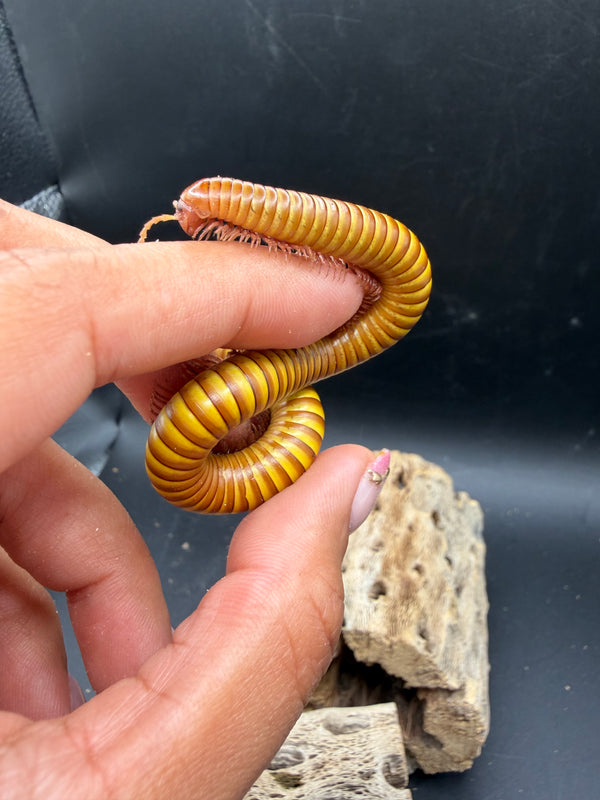
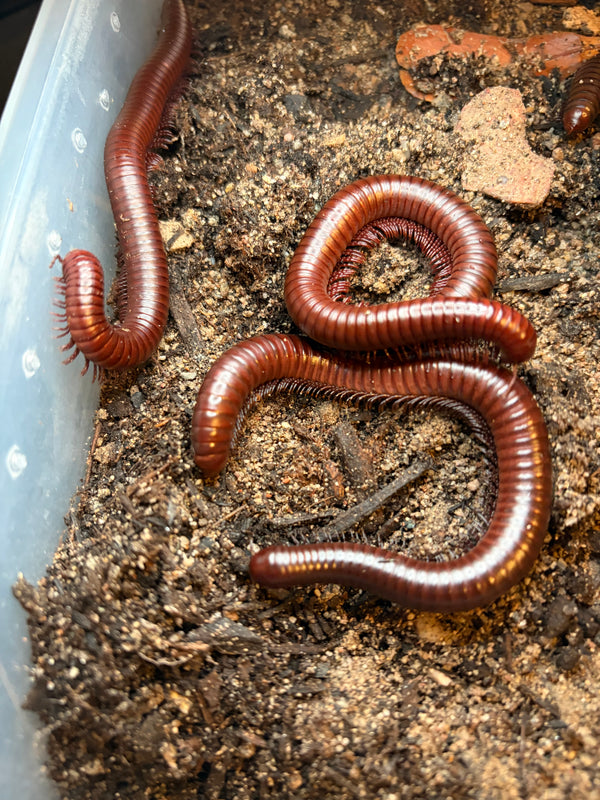
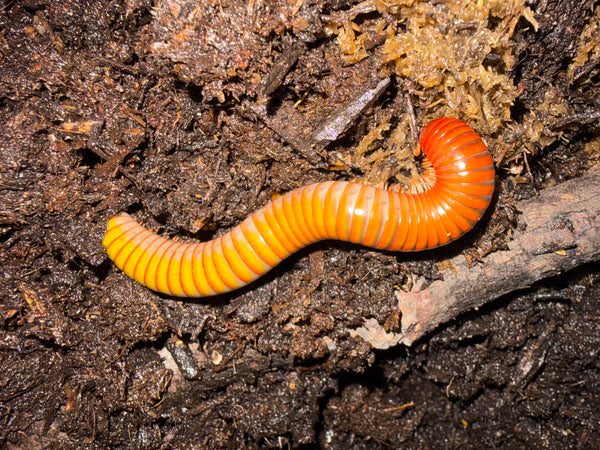
Texas Gold Millipede (Orthoporus ornatus)
Millipede

Golden Blue Leg Baboon Tarantula for sale from Big Z's (Harpactira pulchripes). Spice-rated keeper notes, care guidance, and live-arrival packing where eligible.
Electric blue legs on a golden body, and the most even-tempered baboon in the hobby.
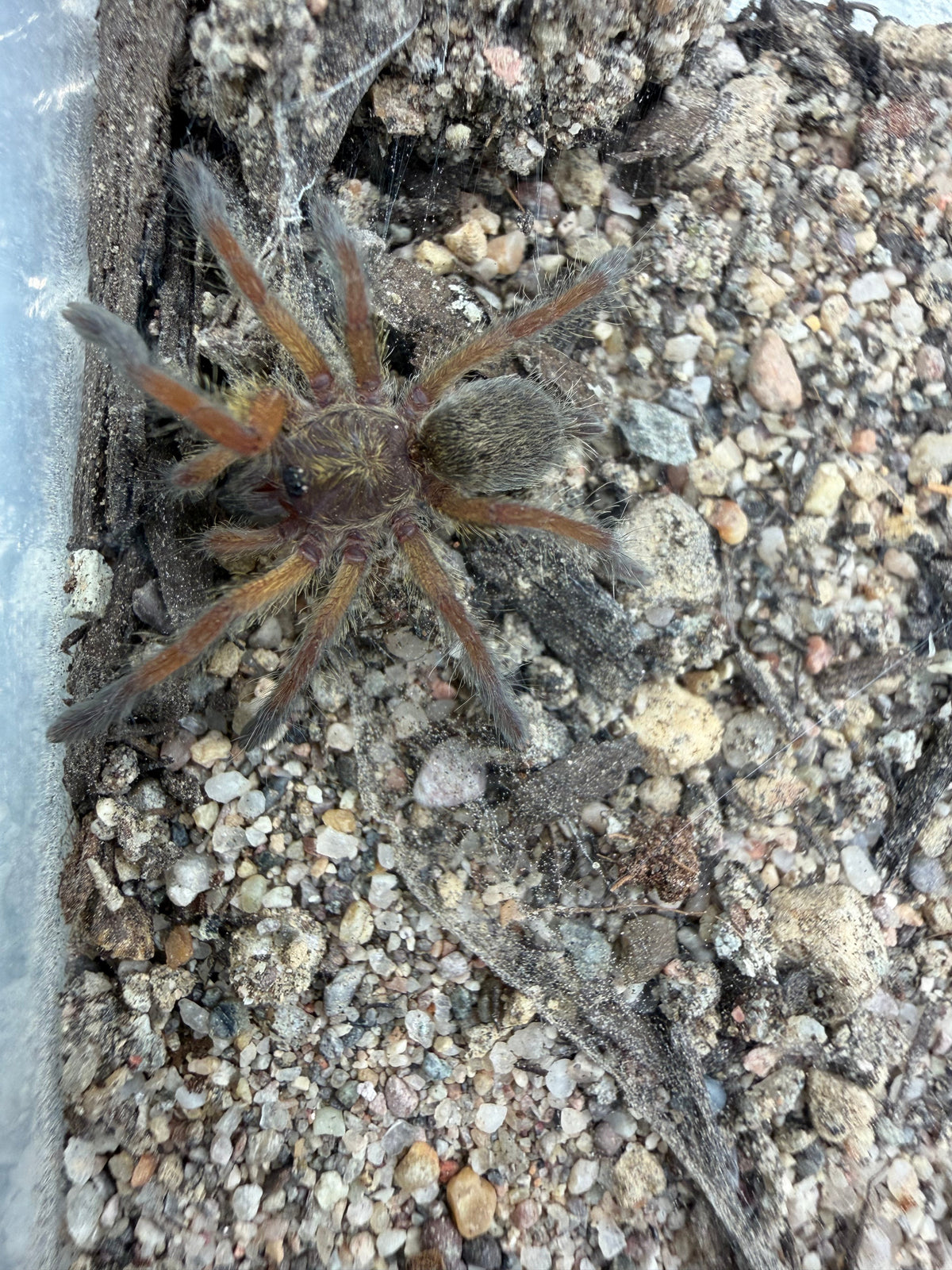
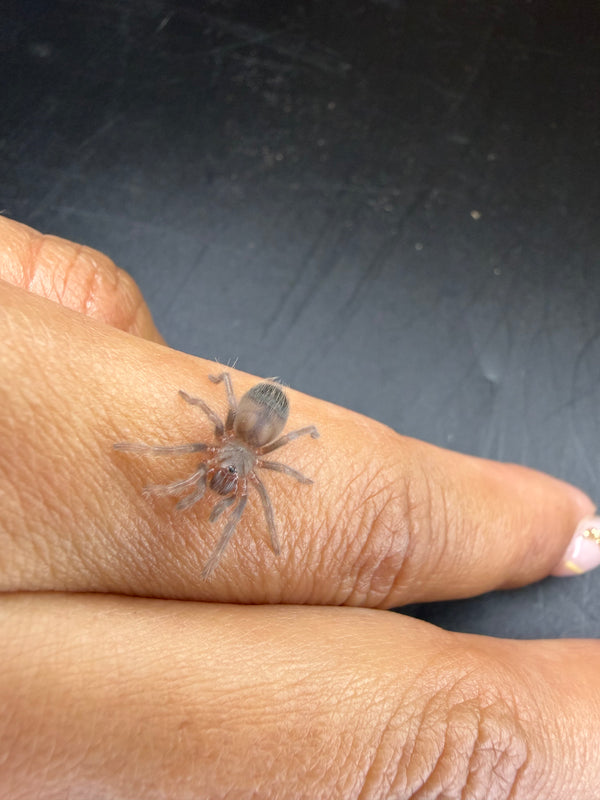
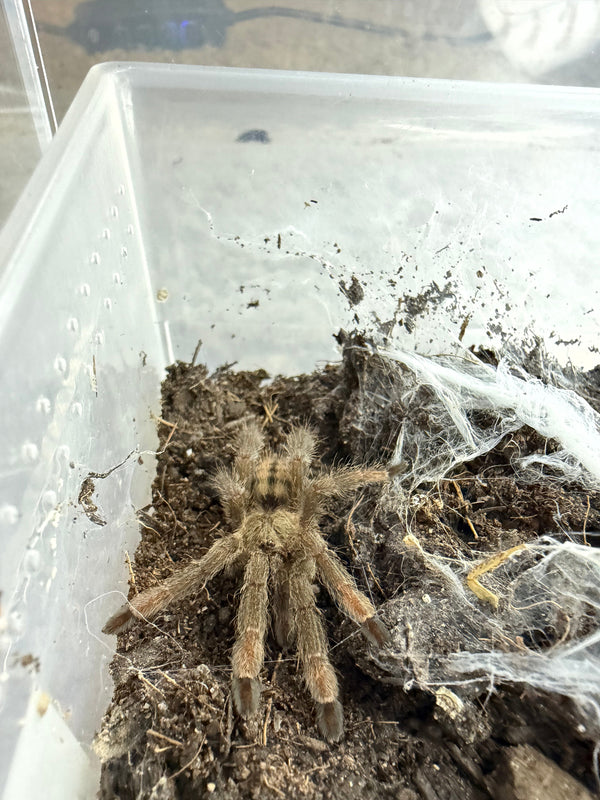
Harpactira pulchripes, the Golden Blue Leg Baboon, comes from the Eastern Cape of South Africa and is the species that broke the rule that Old World means drab. Adults carry a warm golden-fawn carapace and abdomen over metallic blue legs, a combination nothing else in the trade matches. At 0.5 to 0.75 inches these are early slings, and the blue arrives gradually over the next several molts. Grown spiders reach roughly 4 to 5 inches across.
Among Old World baboons this one has the reputation for being the calmest, but calm is relative: it is still faster and more defensive than any New World species, and it is a no-handling animal. Keep it dry and terrestrial with substrate deep enough to burrow, a hide, and a water dish, and let it web its entrance the way it wants to. Spice Level 3: Intermediate, and a genuinely good first Old World for a keeper with a couple of molt cycles behind them. The matched Big Z's care guide has the full dry burrow build.
The numbers live in the care guide. Enclosure size, temps, humidity, feeding schedule, premolt signs, handling boundaries: it's all in the care guide for this exact fella. Start with the full Advanced guide, or click for the quick Open the Simple version →
Tarantula
Golden Blue Leg Baboon Tarantula (Harpactira pulchripes) care guide Read shipping & LAG
Golden Blue Leg Baboon Tarantula for sale from Big Z's (Harpactira pulchripes). Spice-rated keeper notes, care guidance, and live-arrival packing where eligible.
Electric blue legs on a golden body, and the most even-tempered baboon in the hobby.
Harpactira pulchripes, the Golden Blue Leg Baboon, comes from the Eastern Cape of South Africa and is the species that broke the rule that Old World means drab. Adults carry a warm golden-fawn carapace and abdomen over metallic blue legs, a combination nothing else in the trade matches. At 0.5 to 0.75 inches these are early slings, and the blue arrives gradually over the next several molts. Grown spiders reach roughly 4 to 5 inches across.
Among Old World baboons this one has the reputation for being the calmest, but calm is relative: it is still faster and more defensive than any New World species, and it is a no-handling animal. Keep it dry and terrestrial with substrate deep enough to burrow, a hide, and a water dish, and let it web its entrance the way it wants to. Spice Level 3: Intermediate, and a genuinely good first Old World for a keeper with a couple of molt cycles behind them. The matched Big Z's care guide has the full dry burrow build.
The numbers live in the care guide. Enclosure size, temps, humidity, feeding schedule, premolt signs, handling boundaries: it's all in the care guide for this exact fella. Start with the full Advanced guide, or click for the quick Open the Simple version →
Harpactira spp. - Spice 3: Intermediate. Baby Buddy: spiderlings only (escape-proof ventilation; rehouse up before it's cramped); Burrow Buddy: grow-out for juveniles, and a forever home for the smaller Harpactira; Larger custom dry terrestrial/burrow enclosure for adults of the bigger species (e.g. H. pulchripes)
Harpactira spp.
Identity confidence: provisional. This is a genus, group, or trade name rather than a confirmed species. Treat it as the closest match we can stand behind, and use the more conservative end of any range.
Big Z's Quick Verdict: The South African baboons: most famously H. pulchripes, the golden-bodied, blue-legged 'calmest of the baboons'. Faster and more defensive than any New World species, but among the easier and more even-tempered Old Worlds. Adults reach about 4-5 inches across.
| Temp | 72-82°F |
|---|---|
| Humidity | Low ambient (35-50%), ventilated at substrate level; dry substrate, occasional damp corner, water dish |
| Setup | Terrestrial / fossorial (dry) |
| Substrate | Dry soil/coco mix with a starter burrow; occasional moist corner |
| Feeding | Strong feeder: slings weekly, adults every 1-2 weeks |
| Handling | NEVER |
Humidity zones: Very Low under 30% - Low 30-60% - Low-Moderate 40-70% - Moderate 60-80% - Moderate-High 70-85% - High 80%+ - Very High 90%+
Current Big Z's catalog: No
Harpactira spp.
Identity confidence: provisional. This is a genus, group, or trade name rather than a confirmed species. Treat it as the closest match we can stand behind, and use the more conservative end of any range.
Keeper Snapshot: The South African baboons: most famously H. pulchripes, the golden-bodied, blue-legged 'calmest of the baboons'. Faster and more defensive than any New World species, but among the easier and more even-tempered Old Worlds. Adults reach about 4-5 inches across.
| Temperature | 72-82°F |
|---|---|
| Humidity | Low ambient (35-50%), ventilated at substrate level; dry substrate, occasional damp corner, water dish |
| Setup Type | Terrestrial / fossorial (dry) |
| Substrate | Dry soil/coco mix with a starter burrow; occasional moist corner |
| Feeding | Strong feeder: slings weekly, adults every 1-2 weeks |
| Care Difficulty | Spice 3: Intermediate |
| Handling | NEVER |
Humidity zones: Very Low under 30% - Low 30-60% - Low-Moderate 40-70% - Moderate 60-80% - Moderate-High 70-85% - High 80%+ - Very High 90%+

Millipede

Scorpion

Tarantula

Spider

Millipede

Tarantula

Arachnid

Millipede