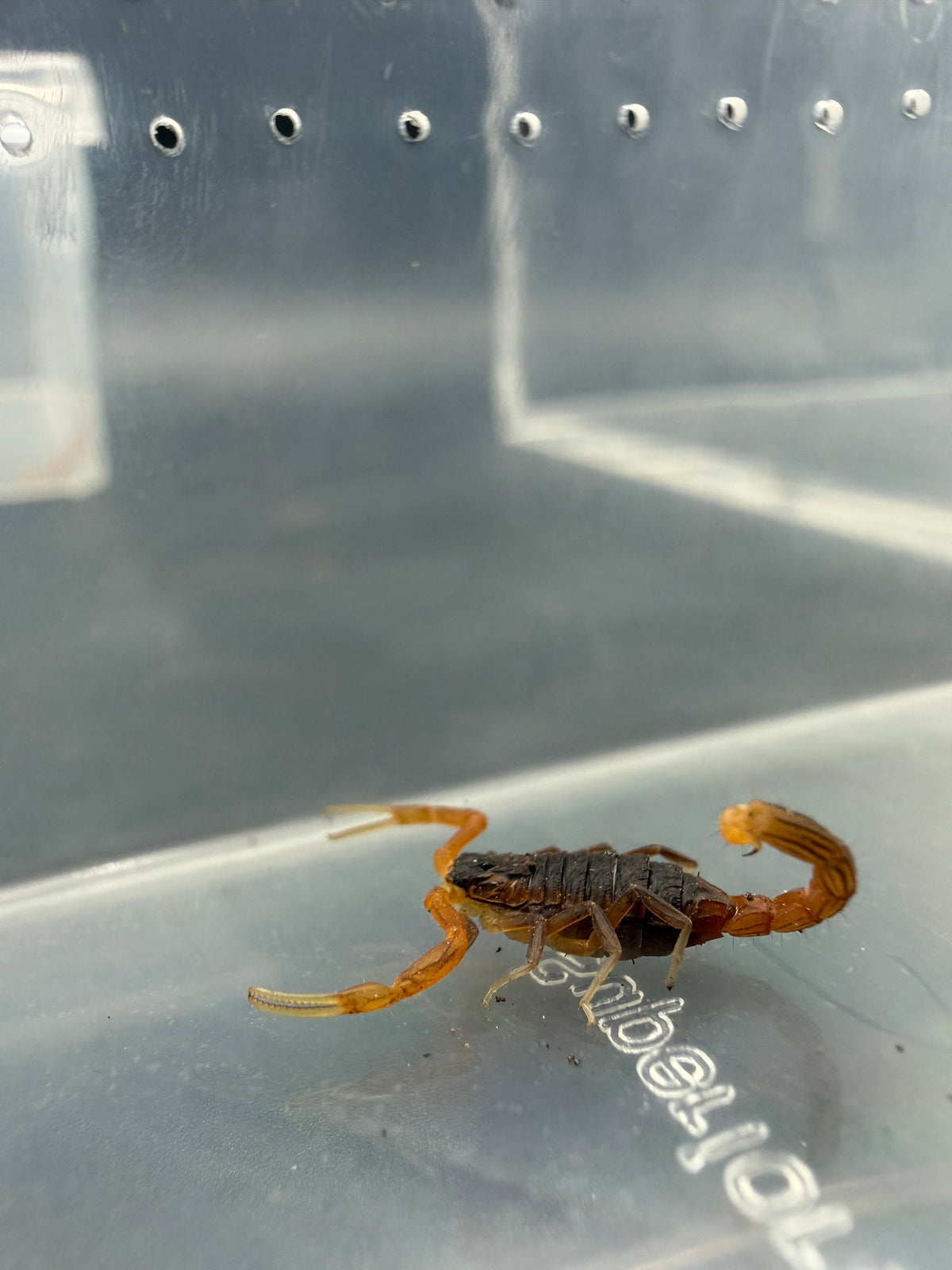
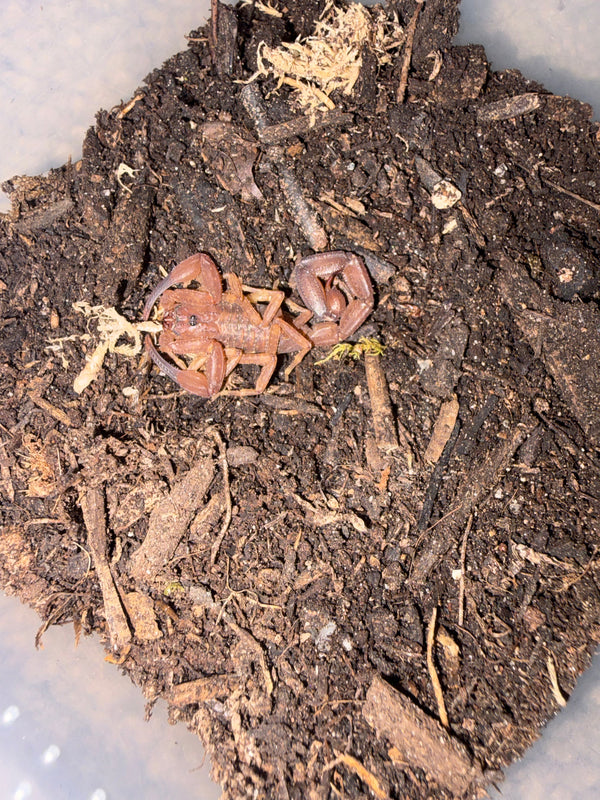
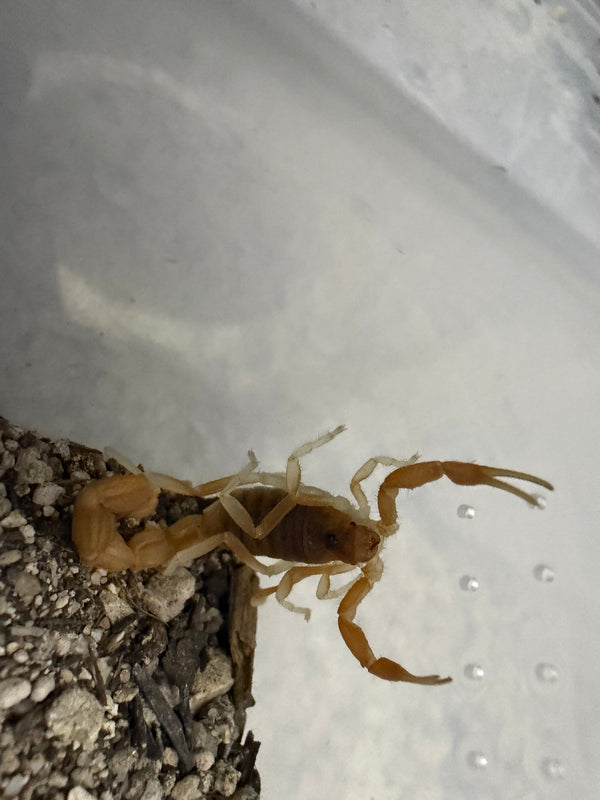
Arizona Bark Scorpion (Centruroides sculpturatus)
Scorpion

Indian Black and Red Scorpion for sale from Big Z's (Hottentotta sp. India). Spice-rated keeper notes, care guidance, and live-arrival packing where eligible.
Plenty of scorpions are display animals. This one is a discipline.
The Indian Black and Red Scorpion is a buthid and an Indian Hottentotta, sold under an open species name, Hottentotta sp. "India". Big Z's keeps it to Hottentotta tamulus standard. H. tamulus is the Indian red scorpion, one of the most medically significant scorpions in the world, and holding this animal to that line is a deliberate conservative control: secondary containment, long tools, a staged catch cup.
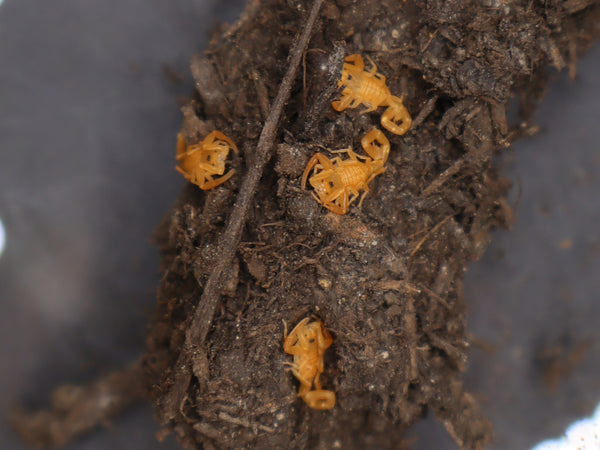
These arrived captive bred and young, at 0.25 to 0.5 inch: scorplings and small juveniles, which is a lot of scorpion in a very small package. The setup is simple and unforgiving: a flat stone or cork cover, one dry exposed surface, one sheltered damp zone, real cross-ventilation, one animal per enclosure, and every vent opening smaller than the metasoma. A Baby Buddy is the right habitat fit.
Spice 5: Extreme. Medically significant, and there is no hand contact with this animal, ever. Read the Big Z's care guide before it arrives.
The numbers live in the care guide. Enclosure size, temps, humidity, feeding schedule, premolt signs, handling boundaries: it's all in the care guide for this exact fella. Start with the full Advanced guide, or click for the quick Open the Simple version →
Scorpion
Indian Black and Red Scorpion (Hottentotta sp. India) care guide Read shipping & LAG
Indian Black and Red Scorpion for sale from Big Z's (Hottentotta sp. India). Spice-rated keeper notes, care guidance, and live-arrival packing where eligible.
Plenty of scorpions are display animals. This one is a discipline.
The Indian Black and Red Scorpion is a buthid and an Indian Hottentotta, sold under an open species name, Hottentotta sp. "India". Big Z's keeps it to Hottentotta tamulus standard. H. tamulus is the Indian red scorpion, one of the most medically significant scorpions in the world, and holding this animal to that line is a deliberate conservative control: secondary containment, long tools, a staged catch cup.
These arrived captive bred and young, at 0.25 to 0.5 inch: scorplings and small juveniles, which is a lot of scorpion in a very small package. The setup is simple and unforgiving: a flat stone or cork cover, one dry exposed surface, one sheltered damp zone, real cross-ventilation, one animal per enclosure, and every vent opening smaller than the metasoma. A Baby Buddy is the right habitat fit.
Spice 5: Extreme. Medically significant, and there is no hand contact with this animal, ever. Read the Big Z's care guide before it arrives.
The numbers live in the care guide. Enclosure size, temps, humidity, feeding schedule, premolt signs, handling boundaries: it's all in the care guide for this exact fella. Start with the full Advanced guide, or click for the quick Open the Simple version →
Hottentotta sp. "India" - Spice 5: Extreme. Baby Buddy: suitable for this 0.25-0.5 in batch of small juveniles/scorplings, exact instar unknown, with one animal per enclosure and every opening smaller than the metasoma; Bark Buddy: usable as the animal grows with a flat stone/cork retreat, dry exposed surface, sheltered damp zone, and escape-proof ventilation; Burrow Buddy: usable for larger animals when kept simple and fitted with stone/cork cover; no species identification or deep-burrowing requirement is implied
Hottentotta sp. "India"
Identity confidence: provisional. This is a genus, group, or trade name rather than a confirmed species. Treat it as the closest match we can stand behind, and use the more conservative end of any range.
Big Z's Quick Verdict: The owner reports this batch came through the same upstream supply line represented in comparable vendor listings as captive-bred Hottentotta sp. India and labeled medically significant. Those screenshots are trade-channel comparators, not exact vendor-lot records. The open name remains deliberate: the supply-line match does not establish a species or locality. Big Z's applies Hottentotta tamulus-level containment and handling precautions as a conservative house ruling, not an identification. No hand contact: use long tools, a staged catch cup and secondary containment. Build for a small stone-associated Hottentotta with a dry exposed surface, sheltered damp zone, effective ventilation and escape-proof openings. This 0.25-0.5 in batch is small juveniles/scorplings, exact instar unknown. - Big Z
| Temp | 79-86 F (26-30 C) is a Big Z starting band, not a published optimum for this unidentified animal. It is informed by regional conditions and Hottentotta analogues. Provide a gradient, avoid uncontrolled overheating or under-floor heat, and adjust from feeding, posture, retreat use, and molt records. |
|---|---|
| Humidity | No numeric RH % target is established. Keep most of the surface dry, maintain one reliably damp sheltered zone, provide water when the animal is large enough to use a safe dish, and preserve cross-ventilation. This physical method is a conservative house synthesis; rainfall-population genetics do not establish captive tolerance. |
| Setup | Unidentified Hottentotta house analogue: stable soil/sand, flat stone or cork cover, dry exposed surface, sheltered damp zone, cross-ventilation, and H. tamulus-level containment without asserting species identity. |
| Substrate | Use a stable soil or soil/sand blend with a flat stone or cork retreat, a mostly dry exposed surface, and one sheltered zone that can retain moisture. Stone-associated field records support the retreat; exact mix and depth are Big Z house choices. The mixed-species laboratory setup used soil and stones but had only 2% scorpling survival, so it is not treated as a successful scorpling protocol. |
| Feeding | The best fetched laboratory evidence used insects smaller than the scorpion and a weekly schedule, but it pooled H. tamulus, H. rugiscutis and Heterometrus and reported only 2% scorpling survival. For this 0.25-0.5 in batch, offer a very small pre-killed prey item at a cautious recorded house cadence; remove leftovers promptly, stop live prey around molt, and change frequency from observed intake and body condition. No evidence-backed twice-weekly claim is made. |
| Handling | Never. This is kept as though it were Hottentotta tamulus, and nobody handles a tamulus. |
Humidity zones: Very Low under 30% - Low 30-60% - Low-Moderate 40-70% - Moderate 60-80% - Moderate-High 70-85% - High 80%+ - Very High 90%+
Current Big Z's catalog: Yes
Hottentotta sp. "India"
Identity confidence: provisional. This is a genus, group, or trade name rather than a confirmed species. Treat it as the closest match we can stand behind, and use the more conservative end of any range.
Keeper Snapshot: The owner reports this batch came through the same upstream supply line represented in comparable vendor listings as captive-bred Hottentotta sp. India and labeled medically significant. Those screenshots are trade-channel comparators, not exact vendor-lot records. The open name remains deliberate: the supply-line match does not establish a species or locality. Big Z's applies Hottentotta tamulus-level containment and handling precautions as a conservative house ruling, not an identification. No hand contact: use long tools, a staged catch cup and secondary containment. Build for a small stone-associated Hottentotta with a dry exposed surface, sheltered damp zone, effective ventilation and escape-proof openings. This 0.25-0.5 in batch is small juveniles/scorplings, exact instar unknown. - Big Z
| Temperature | 79-86 F (26-30 C) is a Big Z starting band, not a published optimum for this unidentified animal. It is informed by regional conditions and Hottentotta analogues. Provide a gradient, avoid uncontrolled overheating or under-floor heat, and adjust from feeding, posture, retreat use, and molt records. |
|---|---|
| Humidity | No numeric RH % target is established. Keep most of the surface dry, maintain one reliably damp sheltered zone, provide water when the animal is large enough to use a safe dish, and preserve cross-ventilation. This physical method is a conservative house synthesis; rainfall-population genetics do not establish captive tolerance. |
| Setup Type | Unidentified Hottentotta house analogue: stable soil/sand, flat stone or cork cover, dry exposed surface, sheltered damp zone, cross-ventilation, and H. tamulus-level containment without asserting species identity. |
| Substrate | Use a stable soil or soil/sand blend with a flat stone or cork retreat, a mostly dry exposed surface, and one sheltered zone that can retain moisture. Stone-associated field records support the retreat; exact mix and depth are Big Z house choices. The mixed-species laboratory setup used soil and stones but had only 2% scorpling survival, so it is not treated as a successful scorpling protocol. |
| Feeding | The best fetched laboratory evidence used insects smaller than the scorpion and a weekly schedule, but it pooled H. tamulus, H. rugiscutis and Heterometrus and reported only 2% scorpling survival. For this 0.25-0.5 in batch, offer a very small pre-killed prey item at a cautious recorded house cadence; remove leftovers promptly, stop live prey around molt, and change frequency from observed intake and body condition. No evidence-backed twice-weekly claim is made. |
| Care Difficulty | Spice 5: Extreme |
| Handling | Never. This is kept as though it were Hottentotta tamulus, and nobody handles a tamulus. |
Humidity zones: Very Low under 30% - Low 30-60% - Low-Moderate 40-70% - Moderate 60-80% - Moderate-High 70-85% - High 80%+ - Very High 90%+

Scorpion

Scorpion

Tarantula

Tarantula

Tarantula

Tarantula

Tarantula

Scorpion