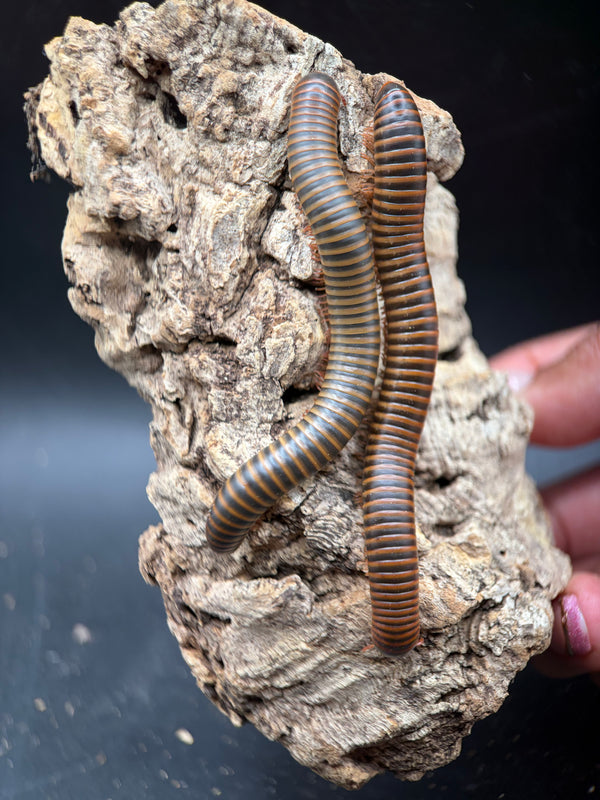
African Giant Millipede (Archispirostreptus gigas)
Millipede

Pink Dragon Millipede for sale from Big Z's (Desmoxytes planata). Spice-rated keeper notes, care guidance, and live-arrival packing where eligible.
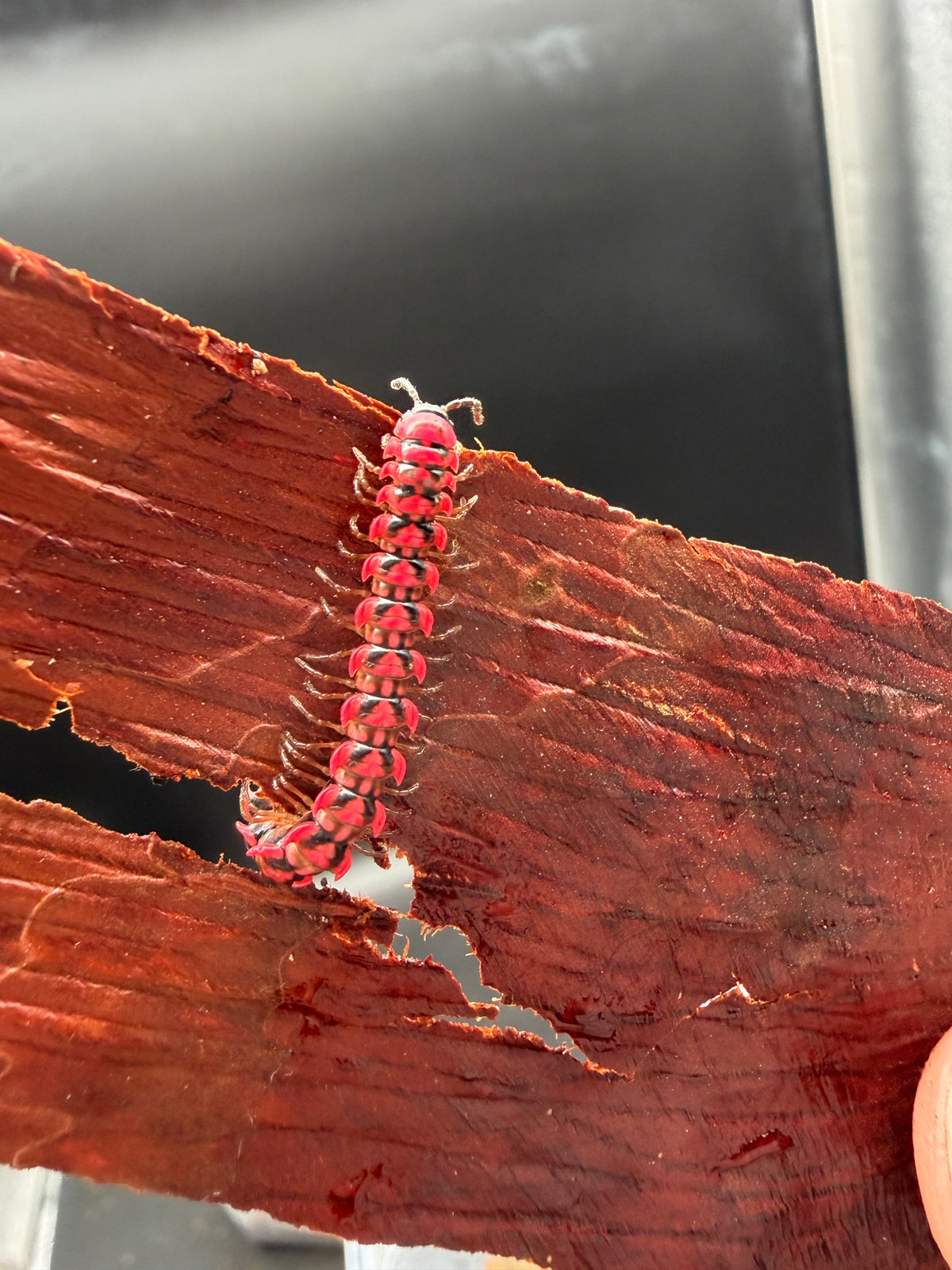
Pink edges give every segment its own outline.
The Pink Dragon Millipede (Desmoxytes planata) has a dark, flattened body with bright pink side keels, the extensions that give dragon millipedes their distinctive shape. The color follows the length of the body, picking out the individual segments against the darker center. These are offered in mixed sizes.
Spice Level 1: Kid Friendly. Our setup starts with moist humus, decomposed leaves, and soft, decayed hardwood that stays available as food. Keep sheltered areas damp without making the substrate marshy, and maintain ventilation. Small produce portions can supplement the edible substrate; remove spoiled leftovers. Leave buried animals undisturbed and keep handling minimal. The Big Z's care guide explains how to maintain the food layer and moisture without turning the enclosure into a wet box.
The numbers live in the care guide. Enclosure size, temps, humidity, feeding schedule, premolt signs, handling boundaries: it's all in the care guide for this exact fella. Start with the full Advanced guide, or click for the quick Open the Simple version →
Millipede
Pink Dragon Millipede (Desmoxytes planata) care guide Read shipping & LAG
Pink Dragon Millipede for sale from Big Z's (Desmoxytes planata). Spice-rated keeper notes, care guidance, and live-arrival packing where eligible.
Pink edges give every segment its own outline.
The Pink Dragon Millipede (Desmoxytes planata) has a dark, flattened body with bright pink side keels, the extensions that give dragon millipedes their distinctive shape. The color follows the length of the body, picking out the individual segments against the darker center. These are offered in mixed sizes.
Spice Level 1: Kid Friendly. Our setup starts with moist humus, decomposed leaves, and soft, decayed hardwood that stays available as food. Keep sheltered areas damp without making the substrate marshy, and maintain ventilation. Small produce portions can supplement the edible substrate; remove spoiled leftovers. Leave buried animals undisturbed and keep handling minimal. The Big Z's care guide explains how to maintain the food layer and moisture without turning the enclosure into a wet box.
The numbers live in the care guide. Enclosure size, temps, humidity, feeding schedule, premolt signs, handling boundaries: it's all in the care guide for this exact fella. Start with the full Advanced guide, or click for the quick Open the Simple version →
Desmoxytes planata - Spice 1: Kid Friendly. Baby Buddy or Burrow Buddy: conditional fit for small animals/groups, not a fixed stocking recommendation.; Deep custom enclosure: use when animal size, group size or food-substrate needs exceed a Buddy's usable dimensions.
Desmoxytes planata
Big Z's Quick Verdict: Build a moist, food-rich home for Pink Dragon millipedes using humus, decomposed leaves and crumbly rotten hardwood. Keep feeding material available throughout the enclosure, provide ventilation and replace what has been eaten. This guide is for D. planata, not the different species D. purpurosea.
| Temp | 72-82°F (22-28°C), the range reported by keeper Valentine Nobara for D. planata. It is a keeper example, not a tested optimum or a reason to heat an already warm enclosure. |
|---|---|
| Humidity | No fixed humidity % target. Keep sheltered litter and the lower substrate damp, not dripping or waterlogged. Check below the surface before adding water, moisten a section at a time, and leave ventilation open. Avoid both a completely dried-out bed and standing water. |
| Setup | Ventilated, food-rich humus enclosure with decayed wood and leaf litter |
| Substrate | Use pesticide-free soil or humus containing plenty of decomposed hardwood leaves and very soft rotten hardwood. As a general millipede planning rule, provide substrate at least as deep as the longest animal is long, with extra depth where needed to retain a damp burrowing area. Coir alone is not a food supply. |
| Feeding | Keep decomposed leaves and soft rotten hardwood available continuously; replace them as they are eaten. Small portions of vegetables can supplement this base, not replace it. Remove spoiled or uneaten supplements before they foul the substrate. |
| Handling | Keep handling to a minimum. Support the animal over a soft surface for any necessary transfer; do not pull it from cover or force it to uncoil. Wash hands after contact or enclosure work. |
Humidity zones: Very Low under 30% - Low 30-60% - Low-Moderate 40-70% - Moderate 60-80% - Moderate-High 70-85% - High 80%+ - Very High 90%+
Current Big Z's catalog: Yes
Desmoxytes planata
Keeper Snapshot: Build a moist, food-rich home for Pink Dragon millipedes using humus, decomposed leaves and crumbly rotten hardwood. Keep feeding material available throughout the enclosure, provide ventilation and replace what has been eaten. This guide is for D. planata, not the different species D. purpurosea.
| Temperature | 72-82°F (22-28°C), the range reported by keeper Valentine Nobara for D. planata. It is a keeper example, not a tested optimum or a reason to heat an already warm enclosure. |
|---|---|
| Humidity | No fixed humidity % target. Keep sheltered litter and the lower substrate damp, not dripping or waterlogged. Check below the surface before adding water, moisten a section at a time, and leave ventilation open. Avoid both a completely dried-out bed and standing water. |
| Setup Type | Ventilated, food-rich humus enclosure with decayed wood and leaf litter |
| Substrate | Use pesticide-free soil or humus containing plenty of decomposed hardwood leaves and very soft rotten hardwood. As a general millipede planning rule, provide substrate at least as deep as the longest animal is long, with extra depth where needed to retain a damp burrowing area. Coir alone is not a food supply. |
| Feeding | Keep decomposed leaves and soft rotten hardwood available continuously; replace them as they are eaten. Small portions of vegetables can supplement this base, not replace it. Remove spoiled or uneaten supplements before they foul the substrate. |
| Care Difficulty | Spice 1: Kid Friendly |
| Handling | Keep handling to a minimum. Support the animal over a soft surface for any necessary transfer; do not pull it from cover or force it to uncoil. Wash hands after contact or enclosure work. |
Humidity zones: Very Low under 30% - Low 30-60% - Low-Moderate 40-70% - Moderate 60-80% - Moderate-High 70-85% - High 80%+ - Very High 90%+

Millipede

Millipede

Millipede

Clean-up Crew

Invertebrate

Millipede

Millipede