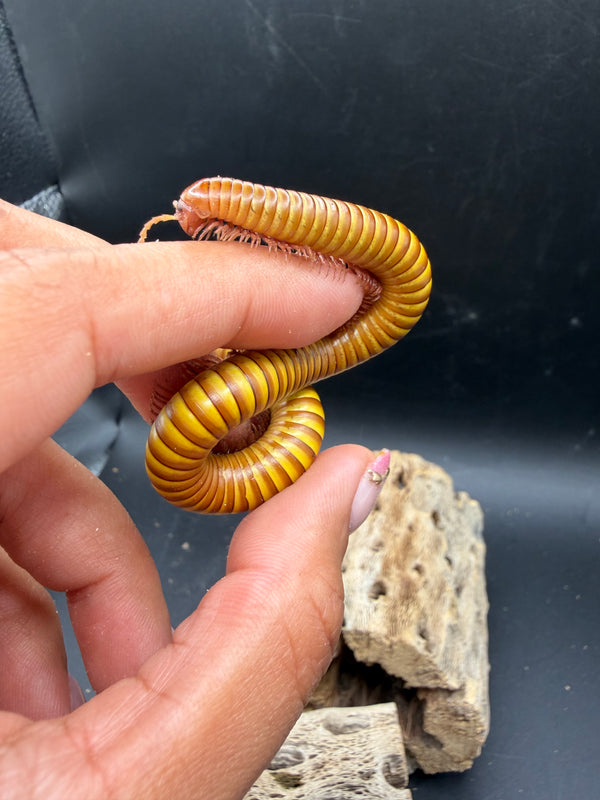
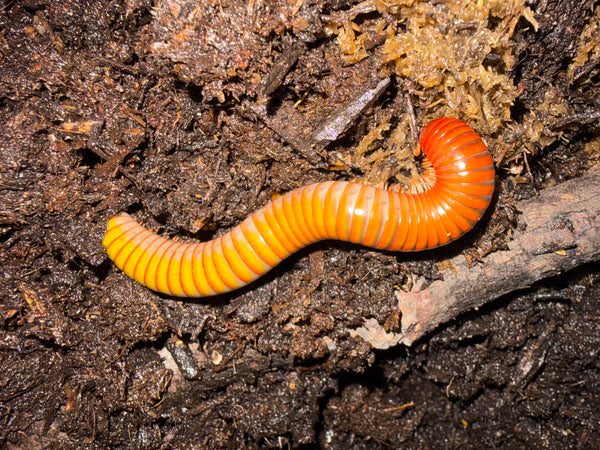
Texas Gold Millipede (Orthoporus ornatus)
Millipede

Red Leg Vinegaroon for sale from Big Z's (Typopeltis sp.). Spice-rated keeper notes, care guidance, and live-arrival packing where eligible.
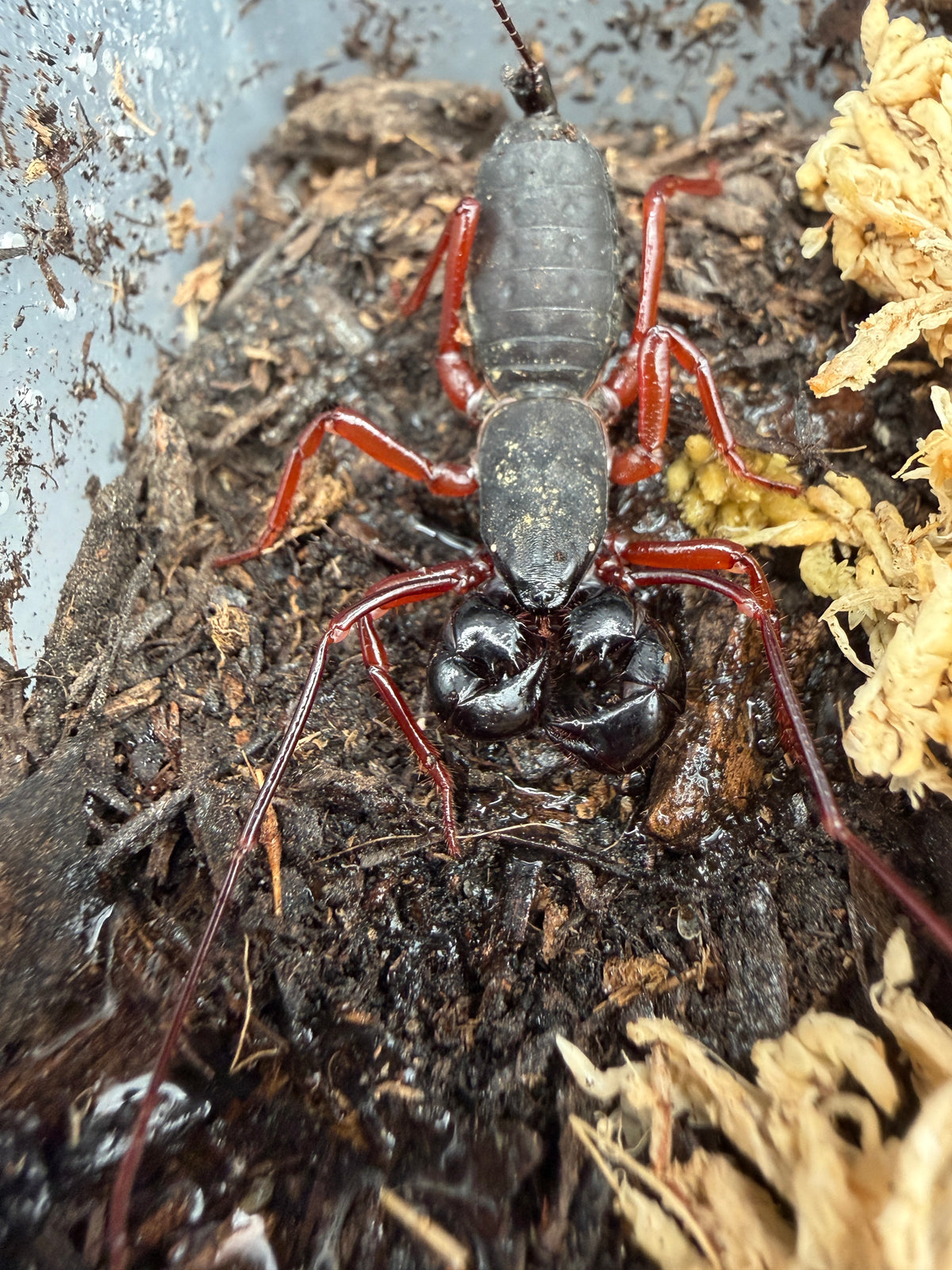
Red walking legs beneath a glossy dark body.
The Red Leg Vinegaroon (Typopeltis sp.) has heavy pedipalps at the front, long feeler-like forelegs, and a thin, whip-like tail. The red walking legs stand out beneath the darker body, giving this form a different look from an all-dark arachnid. These are offered at a 1-2 inch leg span, under the genus name because the exact species is not confirmed.
Spice Level 3: Intermediate. Our care approach follows related vinegaroons: cohesive, diggable soil under secured cork, a lightly damp lower refuge, open ventilation, and a shallow water dish. House individually and leave sealed retreats intact. Offer manageable prey and remove anything refused. Transfer with a cup, never by the legs or tail, and keep your face away from defensive spray. The Big Z's care guide explains the sheltered setup and how to manage feeding without digging the animal out.
The numbers live in the care guide. Enclosure size, temps, humidity, feeding schedule, premolt signs, handling boundaries: it's all in the care guide for this exact fella. Start with the full Advanced guide, or click for the quick Open the Simple version →
Invertebrate
Red Leg Vinegaroon (Typopeltis sp.) care guide Read shipping & LAG
Red Leg Vinegaroon for sale from Big Z's (Typopeltis sp.). Spice-rated keeper notes, care guidance, and live-arrival packing where eligible.
Red walking legs beneath a glossy dark body.
The Red Leg Vinegaroon (Typopeltis sp.) has heavy pedipalps at the front, long feeler-like forelegs, and a thin, whip-like tail. The red walking legs stand out beneath the darker body, giving this form a different look from an all-dark arachnid. These are offered at a 1-2 inch leg span, under the genus name because the exact species is not confirmed.
Spice Level 3: Intermediate. Our care approach follows related vinegaroons: cohesive, diggable soil under secured cork, a lightly damp lower refuge, open ventilation, and a shallow water dish. House individually and leave sealed retreats intact. Offer manageable prey and remove anything refused. Transfer with a cup, never by the legs or tail, and keep your face away from defensive spray. The Big Z's care guide explains the sheltered setup and how to manage feeding without digging the animal out.
The numbers live in the care guide. Enclosure size, temps, humidity, feeding schedule, premolt signs, handling boundaries: it's all in the care guide for this exact fella. Start with the full Advanced guide, or click for the quick Open the Simple version →
Typopeltis sp. - Spice 3: Intermediate. Burrow Buddy only if its actual depth and floor area allow the full retreat and movement space; otherwise use a deeper custom enclosure.
Typopeltis sp.
Identity confidence: provisional. This is a genus, group, or trade name rather than a confirmed species. Treat it as the closest match we can stand behind, and use the more conservative end of any range.
Big Z's Quick Verdict: Give it soil that holds a sheltered burrow, lightly damp lower areas, supported cork and a water dish. Leave closed retreats alone. This care is adapted from related vinegaroons because the exact species is unconfirmed; house animals separately.
| Temp | Keep the enclosure in steady indoor conditions and measure near the occupied retreat. A reliable care range for this unidentified trade form is not established; avoid direct sun and unregulated heat. |
|---|---|
| Humidity | No fixed humidity % target. Keep a sheltered lower area lightly damp, not wet, while maintaining ventilation and a shallow accessible water dish. Add water gradually away from the retreat; do not flood tunnels or let the entire substrate dry out. |
| Setup | Deep, cohesive damp soil with supported cork retreats, water and ventilation |
| Substrate | Use cohesive, diggable soil packed enough to support a chamber beneath secured cork. Provide sufficient depth and floor area for the whole animal to retreat, turn and molt. This related-vinegaroon method has no proven fixed depth or ingredient ratio for this form. |
| Feeding | Offer manageable crickets or roaches and adjust portions to body condition and feeding response. Remove refused live prey promptly and clear remains. Do not force food into a sealed burrow or offer live prey during a molt. |
| Handling | Container transfers only. Do not restrain by hand or grasp the sensory legs or tail; keep your face away from the animal. |
Humidity zones: Very Low under 30% - Low 30-60% - Low-Moderate 40-70% - Moderate 60-80% - Moderate-High 70-85% - High 80%+ - Very High 90%+
Current Big Z's catalog: Yes
Typopeltis sp.
Identity confidence: provisional. This is a genus, group, or trade name rather than a confirmed species. Treat it as the closest match we can stand behind, and use the more conservative end of any range.
Keeper Snapshot: Give it soil that holds a sheltered burrow, lightly damp lower areas, supported cork and a water dish. Leave closed retreats alone. This care is adapted from related vinegaroons because the exact species is unconfirmed; house animals separately.
| Temperature | Keep the enclosure in steady indoor conditions and measure near the occupied retreat. A reliable care range for this unidentified trade form is not established; avoid direct sun and unregulated heat. |
|---|---|
| Humidity | No fixed humidity % target. Keep a sheltered lower area lightly damp, not wet, while maintaining ventilation and a shallow accessible water dish. Add water gradually away from the retreat; do not flood tunnels or let the entire substrate dry out. |
| Setup Type | Deep, cohesive damp soil with supported cork retreats, water and ventilation |
| Substrate | Use cohesive, diggable soil packed enough to support a chamber beneath secured cork. Provide sufficient depth and floor area for the whole animal to retreat, turn and molt. This related-vinegaroon method has no proven fixed depth or ingredient ratio for this form. |
| Feeding | Offer manageable crickets or roaches and adjust portions to body condition and feeding response. Remove refused live prey promptly and clear remains. Do not force food into a sealed burrow or offer live prey during a molt. |
| Care Difficulty | Spice 3: Intermediate |
| Handling | Container transfers only. Do not restrain by hand or grasp the sensory legs or tail; keep your face away from the animal. |
Humidity zones: Very Low under 30% - Low 30-60% - Low-Moderate 40-70% - Moderate 60-80% - Moderate-High 70-85% - High 80%+ - Very High 90%+

Millipede

Scorpion

Tarantula

Spider

Millipede

Tarantula

Arachnid

Millipede