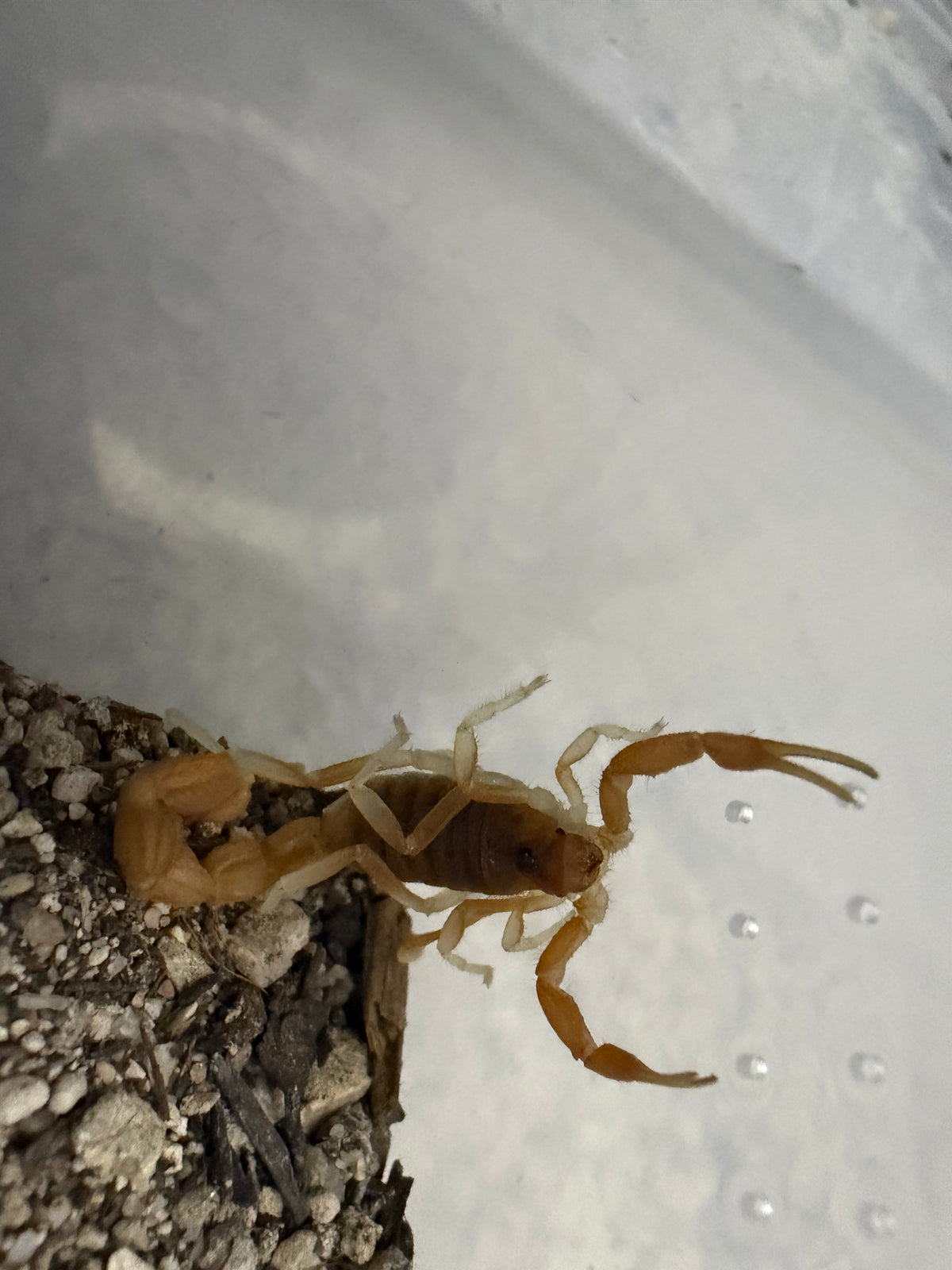
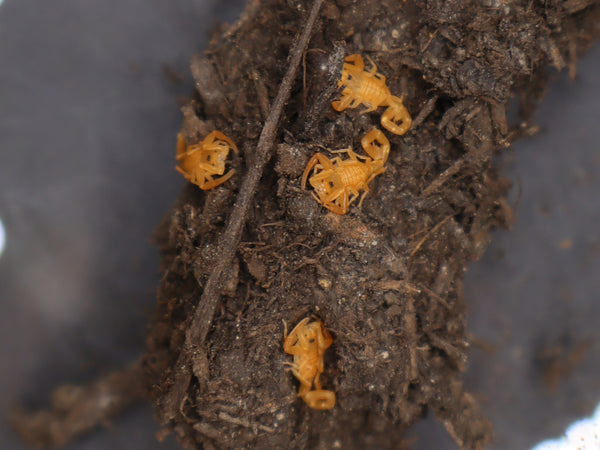
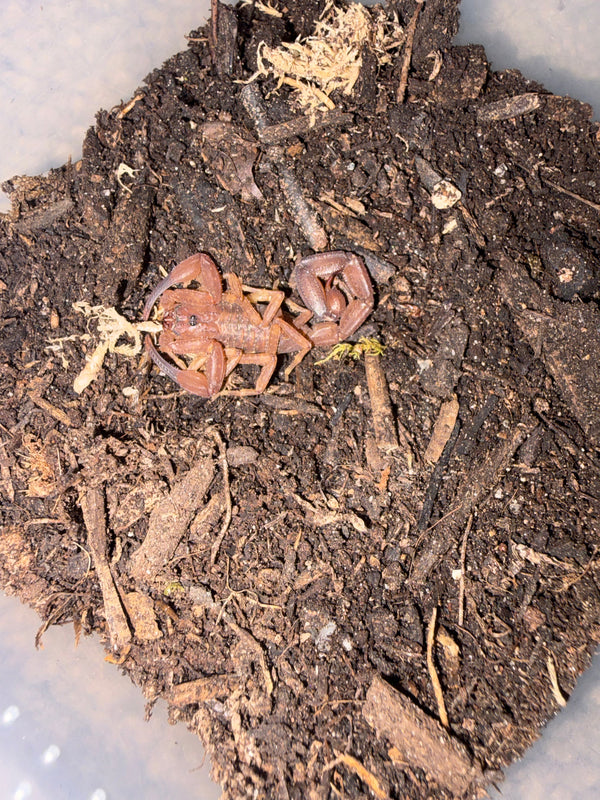
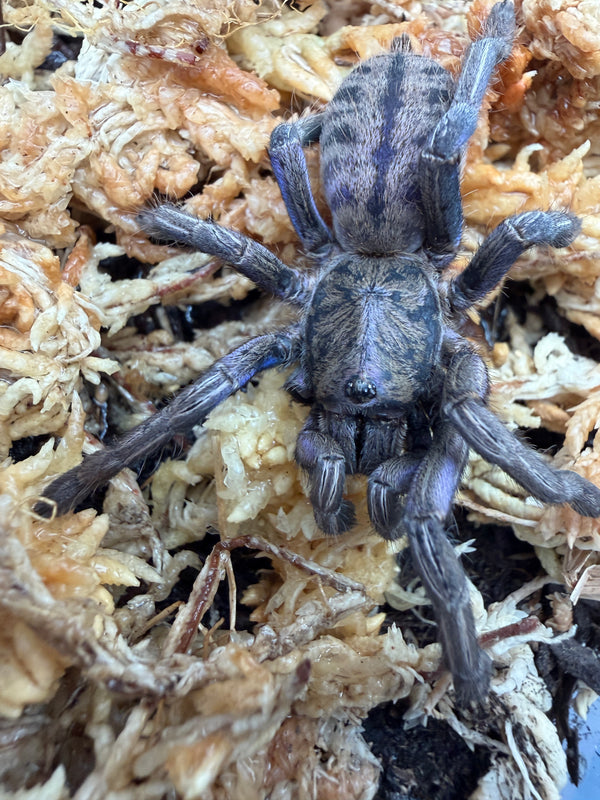
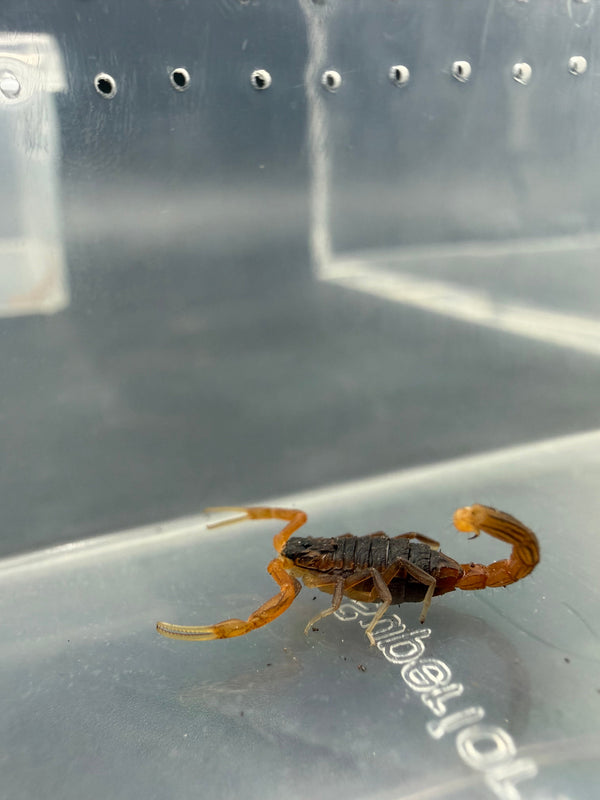
Arizona Bark Scorpion (Centruroides sculpturatus)
Scorpion

Mozambique Thicktail Scorpion for sale from Big Z's (Parabuthus mossambicensis). Spice-rated keeper notes, care guidance, and live-arrival packing where eligible.
Big Z's rates this one Extreme because nobody has proven otherwise.
Parabuthus mossambicensis is a southern African thicktail that digs its own retreat, living on semi-consolidated sandy and gritty ground and burrowing either in the open or in at the base of a shrub. It also stridulates when it has had enough of you, which is a genuinely useful trait in an animal you are never going to touch. These arrived at 0.5 to 0.75 inches.
The venom is where the honesty comes in. The published work does not agree on how serious a sting from this species is, and nobody has published a run of real sting cases either way, so Big Z's takes the cautious end and works it like the rest of the genus: no hand contact, long tools, a staged catch cup, a latched lid, and secondary containment. Build it deep with sandy substrate that will hold a tunnel, give it a starter retreat, keep most of the surface dry with one damp corner, and mount the ventilation low. Spice Level 5: Extreme. Read the matched Big Z's care guide before it ships.
The numbers live in the care guide. Enclosure size, temps, humidity, feeding schedule, premolt signs, handling boundaries: it's all in the care guide for this exact fella. Start with the full Advanced guide, or click for the quick Open the Simple version →
Scorpion
Mozambique Thicktail Scorpion (Parabuthus mossambicensis) care guide Read shipping & LAG
Mozambique Thicktail Scorpion for sale from Big Z's (Parabuthus mossambicensis). Spice-rated keeper notes, care guidance, and live-arrival packing where eligible.
Big Z's rates this one Extreme because nobody has proven otherwise.
Parabuthus mossambicensis is a southern African thicktail that digs its own retreat, living on semi-consolidated sandy and gritty ground and burrowing either in the open or in at the base of a shrub. It also stridulates when it has had enough of you, which is a genuinely useful trait in an animal you are never going to touch. These arrived at 0.5 to 0.75 inches.
The venom is where the honesty comes in. The published work does not agree on how serious a sting from this species is, and nobody has published a run of real sting cases either way, so Big Z's takes the cautious end and works it like the rest of the genus: no hand contact, long tools, a staged catch cup, a latched lid, and secondary containment. Build it deep with sandy substrate that will hold a tunnel, give it a starter retreat, keep most of the surface dry with one damp corner, and mount the ventilation low. Spice Level 5: Extreme. Read the matched Big Z's care guide before it ships.
The numbers live in the care guide. Enclosure size, temps, humidity, feeding schedule, premolt signs, handling boundaries: it's all in the care guide for this exact fella. Start with the full Advanced guide, or click for the quick Open the Simple version →
Parabuthus mossambicensis - Spice 5: Extreme. Baby Buddy: correct for the 0.5-0.75 in scorplings in this batch, one animal per enclosure, every vent opening smaller than the metasoma; Burrow Buddy: the right lane as they grow, and genuinely a burrow setup for this species rather than a crevice one - fill it deep enough with firm sandy substrate that a dug tunnel holds its shape; Adult: size the individual enclosure to preserve deep form-holding digging substrate, a starter retreat, a dry surface, localized moisture, safe open water, and service access under secondary containment; no species minimum enclosure dimension was verified.
Parabuthus mossambicensis
Big Z's Quick Verdict: A burrowing southern-African buthid with uncertain species-specific clinical severity. Ward et al. (2018) assigned P. mossambicensis class U (unknown), likely mild-to-moderate, while specialist secondary sources disagree; no species clinical series was found. Some Parabuthus spray venom, but no published demonstration was found for this species. Big Z's nevertheless uses no hand contact, secondary containment, long tools, and eye protection as conservative genus-level precautions. Give it deep form-holding sandy substrate, a dry exposed surface, a localized damp refuge, effective cross-ventilation, and a secure lid. - Big Z
| Temp | No species captive optimum is established. One genus-level keeper practice used 86-90 F (30-32 C) by day and 77-82 F (25-28 C) at night. Use a warm gradient with ordinary night cooling as a keeper/Big Z starting method; regional seasonality is context, not an optimum. |
|---|---|
| Humidity | No validated numeric RH % ceiling or floor exists. Keep the exposed surface dry, provide a localized slightly damp refuge or side, an appropriately safe water dish, and strong cross-ventilation. Reported percentages are conflicting keeper anecdotes. |
| Setup | Arid semi-psammophilous burrowing setup: firm sandy substrate deep enough to hold a self-dug burrow |
| Substrate | Firm sandy or sand-and-clay substrate, deep enough that the animal can dig and the burrow will hold. This is the load-bearing husbandry fact and it comes straight from the revision: the species is semi-psammophilous, inhabiting semi-consolidated to consolidated sandy and gritty substrata where it excavates burrows in open ground and at the base of shrubs. Prendini backs it morphologically - comb-like rows of long macrosetae, sand combs, on the retrolateral margins of the basitarsi of legs I and II. Pure loose sand will not hold a tunnel; pack it. Add a surface hide as well, which satisfies the field-guide sources that describe it sheltering under debris. |
| Feeding | Adults may start at one appropriately sized prey item weekly based on genus keeper practice. Small juveniles may receive small or pre-killed prey at a cautious recorded Big Z house cadence. Adjust from intake and condition; remove live prey around molt. No species-level stage schedule was found. |
| Handling | Never. Catch cup, long tongs, secondary containment, and eye protection every single time. |
Humidity zones: Very Low under 30% - Low 30-60% - Low-Moderate 40-70% - Moderate 60-80% - Moderate-High 70-85% - High 80%+ - Very High 90%+
Current Big Z's catalog: Yes
Parabuthus mossambicensis
Keeper Snapshot: A burrowing southern-African buthid with uncertain species-specific clinical severity. Ward et al. (2018) assigned P. mossambicensis class U (unknown), likely mild-to-moderate, while specialist secondary sources disagree; no species clinical series was found. Some Parabuthus spray venom, but no published demonstration was found for this species. Big Z's nevertheless uses no hand contact, secondary containment, long tools, and eye protection as conservative genus-level precautions. Give it deep form-holding sandy substrate, a dry exposed surface, a localized damp refuge, effective cross-ventilation, and a secure lid. - Big Z
| Temperature | No species captive optimum is established. One genus-level keeper practice used 86-90 F (30-32 C) by day and 77-82 F (25-28 C) at night. Use a warm gradient with ordinary night cooling as a keeper/Big Z starting method; regional seasonality is context, not an optimum. |
|---|---|
| Humidity | No validated numeric RH % ceiling or floor exists. Keep the exposed surface dry, provide a localized slightly damp refuge or side, an appropriately safe water dish, and strong cross-ventilation. Reported percentages are conflicting keeper anecdotes. |
| Setup Type | Arid semi-psammophilous burrowing setup: firm sandy substrate deep enough to hold a self-dug burrow |
| Substrate | Firm sandy or sand-and-clay substrate, deep enough that the animal can dig and the burrow will hold. This is the load-bearing husbandry fact and it comes straight from the revision: the species is semi-psammophilous, inhabiting semi-consolidated to consolidated sandy and gritty substrata where it excavates burrows in open ground and at the base of shrubs. Prendini backs it morphologically - comb-like rows of long macrosetae, sand combs, on the retrolateral margins of the basitarsi of legs I and II. Pure loose sand will not hold a tunnel; pack it. Add a surface hide as well, which satisfies the field-guide sources that describe it sheltering under debris. |
| Feeding | Adults may start at one appropriately sized prey item weekly based on genus keeper practice. Small juveniles may receive small or pre-killed prey at a cautious recorded Big Z house cadence. Adjust from intake and condition; remove live prey around molt. No species-level stage schedule was found. |
| Care Difficulty | Spice 5: Extreme |
| Handling | Never. Catch cup, long tongs, secondary containment, and eye protection every single time. |
Humidity zones: Very Low under 30% - Low 30-60% - Low-Moderate 40-70% - Moderate 60-80% - Moderate-High 70-85% - High 80%+ - Very High 90%+

Scorpion

Scorpion

Tarantula

Tarantula

Tarantula

Tarantula

Tarantula

Scorpion