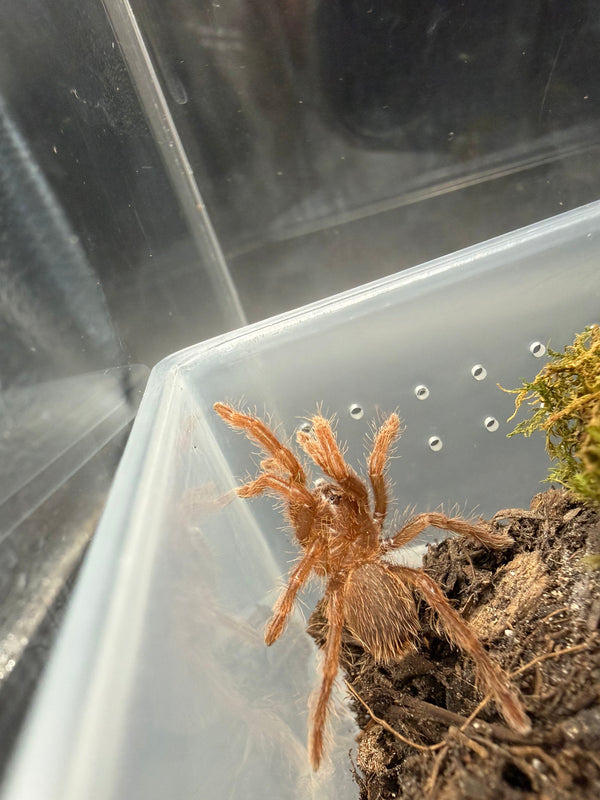
Electric Blue Tarantula (Chilobrachys natanicharum)
Tarantula

Florida Blueleg Centipede for sale from Big Z's (Scolopendra viridis). Spice-rated keeper notes, care guidance, and live-arrival packing where eligible.
Small for a Scolopendra, and absolutely not to be underestimated
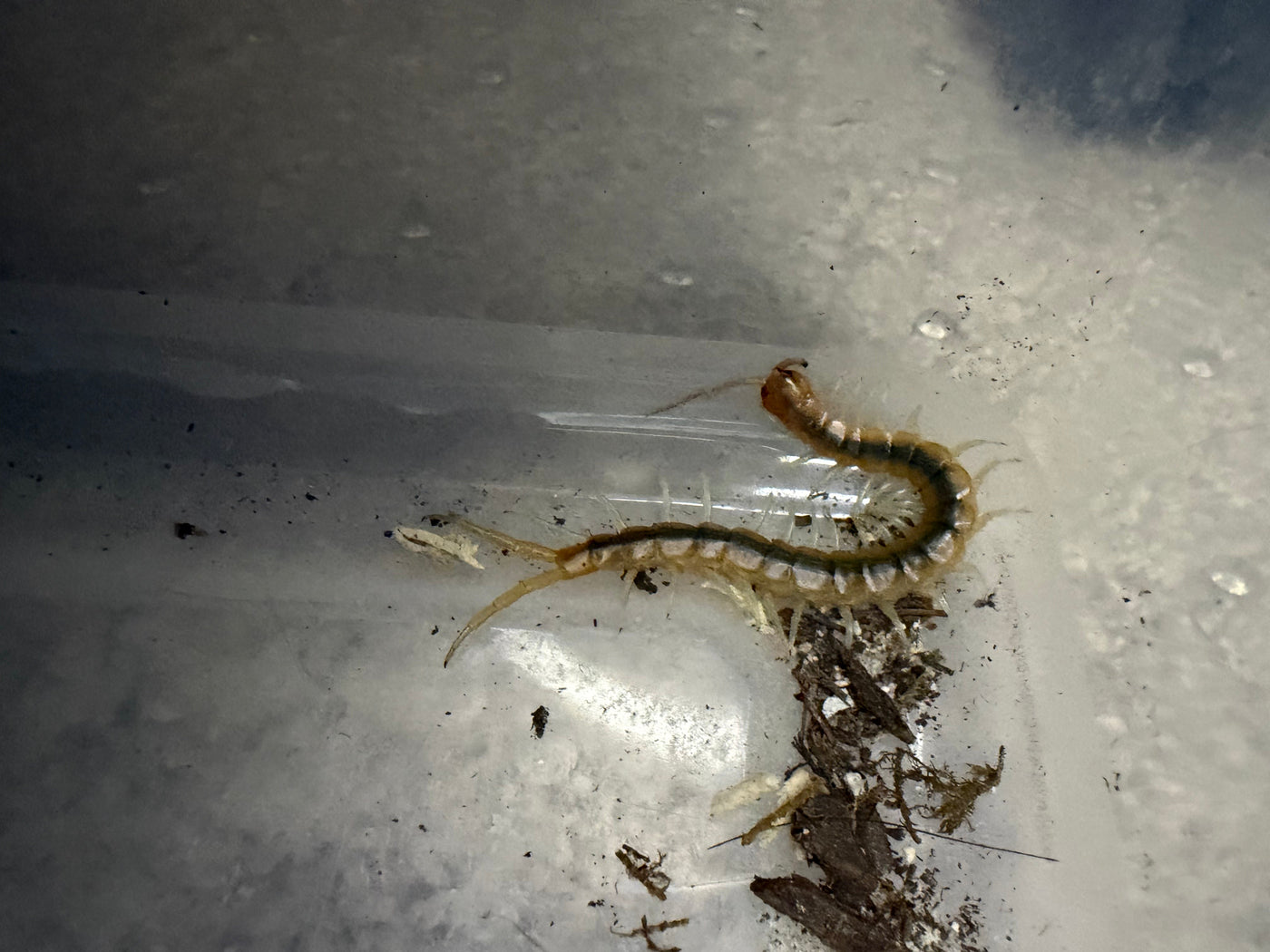
Scolopendra viridis, the Florida Blueleg Centipede, is a native of the southeastern United States, running a slate-to-olive body over legs washed in a cool blue. This one arrived at two to three inches, genuinely small by Scolopendra standards, and that is precisely what makes keepers careless with it.
It is a centipede, which means fast, strong, and armed with a venomous forcipule bite reported as sharply painful even from an animal this small. It is also a committed escape artist. Centipedes find gaps you did not know your enclosure had, and a secure latched lid is not a suggestion. Keep it on deep substrate it can tunnel through with a moist gradient and bark cover, feed live prey with long tongs, and never open the enclosure without knowing where the animal is first. Spice 4, advanced lane, and no handling under any circumstances. Read the care guide before it arrives.
The numbers live in the care guide. Enclosure size, temps, humidity, feeding schedule, premolt signs, handling boundaries: it's all in the care guide for this exact fella. Start with the full Advanced guide, or click for the quick Open the Simple version →
Centipede
Florida Blueleg Centipede (Scolopendra viridis) care guide Read shipping & LAG
Florida Blueleg Centipede for sale from Big Z's (Scolopendra viridis). Spice-rated keeper notes, care guidance, and live-arrival packing where eligible.
Small for a Scolopendra, and absolutely not to be underestimated
Scolopendra viridis, the Florida Blueleg Centipede, is a native of the southeastern United States, running a slate-to-olive body over legs washed in a cool blue. This one arrived at two to three inches, genuinely small by Scolopendra standards, and that is precisely what makes keepers careless with it.
It is a centipede, which means fast, strong, and armed with a venomous forcipule bite reported as sharply painful even from an animal this small. It is also a committed escape artist. Centipedes find gaps you did not know your enclosure had, and a secure latched lid is not a suggestion. Keep it on deep substrate it can tunnel through with a moist gradient and bark cover, feed live prey with long tongs, and never open the enclosure without knowing where the animal is first. Spice 4, advanced lane, and no handling under any circumstances. Read the care guide before it arrives.
The numbers live in the care guide. Enclosure size, temps, humidity, feeding schedule, premolt signs, handling boundaries: it's all in the care guide for this exact fella. Start with the full Advanced guide, or click for the quick Open the Simple version →
Scolopendra viridis - Spice 4: Advanced. Burrow Buddy: the correct format for this species, filled deep and packed firm, PROVIDED the lid locks positively; Adult custom terrestrial build sized from the measured animal, prioritising substrate depth and lid security over display
Scolopendra viridis
Big Z's Quick Verdict: A small native Scolopendra with blue-washed legs over a slate-olive body, and the reason it earns a Spice 4 is not size, it is that people get careless with a three-inch centipede. It is fast, it is strong, the bite is genuinely painful, and it will find any gap in the enclosure you did not know was there. Deep diggable substrate with a moisture gradient, bark cover, a locking lid, and long tongs. Know where the animal is before the lid comes off. Keep it spicy. - Big Z
| Temp | 72-82F working room range. Southeastern US origin covers a wide seasonal range and it tolerates ordinary household temperatures well, including a night drop. Avoid a concentrated hot spot; a centipede that cannot escape heat will burrow to the bottom and stay there. |
|---|---|
| Humidity | No numeric % target. Manage by method: run a gradient, keeping one end of the substrate lightly damp and the other end dry, and let the animal choose. Keep a shallow water dish full. Ventilate at substrate level. A uniformly wet enclosure causes fungal and mite problems; a uniformly dry one causes a failed molt. |
| Setup | Semi-arid terrestrial centipede with deep diggable substrate and a locking lid |
| Substrate | 3-5 in of firmly packed, diggable coco fiber and topsoil that holds a tunnel. This species burrows and will spend most daylight hours underground. Add bark or flat cork as surface cover. Pack it firm rather than leaving it loose, so the tunnels hold and the animal is not constantly re-excavating. |
| Feeding | One appropriately sized live prey item every 5-10 days, adjusted by body condition. Crickets and roaches are both taken readily. Offer with long tongs at the burrow entrance or drop and withdraw immediately. Remove uneaten prey within 24 hours. Withhold entirely when the animal seals itself in or stops responding, which usually signals premolt. |
| Handling | Never, at any size, for any reason. Tongs and a lidded catch cup only. |
Humidity zones: Very Low under 30% - Low 30-60% - Low-Moderate 40-70% - Moderate 60-80% - Moderate-High 70-85% - High 80%+ - Very High 90%+
Current Big Z's catalog: Yes
Scolopendra viridis
Keeper Snapshot: A small native Scolopendra with blue-washed legs over a slate-olive body, and the reason it earns a Spice 4 is not size, it is that people get careless with a three-inch centipede. It is fast, it is strong, the bite is genuinely painful, and it will find any gap in the enclosure you did not know was there. Deep diggable substrate with a moisture gradient, bark cover, a locking lid, and long tongs. Know where the animal is before the lid comes off. Keep it spicy. - Big Z
| Temperature | 72-82F working room range. Southeastern US origin covers a wide seasonal range and it tolerates ordinary household temperatures well, including a night drop. Avoid a concentrated hot spot; a centipede that cannot escape heat will burrow to the bottom and stay there. |
|---|---|
| Humidity | No numeric % target. Manage by method: run a gradient, keeping one end of the substrate lightly damp and the other end dry, and let the animal choose. Keep a shallow water dish full. Ventilate at substrate level. A uniformly wet enclosure causes fungal and mite problems; a uniformly dry one causes a failed molt. |
| Setup Type | Semi-arid terrestrial centipede with deep diggable substrate and a locking lid |
| Substrate | 3-5 in of firmly packed, diggable coco fiber and topsoil that holds a tunnel. This species burrows and will spend most daylight hours underground. Add bark or flat cork as surface cover. Pack it firm rather than leaving it loose, so the tunnels hold and the animal is not constantly re-excavating. |
| Feeding | One appropriately sized live prey item every 5-10 days, adjusted by body condition. Crickets and roaches are both taken readily. Offer with long tongs at the burrow entrance or drop and withdraw immediately. Remove uneaten prey within 24 hours. Withhold entirely when the animal seals itself in or stops responding, which usually signals premolt. |
| Care Difficulty | Spice 4: Advanced |
| Handling | Never, at any size, for any reason. Tongs and a lidded catch cup only. |
Humidity zones: Very Low under 30% - Low 30-60% - Low-Moderate 40-70% - Moderate 60-80% - Moderate-High 70-85% - High 80%+ - Very High 90%+

Tarantula

Tarantula

Tarantula

Tarantula

Tarantula

Scorpion

Tarantula

Tarantula