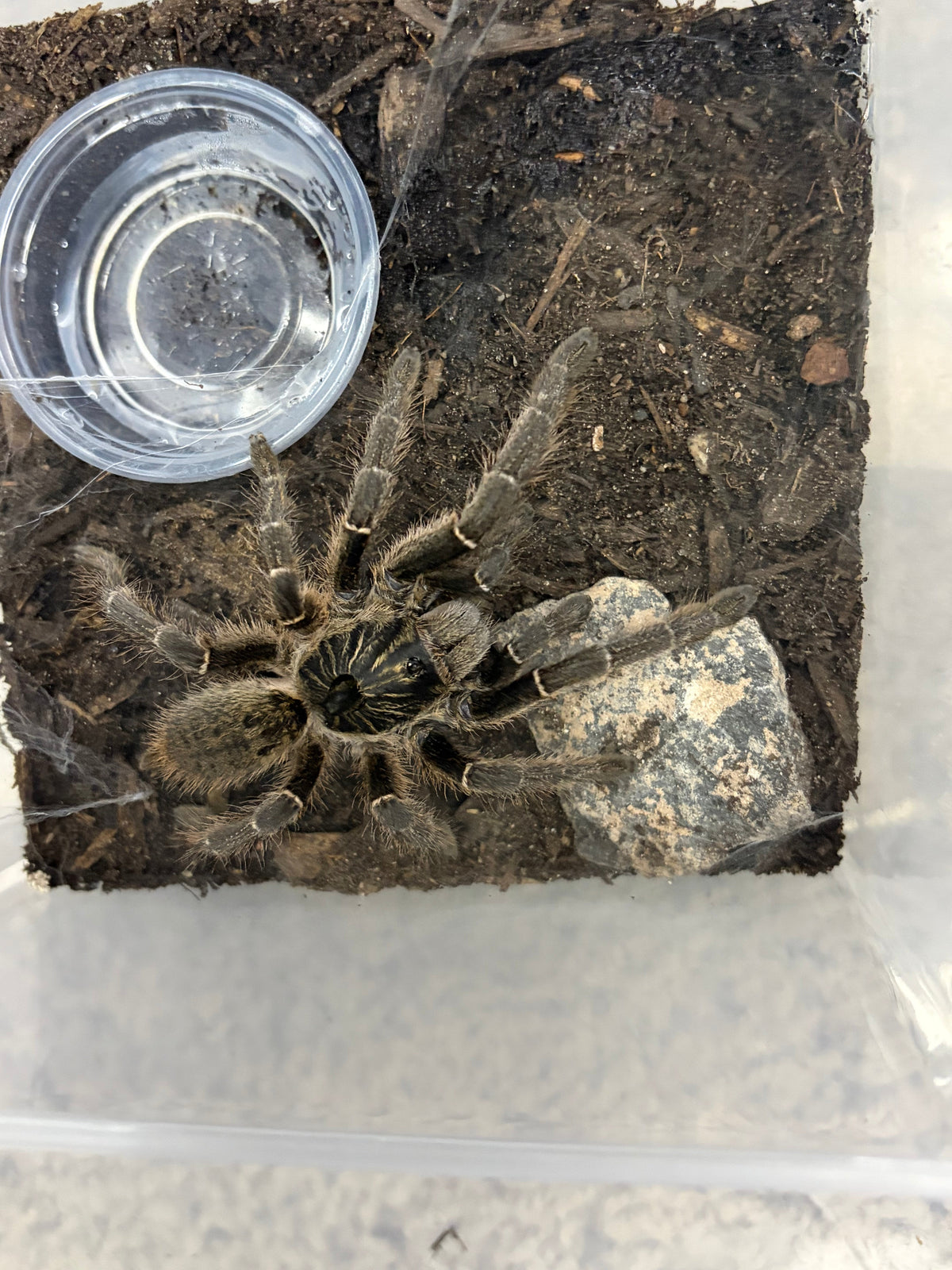
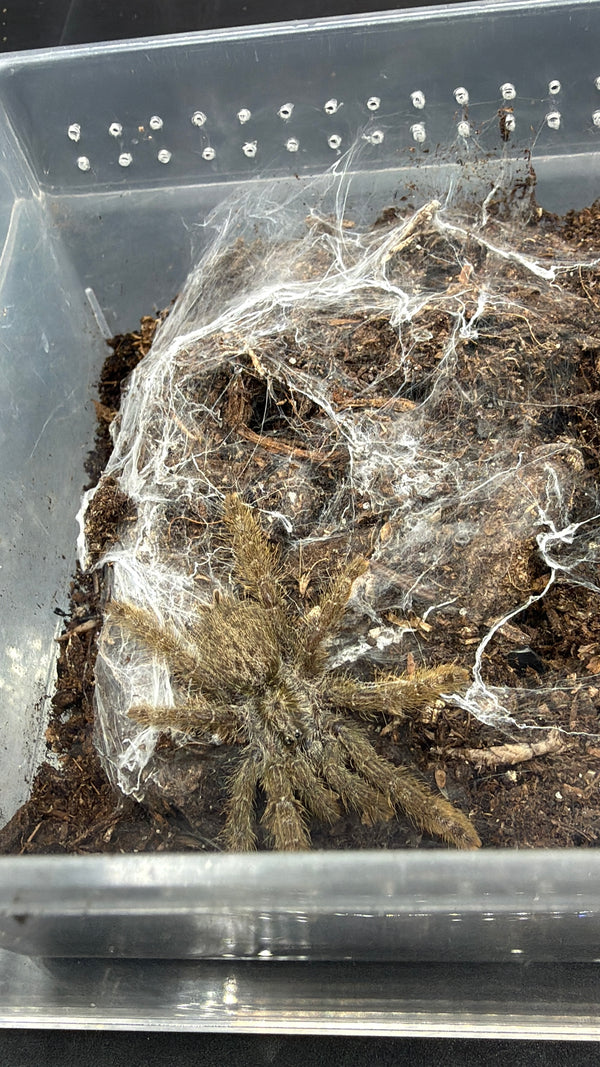
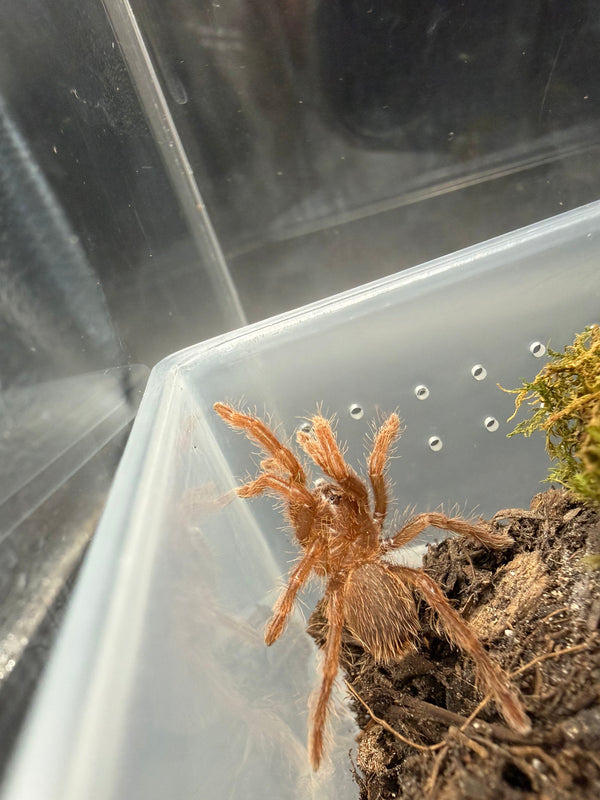
Electric Blue Tarantula (Chilobrachys natanicharum)
Tarantula

Unicorn Horned Baboon Tarantula for sale from Big Z's (Ceratogyrus marshalli). Spice-rated keeper notes, care guidance, and live-arrival packing where eligible.
It has a horn. An actual, forward-curving horn, growing out of its back
Ceratogyrus marshalli, the Unicorn Horned Baboon, grows a genuine foveal horn from the centre of its carapace, and nothing else in the hobby looks remotely like it. Pair that with hard-edged black chevrons striping a tan abdomen and a charcoal body, and you have one of the most immediately recognisable Old World tarantulas on the market. At 2.5 to 3 inches the horn is already well formed.
This is an Old World spider and it behaves like one. There are no urticating hairs to fall back on, so its answer to being bothered is speed and a threat pose it fully intends to back up. The bite is not medically significant, but it is widely reported as genuinely painful, and that makes this a tongs-only, no-handling animal and a poor first tarantula. The husbandry itself is easy provided you respect the burrow: dry substrate deep enough to excavate, a starter hide, and as little disturbance as you can manage. Spice 4, advanced lane. Read the care guide before it arrives.
The numbers live in the care guide. Enclosure size, temps, humidity, feeding schedule, premolt signs, handling boundaries: it's all in the care guide for this exact fella. Start with the full Advanced guide, or click for the quick Open the Simple version →
Tarantula
Unicorn Horned Baboon Tarantula (Ceratogyrus marshalli) care guide Read shipping & LAG
Unicorn Horned Baboon Tarantula for sale from Big Z's (Ceratogyrus marshalli). Spice-rated keeper notes, care guidance, and live-arrival packing where eligible.
It has a horn. An actual, forward-curving horn, growing out of its back
Ceratogyrus marshalli, the Unicorn Horned Baboon, grows a genuine foveal horn from the centre of its carapace, and nothing else in the hobby looks remotely like it. Pair that with hard-edged black chevrons striping a tan abdomen and a charcoal body, and you have one of the most immediately recognisable Old World tarantulas on the market. At 2.5 to 3 inches the horn is already well formed.
This is an Old World spider and it behaves like one. There are no urticating hairs to fall back on, so its answer to being bothered is speed and a threat pose it fully intends to back up. The bite is not medically significant, but it is widely reported as genuinely painful, and that makes this a tongs-only, no-handling animal and a poor first tarantula. The husbandry itself is easy provided you respect the burrow: dry substrate deep enough to excavate, a starter hide, and as little disturbance as you can manage. Spice 4, advanced lane. Read the care guide before it arrives.
The numbers live in the care guide. Enclosure size, temps, humidity, feeding schedule, premolt signs, handling boundaries: it's all in the care guide for this exact fella. Start with the full Advanced guide, or click for the quick Open the Simple version →
Ceratogyrus marshalli - Spice 4: Advanced. Burrow Buddy: the correct format for this species at every stage, filled deep and packed firm; Adult custom fossorial build sized from the measured animal, with depth prioritised and a secure locking lid; Baby Buddy: slings only, filled to the same two-thirds fraction
Ceratogyrus marshalli
Big Z's Quick Verdict: An Old World fossorial with a real horn on its carapace and the temperament that comes with the lane. Keep it at 72-80F on deep, firmly packed dry substrate with a started burrow and an anchored cork slab. It will web the enclosure shut and stay underground. No urticating hair means its answer to disturbance is speed and a threat pose it will back up, so this is tongs-and-catch-cup only, every time, and it is not a first tarantula. Stage the catch cup before the lid comes off. Keep it spicy. - Big Z
| Temp | 72-80F working room range, with an ordinary indoor night drop acceptable. Southern African species tolerate a normal household range; avoid a concentrated hot spot, which pushes the animal to abandon a burrow it has already committed to. |
|---|---|
| Humidity | No numeric % target. Manage by method: keep the surface dry and maintain light moisture only in the deepest third of the substrate column. Keep a pebble-filled dish full. Ventilate low. A wet surface on a dry-habitat fossorial causes burrow collapse and refusal to settle. |
| Setup | Dry Old World fossorial with deep packed substrate and a started burrow |
| Substrate | Deep and firmly packed. Fill roughly two thirds of the enclosure height with an additive-free coco and topsoil blend that holds a tunnel without collapsing. Start a burrow against the glass with a pencil or dowel and anchor a cork slab over the entrance. For the supplied 2.5-3 in animals, 5-6 in of packed depth is the working minimum. |
| Feeding | Spiderlings: small prey twice weekly. Supplied 2.5-3 in juveniles: one appropriately sized cricket or roach every 7 days. Adults: one suitable meal every 10-14 days. Prey no longer than the spider's body. Drop prey at the burrow entrance rather than digging the animal out. Remove uneaten prey within 24 hours and withhold through premolt. |
| Handling | Never. Tongs and catch cup only, with the enclosure staged before it is opened. |
Humidity zones: Very Low under 30% - Low 30-60% - Low-Moderate 40-70% - Moderate 60-80% - Moderate-High 70-85% - High 80%+ - Very High 90%+
Current Big Z's catalog: Yes
Ceratogyrus marshalli
Keeper Snapshot: An Old World fossorial with a real horn on its carapace and the temperament that comes with the lane. Keep it at 72-80F on deep, firmly packed dry substrate with a started burrow and an anchored cork slab. It will web the enclosure shut and stay underground. No urticating hair means its answer to disturbance is speed and a threat pose it will back up, so this is tongs-and-catch-cup only, every time, and it is not a first tarantula. Stage the catch cup before the lid comes off. Keep it spicy. - Big Z
| Temperature | 72-80F working room range, with an ordinary indoor night drop acceptable. Southern African species tolerate a normal household range; avoid a concentrated hot spot, which pushes the animal to abandon a burrow it has already committed to. |
|---|---|
| Humidity | No numeric % target. Manage by method: keep the surface dry and maintain light moisture only in the deepest third of the substrate column. Keep a pebble-filled dish full. Ventilate low. A wet surface on a dry-habitat fossorial causes burrow collapse and refusal to settle. |
| Setup Type | Dry Old World fossorial with deep packed substrate and a started burrow |
| Substrate | Deep and firmly packed. Fill roughly two thirds of the enclosure height with an additive-free coco and topsoil blend that holds a tunnel without collapsing. Start a burrow against the glass with a pencil or dowel and anchor a cork slab over the entrance. For the supplied 2.5-3 in animals, 5-6 in of packed depth is the working minimum. |
| Feeding | Spiderlings: small prey twice weekly. Supplied 2.5-3 in juveniles: one appropriately sized cricket or roach every 7 days. Adults: one suitable meal every 10-14 days. Prey no longer than the spider's body. Drop prey at the burrow entrance rather than digging the animal out. Remove uneaten prey within 24 hours and withhold through premolt. |
| Care Difficulty | Spice 4: Advanced |
| Handling | Never. Tongs and catch cup only, with the enclosure staged before it is opened. |
Humidity zones: Very Low under 30% - Low 30-60% - Low-Moderate 40-70% - Moderate 60-80% - Moderate-High 70-85% - High 80%+ - Very High 90%+

Tarantula

Tarantula

Tarantula

Tarantula

Tarantula

Scorpion

Tarantula

Tarantula