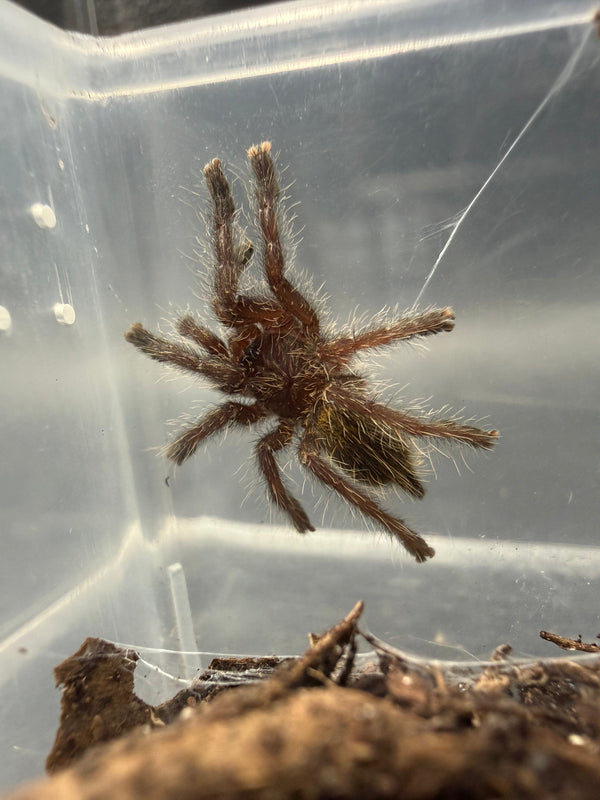
Electric Blue Tarantula (Chilobrachys natanicharum)
Tarantula

Orange Cave Scorpion for sale from Big Z's (Tityopsis sheylae). Spice-rated keeper notes, care guidance, and live-arrival packing where eligible.
One cave in Cuba. That is the whole known range.
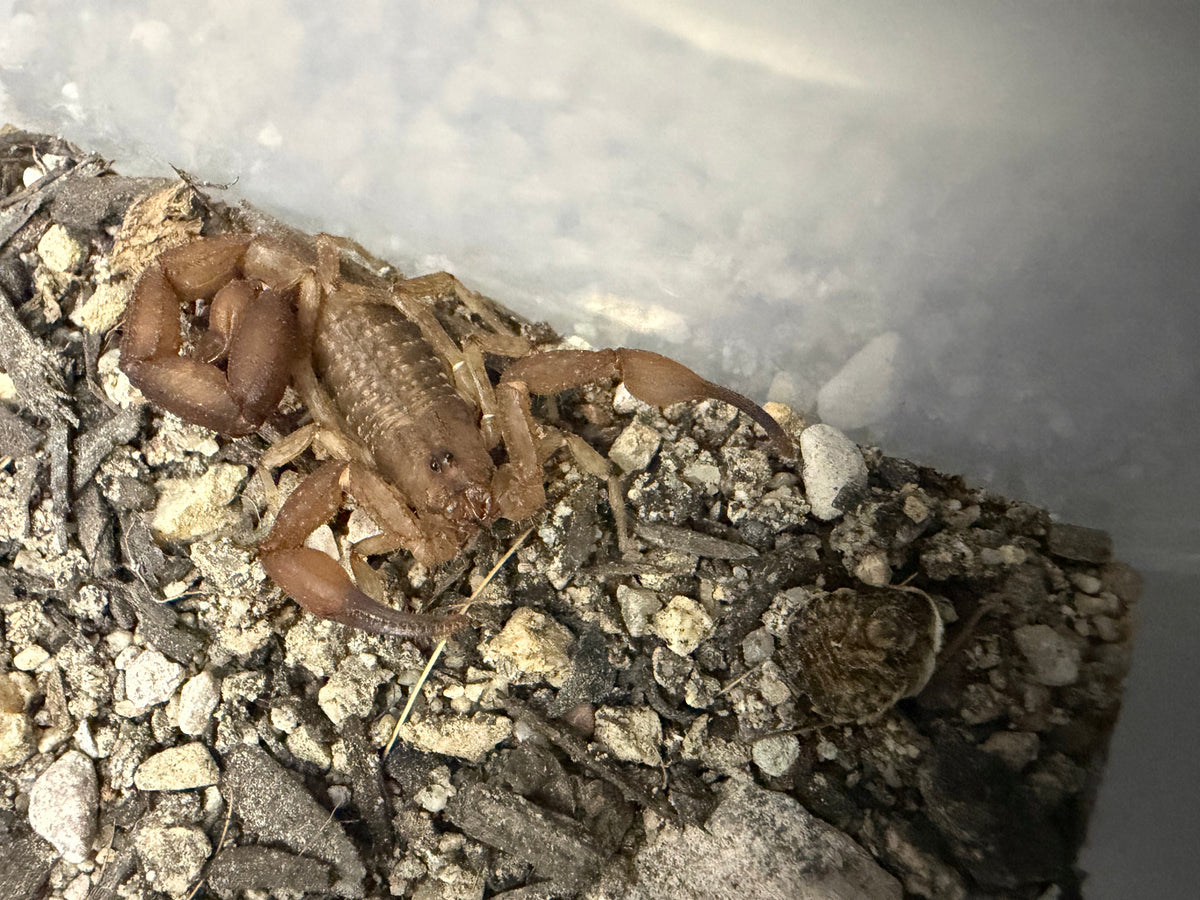
Tityopsis sheylae, described in 2020, is known from a single cave in Mayabeque Province, Cuba; searches of the surrounding hills turned up nothing, not even shed skins. The common name promises orange; the description that named it says light yellowish-brown. These arrived at 0.25 to 0.5 inch, juveniles, exact instar unknown. Even the published adults measure in millimetres.
Humidity is the story, and it is why this is Spice 4: Advanced. The authors who described it report that Tityopsis kept below 85% ambient air humidity critically dehydrate and die within 36 hours. That is a floor with a clock on it, not a comfort range, and it is air humidity, not a swamp. Most in the type cave hid under rocks in the cooler, drier chambers; only a few sat out on the wet walls. Evenly damp substrate, small working vents, a flat rock or cork slab to hide under, never a sealed box. No temperature optimum is published: room temperature, no heat mat.
The venom is undocumented. Nobody has published what it does, so Big Z's treats it as no contact: unknown, therefore respected. Catch cup and long tongs. If you cannot hold humidity, pick another animal. If you can, read the matched care guide before it ships.
The numbers live in the care guide. Enclosure size, temps, humidity, feeding schedule, premolt signs, handling boundaries: it's all in the care guide for this exact fella. Start with the full Advanced guide, or click for the quick Open the Simple version →
Scorpion
Orange Cave Scorpion (Tityopsis sheylae) care guide Read shipping & LAG
Orange Cave Scorpion for sale from Big Z's (Tityopsis sheylae). Spice-rated keeper notes, care guidance, and live-arrival packing where eligible.
One cave in Cuba. That is the whole known range.
Tityopsis sheylae, described in 2020, is known from a single cave in Mayabeque Province, Cuba; searches of the surrounding hills turned up nothing, not even shed skins. The common name promises orange; the description that named it says light yellowish-brown. These arrived at 0.25 to 0.5 inch, juveniles, exact instar unknown. Even the published adults measure in millimetres.
Humidity is the story, and it is why this is Spice 4: Advanced. The authors who described it report that Tityopsis kept below 85% ambient air humidity critically dehydrate and die within 36 hours. That is a floor with a clock on it, not a comfort range, and it is air humidity, not a swamp. Most in the type cave hid under rocks in the cooler, drier chambers; only a few sat out on the wet walls. Evenly damp substrate, small working vents, a flat rock or cork slab to hide under, never a sealed box. No temperature optimum is published: room temperature, no heat mat.
The venom is undocumented. Nobody has published what it does, so Big Z's treats it as no contact: unknown, therefore respected. Catch cup and long tongs. If you cannot hold humidity, pick another animal. If you can, read the matched care guide before it ships.
The numbers live in the care guide. Enclosure size, temps, humidity, feeding schedule, premolt signs, handling boundaries: it's all in the care guide for this exact fella. Start with the full Advanced guide, or click for the quick Open the Simple version →
Tityopsis sheylae - Spice 4: Advanced. Baby Buddy: suitable for the 6-13 mm juveniles supplied, exact instar unknown, when modified for continuously high air humidity, evenly damp substrate, functional micro-ventilation, and escape-proof openings; Bark Buddy: usable as they grow with flat cork/rock cover and a moisture-retentive base; monitor that ventilation does not drive ambient RH below the genus-level threshold; Custom humid micro-enclosure: preferred when it allows reliable RH monitoring above 85%, no standing water, and small functional cross-vents
Tityopsis sheylae
Big Z's Quick Verdict: Humidity is the non-negotiable control. The describing authors report at genus scope that Tityopsis critically dehydrate and die within 36 hours unless ambient air RH stays above 85%. That supports continuously humid air, not saturated substrate or an airtight enclosure. Use evenly damp moisture-retentive substrate with no standing water, minimal but functional cross-ventilation, rock or cork cover, and an escape-proof lid. No numeric temperature optimum exists; this species was more abundant in cooler cave chambers and scarce in the hottest, so normal cool-to-moderate room conditions without direct heat are Big Z house practice. No hand contact: no clinical or toxinology record exists for this genus, so what a sting would do is genuinely unrecorded rather than known to be mild, and Big Z's keeps the boundary on that uncertainty alone. The Advanced lane is set by the humidity window, not by a venom claim. - Big Z
| Temp | No numeric optimum is published. In the type cave 42 T. sheylae were found in the colder chambers and corridors against only 3 in the hottest chamber, but no chamber temperature was ever measured, and that gradient confounds temperature with humidity, light and bat guano - the cool end is also the drier, guano-free end. Treat it as an ecological signal, not a thermal preference curve. Normal cool-to-moderate room conditions without a direct heat source are Big Z house practice. |
|---|---|
| Humidity | Maintain ambient air RH above 85% continuously. This threshold is genus-level primary evidence: published authors report Tityopsis dehydrate and die within 36 hours below it. Use moisture-retentive substrate kept evenly damp, not saturated or standing wet, with enough small cross-ventilation to prevent stagnant air while retaining humidity. |
| Setup | Small high-humidity cave setup: flat limestone or cork cover over evenly damp moisture-retentive substrate, ambient air RH held continuously above 85%, with small functional cross-vents. Never sealed airtight and never waterlogged. |
| Substrate | Use evenly damp, moisture-retentive soil/coir or a stable equivalent with flat rock or cork cover. Exact mix and depth are Big Z construction choices. Do not waterlog the substrate or leave standing water. The primary evidence concerns ambient RH above 85%, not saturated substrate or a sealed vessel. |
| Feeding | Offer very small soft-bodied prey or pre-killed portions at a cautious recorded Big Z house cadence. Mealworms, roach nymphs, and other prey are reported for captive congeners, not T. sheylae. No species feeding trial, prey-size rule, or validated cadence was found; remove leftovers and stop live prey around molt. |
| Handling | No contact. Not because the sting is known to be dangerous, but because nobody has established what this genus's venom does, and an absence of study is not evidence of a mild sting. Catch cup and long tongs only. |
Humidity zones: Very Low under 30% - Low 30-60% - Low-Moderate 40-70% - Moderate 60-80% - Moderate-High 70-85% - High 80%+ - Very High 90%+
Current Big Z's catalog: Yes
Tityopsis sheylae
Keeper Snapshot: Humidity is the non-negotiable control. The describing authors report at genus scope that Tityopsis critically dehydrate and die within 36 hours unless ambient air RH stays above 85%. That supports continuously humid air, not saturated substrate or an airtight enclosure. Use evenly damp moisture-retentive substrate with no standing water, minimal but functional cross-ventilation, rock or cork cover, and an escape-proof lid. No numeric temperature optimum exists; this species was more abundant in cooler cave chambers and scarce in the hottest, so normal cool-to-moderate room conditions without direct heat are Big Z house practice. No hand contact: no clinical or toxinology record exists for this genus, so what a sting would do is genuinely unrecorded rather than known to be mild, and Big Z's keeps the boundary on that uncertainty alone. The Advanced lane is set by the humidity window, not by a venom claim. - Big Z
| Temperature | No numeric optimum is published. In the type cave 42 T. sheylae were found in the colder chambers and corridors against only 3 in the hottest chamber, but no chamber temperature was ever measured, and that gradient confounds temperature with humidity, light and bat guano - the cool end is also the drier, guano-free end. Treat it as an ecological signal, not a thermal preference curve. Normal cool-to-moderate room conditions without a direct heat source are Big Z house practice. |
|---|---|
| Humidity | Maintain ambient air RH above 85% continuously. This threshold is genus-level primary evidence: published authors report Tityopsis dehydrate and die within 36 hours below it. Use moisture-retentive substrate kept evenly damp, not saturated or standing wet, with enough small cross-ventilation to prevent stagnant air while retaining humidity. |
| Setup Type | Small high-humidity cave setup: flat limestone or cork cover over evenly damp moisture-retentive substrate, ambient air RH held continuously above 85%, with small functional cross-vents. Never sealed airtight and never waterlogged. |
| Substrate | Use evenly damp, moisture-retentive soil/coir or a stable equivalent with flat rock or cork cover. Exact mix and depth are Big Z construction choices. Do not waterlog the substrate or leave standing water. The primary evidence concerns ambient RH above 85%, not saturated substrate or a sealed vessel. |
| Feeding | Offer very small soft-bodied prey or pre-killed portions at a cautious recorded Big Z house cadence. Mealworms, roach nymphs, and other prey are reported for captive congeners, not T. sheylae. No species feeding trial, prey-size rule, or validated cadence was found; remove leftovers and stop live prey around molt. |
| Care Difficulty | Spice 4: Advanced |
| Handling | No contact. Not because the sting is known to be dangerous, but because nobody has established what this genus's venom does, and an absence of study is not evidence of a mild sting. Catch cup and long tongs only. |
Humidity zones: Very Low under 30% - Low 30-60% - Low-Moderate 40-70% - Moderate 60-80% - Moderate-High 70-85% - High 80%+ - Very High 90%+

Tarantula

Tarantula

Tarantula

Tarantula

Tarantula

Tarantula

Tarantula

Tarantula